

National Police: Allegations of Treason by Listyo Sigit and Others Move to Investigation Stage
-
News
-
2 minutes ago
This article was translated by AI. Read the original article on Kompas.com. See Original
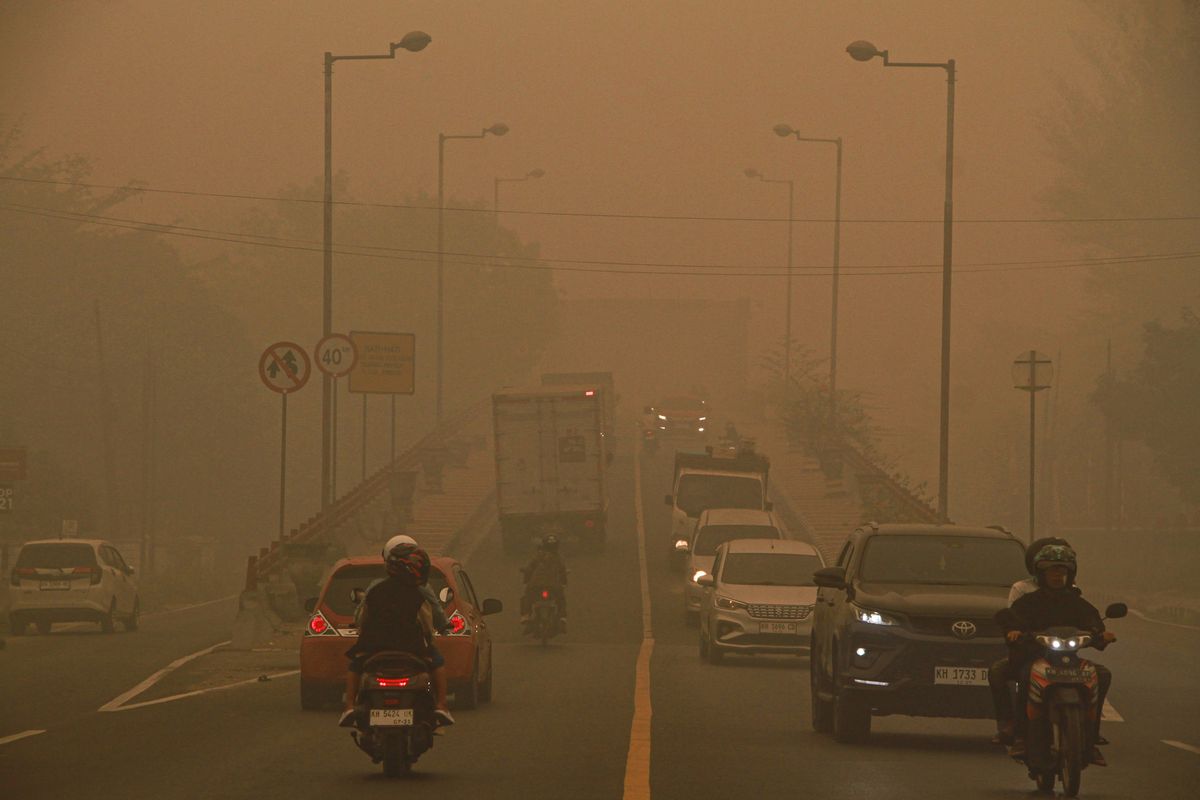
A NUMBER OF users on social media platforms Threads and Instagram, in October 2026, expressed dissatisfaction over the decline in the reach of their posts when sharing content about forest and land fires (Karhutla) in Indonesia.
They sought clarification from Meta AI, the artificial intelligence feature owned by the company that also runs both platforms.
Surprisingly, Meta AI provided a seemingly convincing response, stating that the content restrictions were linked to a request from the Ministry of Communication and Digital (Komdigi).
This chatbot response sparked discussions, with many believing the government was conducting a suppression of critical public information.
However, the AI chatbot's answer was clearly not evidence of government policy or platform moderation decisions.
The Komdigi ministry issued a strong rebuttal, stating that it never requested digital platforms to delete or restrict Karhutla content. Komdigi even sought clarification from Meta AI.
In subsequent conversations, Meta AI revised its response, indicating that Komdigi had never issued any instructions, legal orders, or formal requests to limit or reduce Karhutla-related content.
While Meta AI casually issued a correction, the digital space had already been thrown into chaos.
Surprised? You shouldn’t be. Active users of AI technology are likely unfazed by Meta AI's seemingly inconsistent responses. The main flaw of generative artificial intelligence is its tendency to hallucinate and play with fabricated data.
The system operates merely as a stochastic parrot, stringing together statistical patterns of words without factual understanding. Thus, the output generated by AI is often inconsistent and fictional (Azozz & Alishahi, 2024; Huang et al., 2023).
Rather than delivering genuine understanding, artificial intelligence merely produces a random assembly of words that can be misleading if taken at face value.
So, why was the Meta AI chatbot accepted at face value? Because everything seemed credible.
More than six decades ago, Marshall McLuhan (1964) famously stated, "the medium is the message."
Thus, the medium used can often be more influential in shaping human thought than the content of the message itself.
When netizens pose questions, and AI responds directly, seemingly grasping the context, even mentioning agency names and statistical data, AI's answers are often taken as fact.
Adding to this discourse, Harold Innis (1951) explained that each medium carries a particular bias towards space or time.
Modern digital media clearly emphasizes speed and the broad reach of information. This characteristic allows false information or machine errors (hallucination) to spread rapidly among the public before they can be verified.
Even after Meta AI provided clarifications, the initial misleading information continues to circulate widely.
Initial claims, especially those that are emotional and sensational, often spread much farther and wider than subsequent corrections.
This is because information that triggers psychological reactions is amplified by platform recommendation algorithms and deeply embedded in public perception before factual processes can catch up (Vosoughi et al., 2018).
It's indeed problematic. And it will only become more complex as artificial intelligence increasingly dominates public discourse.
Such a giant as Meta AI should no longer hide behind excuses of "technical errors" or mere hallucinations.
They bear an ethical responsibility to implement far stricter safeguards on their AI systems, particularly when touching on public policy, law, and sensitive societal issues.
If users are complaining about reach limitations, platforms must also provide verifiable explanations.
This demand for transparency regarding the reasons for restrictions, as well as mechanisms for complaints and appeals, has also been communicated by Komdigi in response to this controversy.
On the other hand, the government along with society needs to foster a new kind of critical literacy, one that encourages viewing artificial intelligence not as an oracle of truth.
Clearly, AI is merely a language processing machine whose output must be reassessed. The controversy between Meta AI and Komdigi teaches us this lesson very clearly.
Another takeaway is that government communication in addressing Karhutla needs significant improvement. There's no longer room to treat communication, crisis communication, and risk communication as mere supplementary aspects of managing Karhutla.
Risk communication helps the public comprehend threats and take protective actions.
Crisis communication adds a sense of urgency when disasters occur, so information must be quick, accurate, coordinated, and actionable.
Both elements are intertwined within an integrative approach to risk and emergency communication (Reynolds and Seeger, 2005).
Without effective risk communication, efforts to prevent land burning and educate about the impacts of smoke will be consumed by the flames.
So, when the fire blazes, the public needs more than a statement that the situation is being managed.
They require explanations about affected areas, air quality, health services, evacuation routes, and places for seeking help.
Ambiguity regarding casualty data, the spread of hotspots, and evacuation guidance will create a data void that incites panic, disinformation, and undermines the legitimacy of disaster management in the eyes of the public.
The government cannot battle the fires alone either. Addressing Karhutla requires broad community involvement—at least from domestic citizens, if there is still reluctance towards international support.
However, this involvement must be supported by useful information, not mere calls for calm or exhortations against spreading unclear news.
The absence of valid and open data can also breed public suspicion and algorithmic hallucinations in the digital space.
It is essential for the government to carry out data consolidation across agencies transparently and publish it regularly, covering hotspot data, the number and condition of affected casualties, evacuation points, and transparency in law enforcement against land burn perpetrators.
Komdigi could be empowered to enhance coordination in disseminating public information, while the validation of data remains the responsibility of technical agencies according to their authority.
The public does not require uniformity in narratives, but rather consistency in data and openness in explanations.
If information is still provisional, say so. If there are errors, correct them openly.
The channels of communication should not solely rely on official websites, conventional media, and social media. Safety information needs to reach citizens through village devices, health facilities, local radio, volunteers, and other channels truly used by affected communities.
Transparency in data and consistently coordinated narratives are absolute prerequisites for building public trust and mobilizing effective emergency response actions (Reynolds & Seeger, 2005).
Without reliable crisis information management, the digital space will continue to be torn apart by speculation.
Urban netizens may be loud on digital platforms, while those living near forests continue to bear the impact of disasters without clear safety navigation.