

Hosting an E-Sport Tournament, Golkar: Politicians Shouldn't Just Know How to Gather Votes
-
News
-
4 hours ago
This article was translated by AI. Read the original article on Kompas.com. See Original
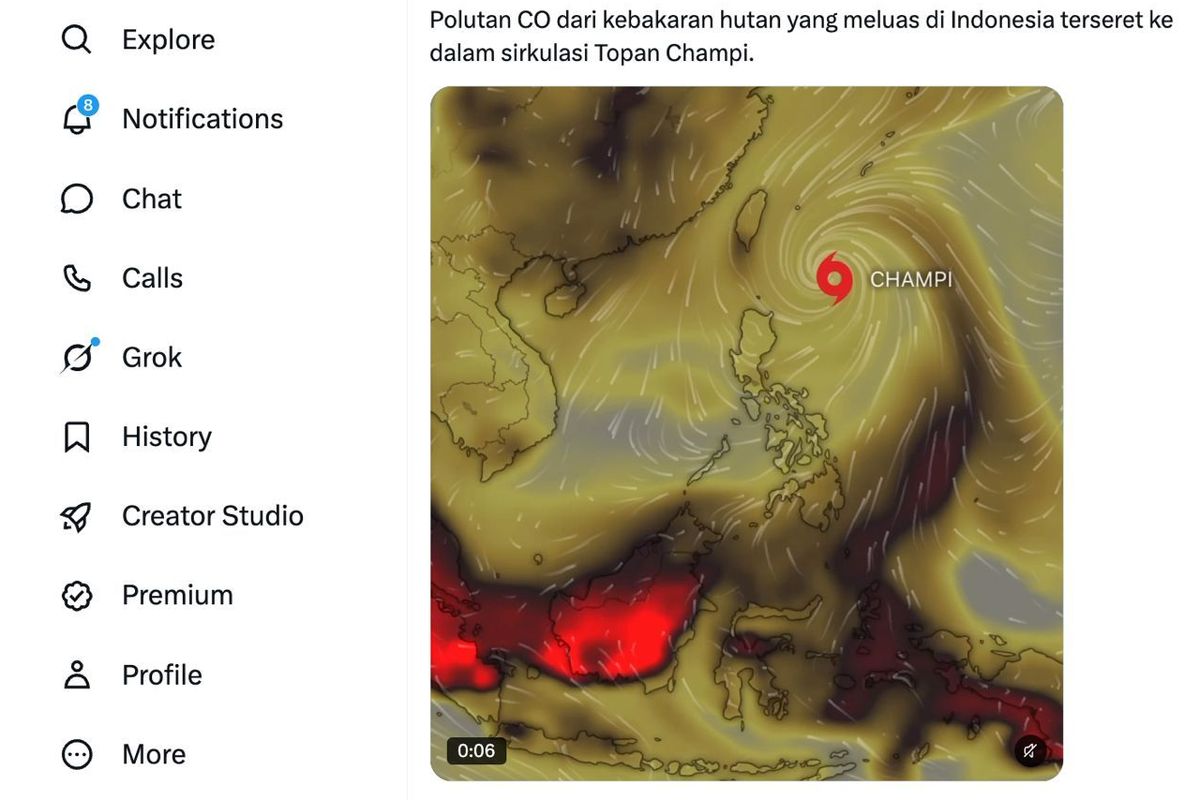
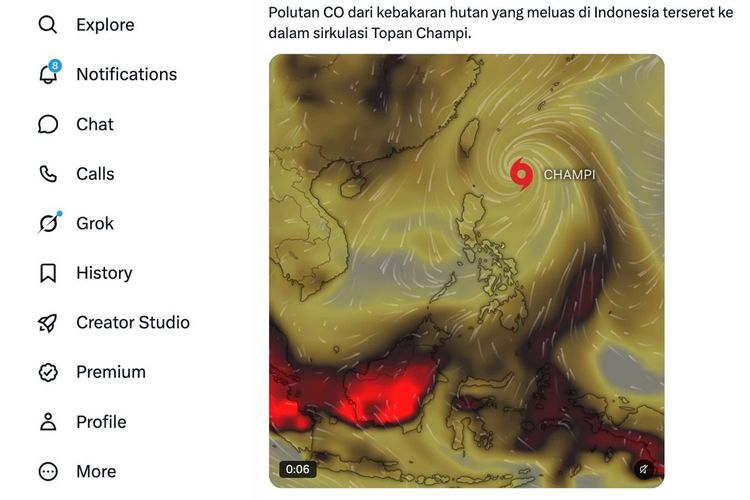
JAKARTA, KOMPAS.com - Typhoon Champi, which is currently affecting Taiwan, has been suggested to potentially draw in carbon monoxide pollutants resulting from forest and land fires (Karhutla) in Indonesia.
This hypothesis was put forward by the Backpirch Weather account, which claims that the pollutants from the Karhutla are being pulled into the expanding circulation of Typhoon Champi in the Taiwan region as of October 22, 2026.
Daryono, a member of the Indonesian Disaster Experts Association (IABI), stated that from a scientific standpoint, the hypothesis of Karhutla smoke being absorbed by Typhoon Champi is plausible.
"Scientifically, the transportation of Karhutla pollutants to a typhoon system is indeed possible," he said in a text message on Friday (October 23, 2026).
However, Daryono emphasized that carbon monoxide (CO) pollution does not automatically increase rainfall intensity.
This is because the CO compound does not function as a cloud condensation nucleus that enhances the likelihood of rain.
"Under certain conditions, aerosols can strengthen the rain formation process, but in other conditions, they can actually hinder rain formation. The effect heavily depends on atmospheric conditions and cloud dynamics," he noted.
Moreover, Daryono pointed out that the possibility of Karhutla smoke being absorbed by Typhoon Champi does not mean the surface air will be clear.
Air pollution, which poses a risk of Acute Respiratory Infection (ISPA) to the community, especially infants and toddlers, must still be accurately measured.
"A typhoon is not a solution for controlling Karhutla pollution; the extinguishing of fire sources remains the top priority."