
Illegal Wiretapping and Constitutional Testing
-
News
-
25 minutes ago
This article was translated by AI. Read the original article on Kompas.com. See Original
JAKARTA, KOMPAS.com - Education costs remain a significant issue for many families in Indonesia.
Although public schools receive operational assistance from the government, parents still face various expenses when sending their children to school, from basic educational needs to higher education costs.
Moreover, not all children are accommodated in public schools.
Some must attend private educational institutions, which still impose fees on parents, including tuition and registration fees.
The issue of educational financing has resurfaced as we approach the two-year mark of President Prabowo Subianto and Vice President Gibran Rakabuming Raka's administration.
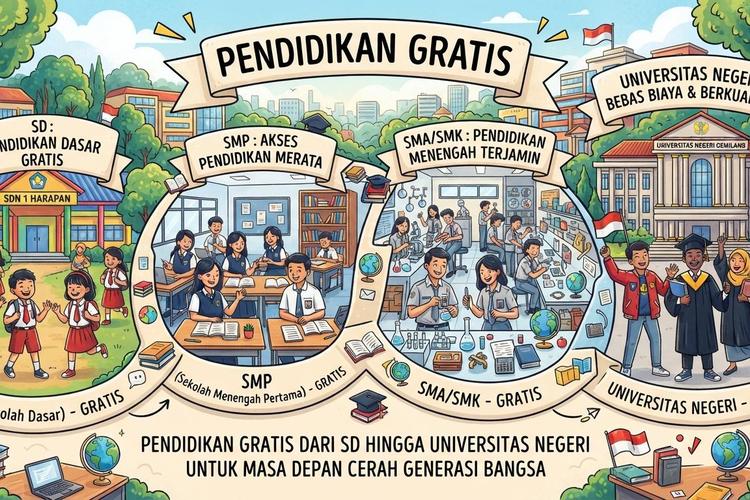
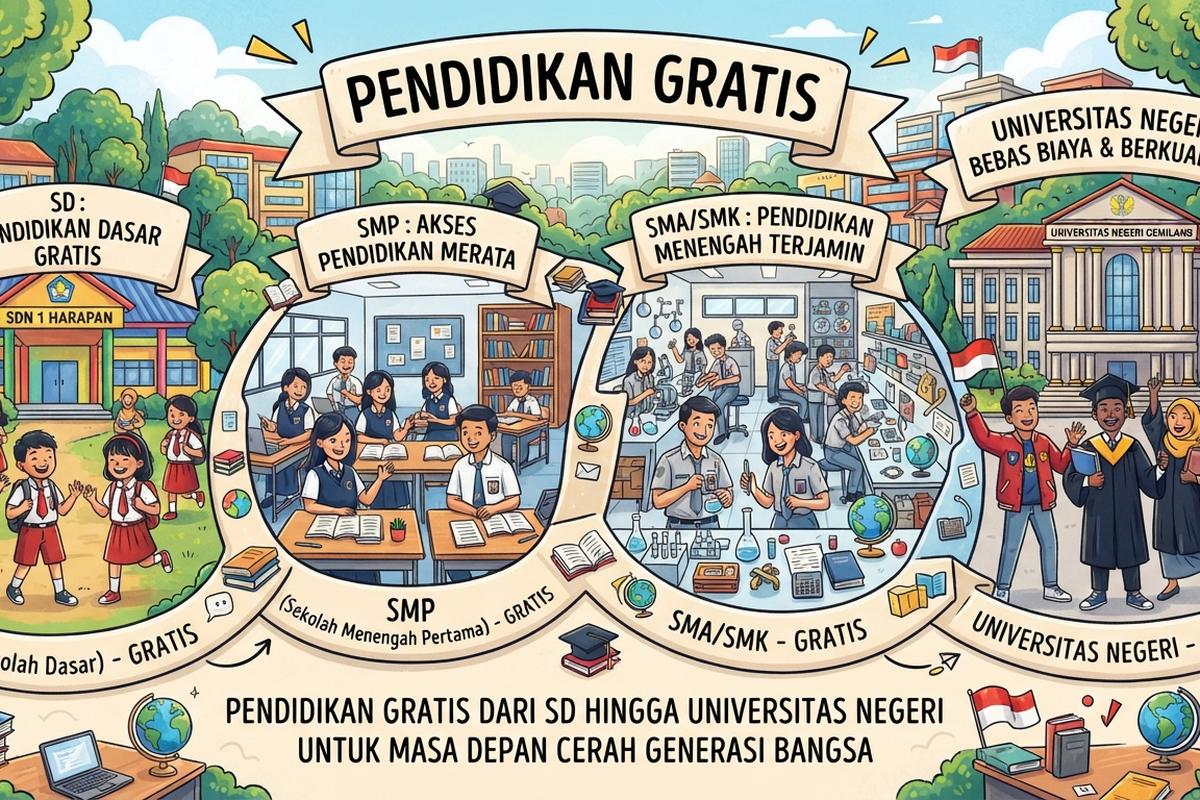
Prabowo has expressed his commitment to providing free education, from elementary school through to state universities.
This statement was made by Prabowo during a speech at the 28th anniversary of the National Mandate Party (PAN) in Jakarta on Friday (18/9/2026).
"I fully support this initiative. I will soon convene a meeting focused on education costs—state education must be free! Free education from elementary to university level!" Prabowo stated.
He also addressed the funding sources necessary to realize this plan.
According to him, the government can utilize funds that have been embezzled to finance free education.
"People might ask, where will the funding come from? It comes from the money that has been stolen, from the corruption that has occurred," he added.
In addition to education costs, Prabowo urged the government to repair damaged schools and improve teacher welfare.
He believes these needs cannot be postponed as the public requires tangible results from the government's efforts.
"Schools must be immediately repaired; roofs need fixing, and we must ensure schools have decent sanitation facilities. Teacher salaries also need to be improved," Prabowo noted.
However, achieving free education is not merely about eliminating fees in public schools.
The government must also guarantee that children from low-income families can access education, including those attending private institutions, without sacrificing the quality of learning.
So, what does the journey toward inclusive free education in Indonesia look like? How is the implementation proceeding currently?
The effort to implement free education is also linked to the Constitutional Court's decision regarding the funding of basic education.
In Decision Number 3/PUU-XXII/2024, read on May 27, 2025, the court emphasized that both central and regional governments must ensure that compulsory education at the elementary level is provided without charge, whether in public or private schools.
Constitutional Judge Enny Nurbaningsih explained that free basic education is part of fulfilling economic, social, and cultural rights.
However, the court stated that this right can be fulfilled gradually according to the country's capacity.
Its implementation must be equitable and affirmative and not lead to discriminatory practices.
This ruling serves as a foundational guideline for the government to expand access to free basic education, including for students in private schools.
Education observer Totok Amin argues that the government needs to translate the constitutional ruling into more operational regulations so that the obligation to fund basic education does not remain merely on the legal level.
One of his proposed steps is to issue government regulations or presidential decrees as a legal umbrella for free basic education.
These regulations, according to Totok, should include a roadmap for implementing nine to twelve years of compulsory education in both public and private schools.
"The most crucial aspect is revising the National Education System Law and Government Regulations related to Education Funding to include the obligation to fully fund private schools providing basic education," Totok told Kompas.com on Friday (16/10/2026).
He suggested that private schools receiving subsidies for free education programs should be required to waive all tuition fees.
Meanwhile, premium or commercial private schools could be given the option to opt-out of such subsidy schemes.
According to Totok, the government also needs to calculate funding requirements per student based on the operational conditions of private schools across regions.