

Prabowo: Thank You PDI-P, Even Though You Are Not in the Coalition
-
News
-
2 minutes ago
This article was translated by AI. Read the original article on Kompas.com. See Original

THE WAVE of demonstrations in France on October 17, 2026, revealed how education issues can escalate into broader social unrest.
Starting from complaints about school conditions, the protests converged with rising frustrations over the cost of living and declining public services.
In Italy, a demonstration in Milan on the same day showcased a meeting of student solidarity and dissatisfaction with government policies.
These two events do not necessarily prove that a similar crisis exists worldwide. However, they raise a crucial question: what happens when the state increasingly struggles to meet public expectations for services, particularly education?
This question is highly relevant for Indonesia. Not because Indonesia must wait for a similar riot, but because education is a fundamental promise that the state makes to its citizens.
Schools should serve as pathways for social mobility, allowing children the chance to improve their lives without being entirely dictated by their family background.
When learning facilities are inadequate, learning quality lags behind, and opportunity disparities remain vast, the issue transcends mere educational administration.
At stake is public trust in the government's ability to fulfill its constitutional responsibilities.
Indonesia does not actually lack educational funding in nominal terms. The government has planned an education budget of IDR 757.8 trillion for the 2026 state budget, an increase from the 2025 outlook of IDR 690.1 trillion.
The government has also allocated funds for school repairs and improvements in service quality.
However, the size of the budget does not automatically translate into quality learning. Between budget decisions and the real experiences of students in classrooms, there are problems related to distribution, implementation, oversight, and spending effectiveness that cannot be solved simply by increasing allocations.
This issue is evident in the need for educational infrastructure. The Ministry of Education and Culture reports that 196,022 educational units require damage repairs.
This number does not mean all are severely damaged, but it indicates the magnitude of the homework that needs to be tackled.
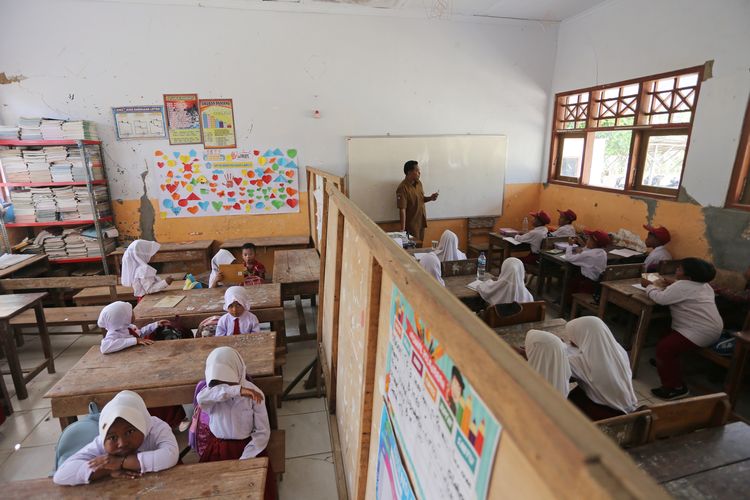 First-grade (left) and second-grade (right) students of UPTD SD Negeri Pakaan Laok 1 participating in learning activities in the same classroom in Bangkalan, East Java, on Tuesday (September 1, 2026). This school, which has 86 students, conducts learning activities by dividing one room for two classes due to one of its buildings being damaged for years and not being repaired due to unclear land status.
The challenge lies in ensuring assistance reaches the most needy schools, is completed on time, and genuinely improves the learning environment.
More fundamentally, the quality of education cannot be assessed merely by the number of schools built, classrooms repaired, or students enrolled.
The latest Programme for International Student Assessment (PISA) results from 2022, and the projected trends leading to the 2025 PISA cycle, show that only about 17 percent of Indonesian students aged 15 achieve at least Level 2 in mathematics.
Indonesia's performance in mathematics, reading, and science has not shown significant leaps since 2015 and still falls below the OECD average.
These figures are not just educational statistics. Reading, arithmetic, and scientific understanding are foundations for individuals to continue their education, enter the workforce, and make informed decisions in daily life.
When most students have yet to achieve the basic competencies expected of them, the problem exceeds the classroom.
Indonesia faces the risk of a productivity gap and opportunity deprivation passed down from one generation to the next.
Children may remain in school, but being present in class does not always mean they acquire the necessary skills to face the future.