

Condemning the Case in Malang, Minister PPPA Asserts No Child Should Die Due to Violence
-
News
-
10 minutes ago
This article was translated by AI. Read the original article on Kompas.com. See Original
JAKARTA, KOMPAS.com - Soon, the government of President Prabowo Subianto and Vice President Gibran Rakabuming Raka will celebrate its second anniversary.
During this period, labor issues are set to enter a new chapter following the House of Representatives (DPR) and the government’s passage of the Employment Protection Law on October 6, 2026.
The enactment of this law is part of a lengthy journey to reform labor regulations in Indonesia.
Previously, the Constitutional Court (MK), through Decision No. 168/PUU-XXI/2023 on October 31, 2024, granted several petitions against the Job Creation Law filed by labor groups.
The decision contained various corrections regarding labor regulations, including contract work systems, outsourcing, wage structures, and termination of employment (PHK).
The MK also requested lawmakers to draft a standalone labor law, separate from the Job Creation Law.
This request served as a crucial foundation in drafting the new regulations that were eventually enacted by the DPR and the government in October 2026.
The Employment Protection Law, comprising 23 chapters and 313 articles, is designed to enhance worker protection while providing legal certainty for employees, employers, and the government.
Key provisions that concern workers include wage regulations, restrictions on outsourcing, workplace relationships, and severance payment mechanisms.
So, to what extent does this new labor regulation address the issues workers have faced?
What protections have been strengthened, and how can we ensure that these new provisions genuinely provide certainty for workers?
The path to enacting the Employment Protection Law cannot be separated from the MK’s decision on October 31, 2024.
Through Decision No. 168/PUU-XXI/2023, the MK partially granted requests filed by several labor unions, the Labor Party, and individual workers concerning labor provisions in the Job Creation Law.
In the 687-page ruling, the MK emphasized issues in labor regulations that were deemed to cause legal uncertainty and injustice.
The court determined that labor provisions needed to be more clearly defined to provide certainty for both workers and employers.
Based on this, the MK urged lawmakers to create a standalone labor law, separate from the Job Creation Law.
"Lawmakers must promptly draft a new labor law and exclude it from the provisions outlined in Law No. 6 of 2023," said Constitutional Judge Enny Nurbaningsih during a session at the MK building in Central Jakarta on Thursday (31/10/2024).
The ruling also included several important changes.
For instance, regarding fixed-term employment agreements (PKWT), the MK emphasized a maximum contract duration of five years, including extensions.
The MK also requested that the types and fields of work that can be outsourced should be determined by the minister.
This measure aims to ensure that workers, the employing companies, and the outsourcing service providers have clear standards regarding the jobs eligible for outsourcing.
In terms of working hours, the MK reinstated a five-day workweek with two days off.
In terms of wages, the court emphasized that remuneration must be sufficient to meet the basic living needs of workers and their families, including provisions for food, clothing, housing, education, healthcare, recreation, and old-age insurance.
The MK also reasserted the role of local wage councils in advising the central government.
Moreover, the provisions regarding sectoral minimum wages were strengthened to consider the characteristics and risks of jobs in specific sectors.
Regarding layoffs, the MK stressed that if negotiations between workers and employers do not reach an agreement, termination can only occur after obtaining a ruling from an industrial relations dispute resolution body whose ruling is legally binding.
These corrections became vital elements in discussions about updating labor regulations.
On October 6, 2026, the DPR officially enacted the Employment Protection Bill into law during a plenary session led by DPR Chair Puan Maharani.
The enactment followed the report of deliberations read by Deputy Chair of Commission IX DPR Putih Sari, with all factions expressing approval.
Putih stated that the law is formulated to enhance worker protection, provide legal certainty, expand job opportunities, improve workforce competence and productivity, and realize a fair and decent wage system.
The new law also covers regulations concerning training and internships, the placement of labor, the informal sector, labor relations, welfare, industrial relations, layoffs, severance reserve funds, and oversight and criminal provisions.
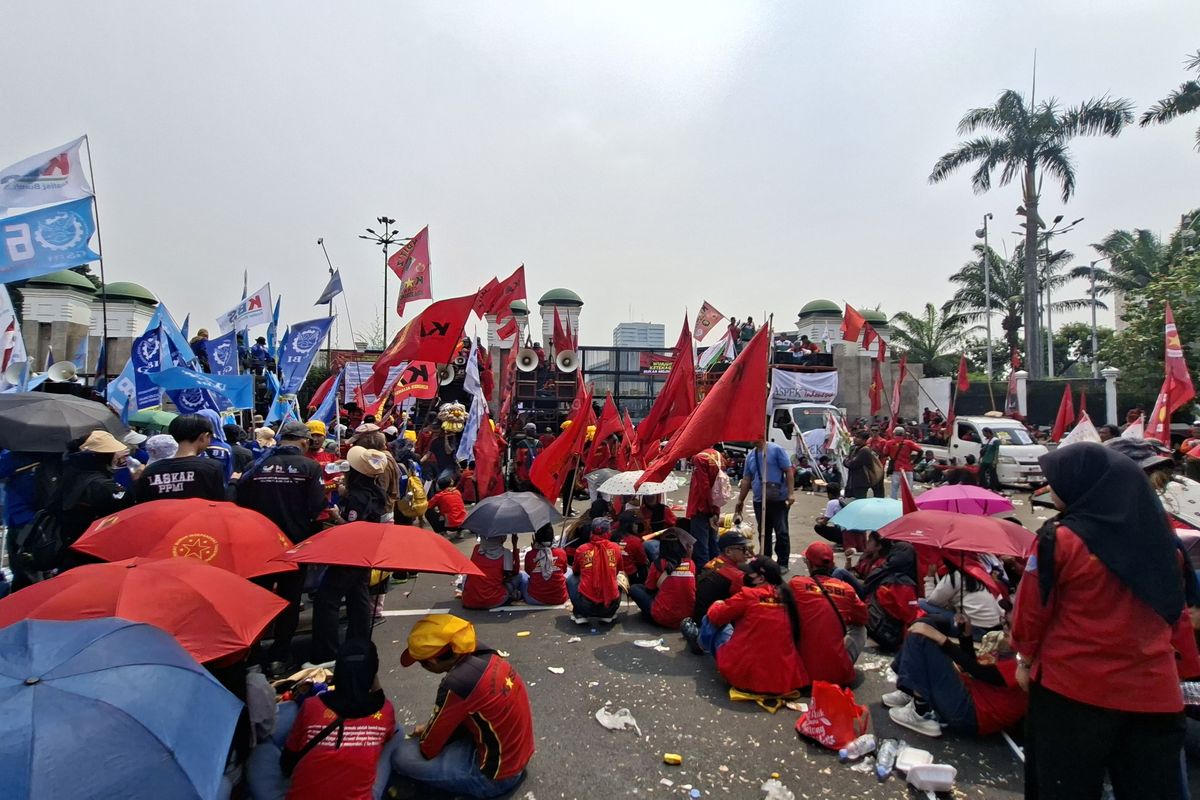
Following the law's passage, labor groups expressed their responses to several provisions believed to enhance worker protection.
The President of the Confederation of Indonesian Trade Unions (KSPI) and President of the Labor Party, Said Iqbal, stated that they accepted the Employment Protection Law with reservations.
He noted that the regulatory direction is better than the labor cluster in the Job Creation Law because several previously diminished protective provisions have been restored and strengthened.
"KSPI and the Labor Party accept this Employment Protection Law with reservations," said Said in a statement on Wednesday (7/10/2026).
One aspect highlighted is the mechanism for layoffs.
According to Said, regarding the results of the discussions, employers must notify workers of the planned layoffs and conduct bipartite negotiations with them.
If negotiations do not yield an agreement, the resolution can continue through mediation up to the Industrial Relations Court.
Said emphasized the importance of ensuring wage payment during the dispute process until a legally binding decision is reached.
He argued that this provision is necessary so that workers do not lose income while fighting for their rights.
"In other words, it is not easy now for employers to carry out layoffs," he stated.
Regarding severance, Said noted there is reinforcement through the stipulation of at least one times the mandated payment.
He considers this regulation vital for ending the practice of paying severance at 0.5 times the mandated amount while also allowing space for higher payment agreements between workers and employers.
Meanwhile, in terms of wages, Said explained that a decent living standard is an essential aspect that must be considered in setting minimum wage increases.
Based on information regarding the discussions obtained by KSPI, the wage increase formula also includes inflation, economic growth, and indices with a maximum cap of 1.0.
Regulations for sectoral minimum wages are also seen as part of strengthening worker protection.
Said also highlighted restrictions on outsourcing for support activities.
He clarified that these four activities include catering, security, cleaning, and driving, with special regulations for support activities in mining, oil, and state-owned enterprises (BUMN).
He believes that outsourcing regulations must ensure certainty regarding employment relationships, income, social security, and worker rights when employment relationships end.
However, Said reminded that certain provisions still need clarification to avoid creating new problems in implementation.
One note from KSPI and the Labor Party relates to provisions for wage suspension for companies deemed unable to pay.
Said requested that the term "unable" have clear criteria that can be objectively verified.
He stated that bipartite negotiations alone are not enough to guarantee worker protection, especially in companies without labor unions.
"The definition of inability must be clarified," he asserted.
KSPI and the Labor Party proposed that a company's inability be proven through firm indicators, such as losses for two consecutive years.
The time limit for suspensions also needs to be clarified to prevent repeated applications of such policies.
Additionally, Said called for the wage shortfall during the suspension period to still be counted as a liability for the company towards workers.
Another observation pertains to internships.
Said reminded that internships are part of job training, so their requirements must be distinctly separated from regular employment relationships.
He emphasized the need for clarity around the implementation of internships, including maximum durations of six months, training schedules, and activities performed by participants.
Without strict regulations, Said fears that the restrictions on outsourcing could lead to a shift in recruitment through internships to fill regular positions.
This risk needs to be addressed since interns receive stipends while internships are not treated as employment relationships.
"This must be clear. The difference between working individuals and interns," he stated.
Another issue of concern is the mechanism for severance funds.
Said appreciated the idea of placing severance funds separately from company assets to ensure payment of worker rights.
However, he requested clarity on who pays, the managing institution, the mechanism for disbursement, and sanctions for companies that fail to meet their obligations.
KSPI and the Labor Party view that financing severance reserves is the employer's responsibility, not that of the workers.
Regulations also need to clarify how payments are made if workers and companies agree on severance above the available reserves.
"What if the employer does not pay the severance reserve contributions? There must be clarity," said Said.
These various issues will be part of the notes that KSPI and the Labor Party present to the government and DPR leaders.
Said stated that his organization will push for provisions that remain open to interpretation to be clarified in government regulations.
KSPI and the Labor Party also remain open to the possibility of filing legal challenges if they discover provisions that are detrimental to workers.
"If it turns out to be harmful to workers, then certainly, judicial review," he affirmed.

























