

On Vice Presidential Election in the MPR, PKB: If Possible, Consensus
-
News
-
34 minutes ago
This article was translated by AI. Read the original article on Kompas.com. See Original
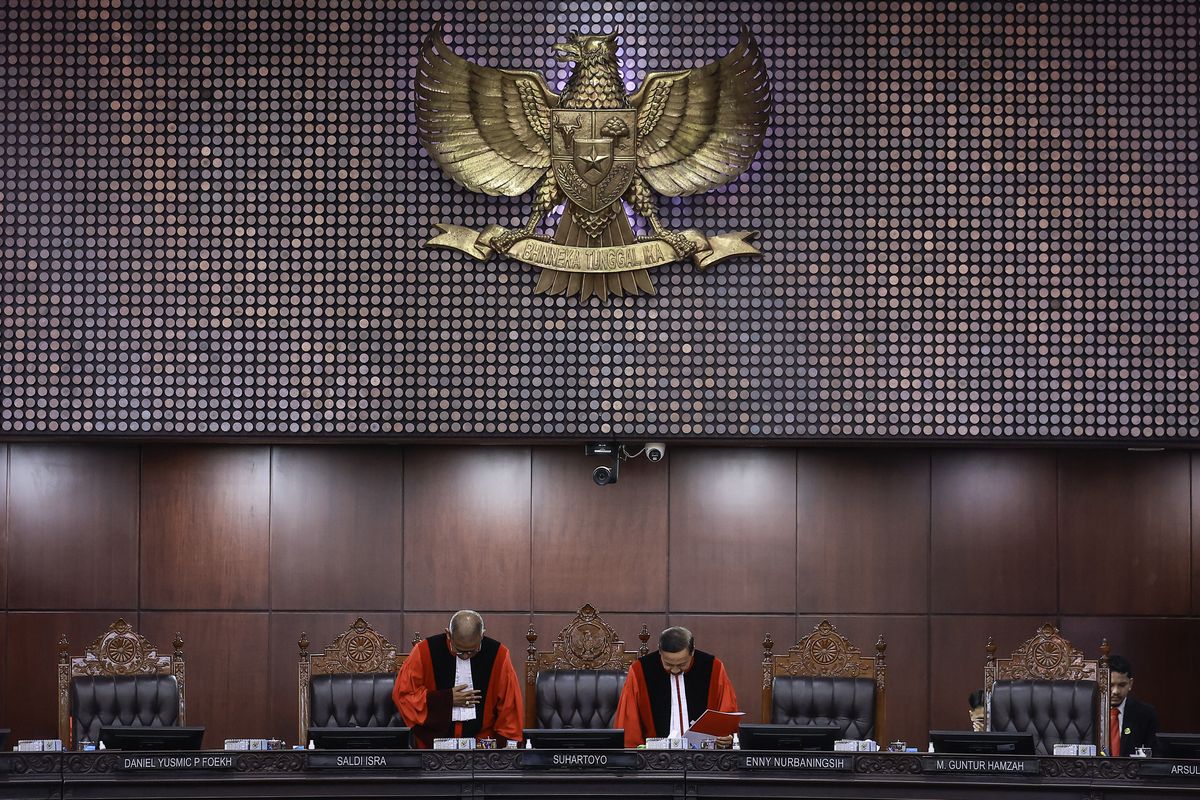
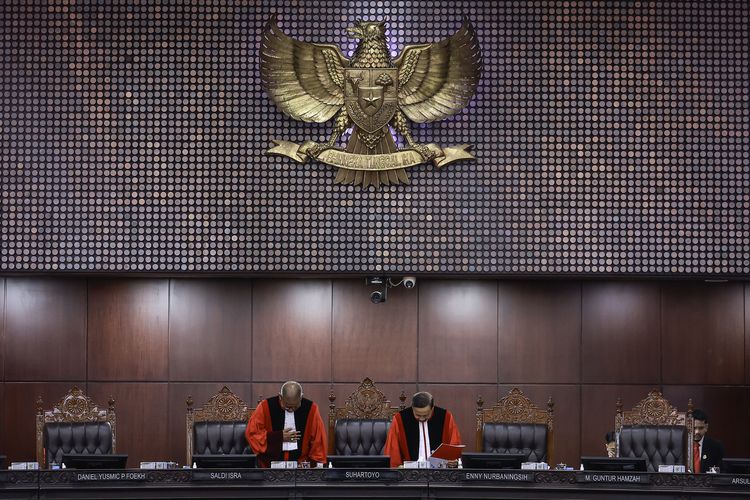
RULING The Constitutional Court (MK) on October 6, 2026, left unresolved issues that cannot be settled merely by the strike of a gavel.
In the dispute regarding the Results of the General Election (PHPU) concerning the educational qualifications of Vice President Gibran Rakabuming Raka, the MK stated it found no convincing evidence that Gibran holds a diploma, certificate, or other documentation proving he has completed education equivalent to senior high school (SMA).
However, the Court did not disqualify him because the petitioners lacked legal standing to file the case.
This is where the constitutional irony lies. Fundamental issues emerged during the deliberation, yet the petition could not be accepted due to procedural legal hurdles.
The ruling does not deliver a judgment that Gibran has violated the law. However, it also does not certify that all the requirements for his candidacy have been fulfilled.
While the Court may have closed the door on the PHPU filed by the petitioners, should the door to legal accountability also be closed? Certainly not.
This issue is not merely about public taste concerning Gibran, nor is it related to political enmity towards Joko Widodo, his biological father. It concerns the legal requirements to hold the second highest position in the country.
Article 169 letter r of Law No. 7 of 2017 on General Elections stipulates that presidential and vice presidential candidates must possess at least a high school diploma, secular madrasah, vocational high school (SMK), or equivalent education.
Meanwhile, Article 227 letter l of the same law regulates that the required documents include a photocopy of the diploma, a certificate of completion, or other legalized statements from an educational institution or secondary educational program.
The keyword here is not merely having attended school, but having graduated. Merely attending educational activities does not automatically mean one has completed a level of education.
Similarly, administrative documents that declare equivalency do not necessarily replace proof of graduation from which they are issued.
In case number 01/PHPU.PRES-XXIV/2026, the MK stated it found no diploma, certificate, or diploma proving Gibran has completed foreign education equivalent to SMA.
The Court also outlined statements from educational officials that supporting documents for the equivalency statement revealed in the proceedings, such as certificate of attendance, academic records, and grade explanations, are not proofs of graduation.
This court fact raises a question that must be answered openly: what was the basis for the issuance of the equivalency letter used in Gibran's candidacy?
What documents were used as the foundation? Who examined and approved them? Did these documents meet the applicable regulations at the time the letter was issued?
Second, the DPR needs to investigate the KPU. How was the verification of educational qualifications conducted at the time of the presidential and vice presidential candidacies in 2023?
Did the KPU only rely on the statement letter, or did it also examine supporting documents as mandated by law?
Third, the DPR needs to request explanations from Bawaslu regarding its oversight on meeting these qualifications. If errors are found, were there any inspections or corrective actions taken?
Fourth, all original documents, inspection records, correspondence, and statements from the involved officials should be made available and examined according to legal provisions. We must not allow investigations to stall due to the mutual passing of responsibility between agencies.
From this point, the DPR can assess whether these issues are merely administrative weaknesses, interpretive errors in regulations, ethical violations, or potential serious legal infringements.
The most essential question is quite simple: is the DPR willing to investigate a matter involving someone in the power circle, using the same standards as when investigating others?
This matter should also be viewed through Article 7A of the 1945 Constitution. The Constitution states that the president and/or vice president can be dismissed during their term by the People's Consultative Assembly upon the DPR's recommendation if they are found to have committed certain legal violations or no longer meet the requirements to serve as president and/or vice president.
The latter provision is important. The Constitution explicitly provides grounds for dismissal if the concerned official is proven to no longer meet the qualifications for office.
Therefore, if the DPR's investigation discovers evidence that Gibran's educational qualifications were not met since his nomination, then this issue could develop into a constitutional matter regarding his eligibility as vice president.
The consequences could be serious, including the possibility of removal from office.
However, this process does not automatically occur merely because the DPR utilizes its rights or finds document irregularities. There must be examination and proof according to constitutional mechanisms.
Article 7B of the 1945 Constitution stipulates that the DPR, in exercising its supervisory functions, can state opinions on allegations of violations or failure to meet the qualifications of the president and/or vice president.
This opinion must be decided through internal DPR mechanisms with the support of at least two-thirds of members present at the plenary session supported by at least two-thirds of the total number of DPR members.
If these conditions are met, the DPR may request the MK to examine, adjudicate, and decide on the DPR's opinion.
If the MK confirms it, the DPR forwards the dismissal proposal to the MPR. The MPR would then decide according to the quorum and consent determined by the Constitution, after giving the vice president the opportunity to present explanations.
Thus, the DPR is not an institution that can independently dismiss Gibran. The rights to inquiry are not a shortcut to impeachment.
However, the DPR plays a vital role in ensuring that there is sufficient basis for this constitutional process.
This is where Article 7A cannot be read as constitutional decoration. If evidence later shows that the office requirement has indeed not been fulfilled, the removal mechanism must be treated as a tangible constitutional option, not something taboo merely because it involves the vice president.
This matter does not only concern Gibran. It also relates to the integrity of the Ministry of Education, KPU, Bawaslu, and the entire presidential and vice-presidential nomination system.
If the equivalency letter was issued correctly and the legal requirements are genuinely met, the relevant institutions must be able to explain this with open and verifiable evidence. A clear explanation will instead resolve this polemic.
Conversely, if mistakes are found in the issuance of documents, verification of nominations, or electoral oversight, accountability must occur according to each institution's authority.
It is not enough to simply state that documents have been received or decisions taken.
Democracy must not rely on the hope that every official is always right. Democracy requires mechanisms to scrutinize officials and institutions when reasonable doubts arise.
The MK's ruling has provided strong reasons to investigate this matter, but it does not provide grounds to declare Gibran automatically guilty or to be dismissed. Such conclusions must arise from proper legal processes.
Now the DPR faces a political and constitutional test. Will this representative institution seek explanations, uncover documents, examine the issuance process of the equivalency letter, and scrutinize how the KPU verifies candidate qualifications?
Or will the DPR choose silence because this matter touches the power circle?
If the DPR finds sufficient basis, the mechanisms outlined in Articles 7A and 7B of the 1945 Constitution are open for consideration.
If there are signs of forged documents or fulfilled criminal elements, the law enforcement pathway must also take action.
If no violations are found, the results of the investigation must be publicly announced transparently to give certainty to the public.
All of this must be carried out without political prejudice and without protection for anyone.
Because the vice presidential office is not a family right, nor a political gift, nor an area shielded from legal scrutiny. This office arises from elections that must adhere to legal requirements.
The MK has stated that it does not find convincing evidence regarding the contested graduation documents. This ruling does not resolve all substantive questions.
Now the DPR and other authorized institutions must demonstrate whether the state has the courage to address this issue. We must not let the law stop at the door of power.

























