

Chair of Commission III of the House of Representatives Calls East Java Police Chief to Monitor Case of Bullying Against High School Student in Malang
-
News
-
3 minutes ago
This article was translated by AI. Read the original article on Kompas.com. See Original
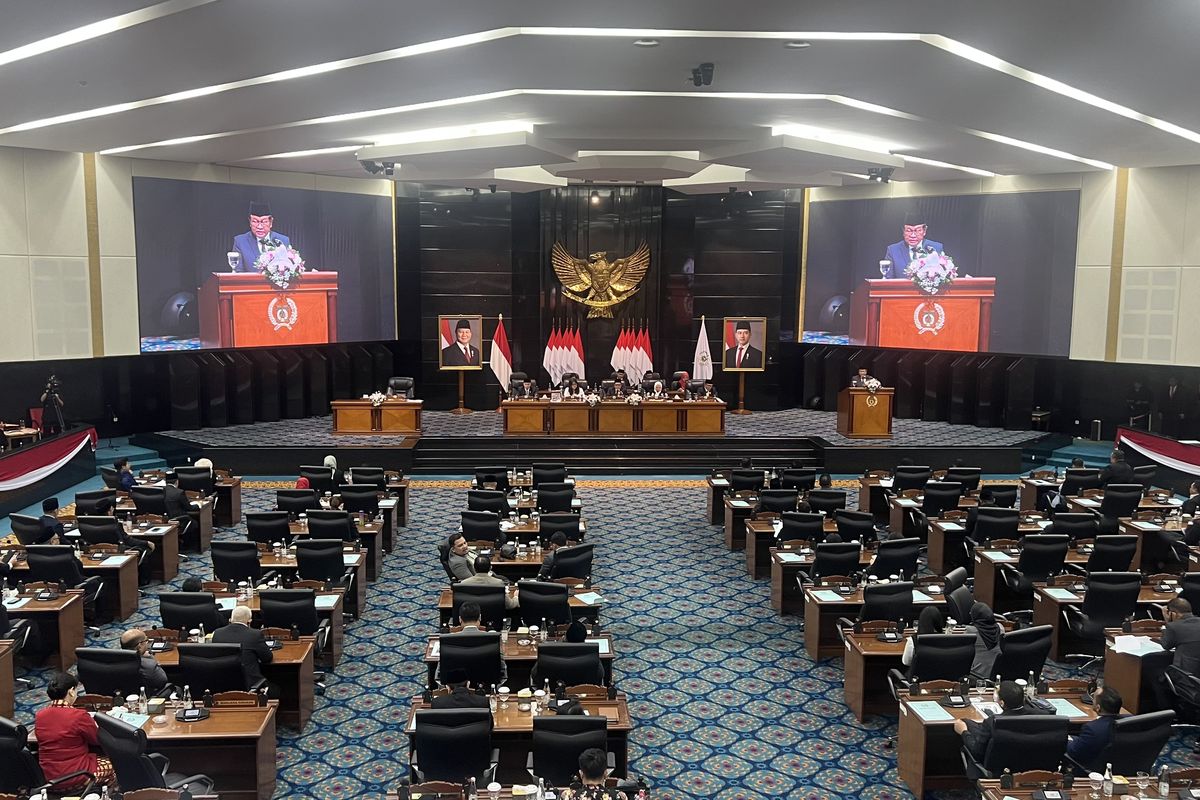
JAKARTA, KOMPAS.com - The change of Jakarta's status from special capital region to special area brings consequences for several provisions concerning local government administration, including the number of members in the Regional People's Representative Council (DPRD).
Recently, due to this change, DKI Jakarta's DPRD is pushing for an increase in the number of seats to 180-220.
This proposal arises amid the potential decrease in the number of Jakarta's DPRD members from 106 to 85 seats in the 2029 Election, following changes in the regulations under Law Number 2 of 2024 concerning the Special Capital Region of Jakarta.
Jakarta Governor Pramono Anung stated that the DPRD is not actually requesting an increase in seats, but rather a return to the seat count as it was in the 2024 Election.
Regardless of this controversy, is there a need to adjust the DPRD seats? What would be the ideal number?
Political observer from UIN Syarif Hidayatullah Jakarta, Adi Prayitno, believes that the necessity for adjusting the number of seats should be evaluated based on purpose.
According to Adi, if the increase in DPRD seats aims to absorb the people's aspirations and bring the council closer to voters, then an increase makes sense as it has positive implications.
"Conversely, if people’s aspirations are consistently unheard and the council remains distant from its constituents, increasing the DPRD is irrelevant as it only burdens the local budget," Adi said to Kompas.com on Tuesday (13/10/2026).
Adi suggests that there are several indicators that can serve as parameters for this consideration.
In addition to the population percentage, increases must consider the council members' ability to represent and absorb public aspirations.
Moreover, Adi argues that the impact of this increase on the relationship between representatives and the public must also be scrutinized.
With more council members, will they become more responsive to the people's demands, or the opposite?
"Does increasing DPRD seats lead its members to be more fearful of the electorate? This must be examined. There has been a perception that the council only works every five years and often neglects the public’s aspirations," Adi elaborated.
Political observer and member of the National Committee for Independent Election Monitoring (KIPP) Indonesia, Jojo Rohi, argues that the discourse of adding DPRD seats should be preceded by an evaluation of the institutional performance.
Only after that should the potential representation gap between council members and the community they represent be identified.
He believes that evaluation allows the main issues to be clearly seen, whether it is a shortage of members or the need for improvements in institutional performance quality.
"For me, the order must be clear: evaluate performance first, identify the representation gap, then discuss the number of seats," said Jojo.
Jojo sees such evaluation as crucial since adding seats essentially increases institutional capacity.
The DPRD Jakarta's argument claiming that their workload is overwhelming due to representing around 11 million residents and the absence of a city/county DPRD must be scrutinized.
"The DPRD must show the cause-and-effect relationship; which aspects of representation, legislation, budgeting, and oversight cannot be optimally implemented due to member shortages?" he questioned.
Additionally, Jojo recommends auditing the existing 106 DPRD members. He states that an audit should not merely calculate meeting frequency, local regulations, recesses, or work visits conducted.
The audit should aim to measure outcomes, such as how effectively citizen aspirations are addressed, the quality of local regulations produced, oversight of the regional budget and government policies, and the responsiveness of council members to their constituents.
If evaluations prove that the 106 members indeed face structural overload, and measured additional members can improve representation quality, then the seat increase would have rational grounds.
"But if the main problem resides in performance quality and institutional design, adding seats risks merely enlarging the parliament without enhancing its effectiveness," he asserted.
He does not wish for this issue to result in misdiagnosis.
Jojo emphasizes that increasing seats or the number of parliament members does not automatically solve the underlying issues, particularly when they lie in performance quality, productivity, member capacity, effectiveness of recesses, follow-up of aspirations, and poor oversight quality.
"The ultimate goal is not to make Jakarta's DPRD larger. The ultimate aim is to make the political representation of Jakarta’s residents more effective," he stated.
Meanwhile, Professor Djohermansyah Djohan from the Institute of Home Affairs (IPDN) argues that Jakarta's DPRD does not need to become "overweight." He warns against the justification of strengthening people’s representation leading to bloated political institutions and budget waste.
Moreover, the addition of 74 to 114 seats does not necessarily ensure that the voices of Jakarta's citizens will be better represented.
While Jakarta has five administrative cities and one administrative district, he points out that these six areas are not autonomous regions.
They are administrative regions within a single autonomous provincial area.
Moreover, mayors and administrative district heads are appointed from the civil service by the governor.
"This means that the absence of a city or county DPRD in Jakarta is not a 'debt of representation' that must be paid by adding dozens or even over a hundred seats in the provincial DPRD.
Do not use administrative specialness as a reason to inflate local parliament," Djohermansyah warned.
The former Director General of Regional Autonomy at the Ministry of Home Affairs from 2010–2014 also discussed more critical metrics to consider when adding seats, instead of only considering population numbers.
Those metrics include whether the regulations produced are of high quality, whether the regional budget is critically analyzed, whether the governor's policies are thoroughly monitored, and whether citizen aspirations are genuinely heard.
The DPRD has three main functions: legislation, budgeting, and oversight.
Thus, Djohermansyah stresses that a more important measure is whether DPRD members can effectively execute these functions.
"If the issue lies in the quality of representation, the answer is not to automatically add more seats. What needs improvement is the capacity of members, DPRD work systems, mechanism for absorbing aspirations, quality of supporting tools, expert staffing, and the relationship between council members and their constituents," he concluded.
On the other hand, he urges these parties to carefully calculate the budgetary consequences that each new seat would carry.
Cost components would include secretariat expenses, expert staff, supporting personnel, working facilities, business travel, recesses, meetings, and various other institutional support costs are pushed upwards.
This burden enters the regional budget (APBD).
However, the APBD is not the money of the government or the DPRD.
It comes from the people's money, which should be returned in the form of public services and development.
Moreover, there are additional costs arising before new DPRD members can operate, such as the costs of organizing legislative elections.
He acknowledges that adding DPRD seats in Jakarta will impact the logistical needs for the 2029 Elections.
The government grant budget for the DKI Jakarta Provincial Election Commission and funding support for conducting elections could potentially increase.
"The more seats contested, the greater the technical, logistical, administrative, socialization, and counting needs. Therefore, don't just calculate the expenses after people are seated. Also consider the costs of campaigning and providing those seats," Djohermansyah remarked.

























