

In Addition to Patrols, Cartenz Peace Task Force Builds Closer Ties with the Community in Nabire, Papua
-
News
-
4 minutes ago
This article was translated by AI. Read the original article on Kompas.com. See Original
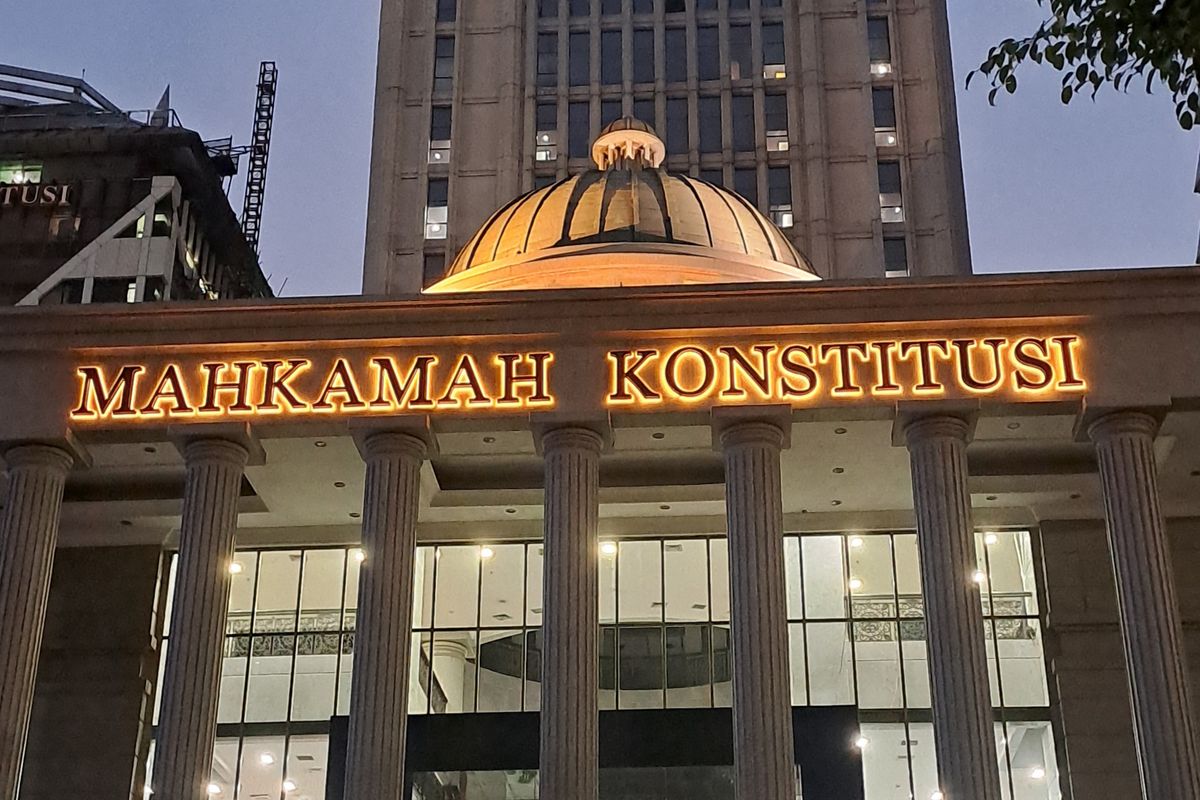
JAKARTA, KOMPAS.com - The requirement for high school diploma verification for presidential and vice-presidential candidates under Law No. 7 of 2017 on General Elections (Election Law), despite candidates already holding a bachelor's degree, is considered to disregard legal logic.
The petitioner is challenging Article 227 letter l of the Election Law at the Constitutional Court, arguing that the regulation rigidly restricts administrative verification solely to the legality of a high school diploma, even though candidates may have educational qualifications exceeding that level.
"Based on the legal logic principle argumentum a fortiori, if a person has completed a higher level of education (S-1, S-2, or S-3) that is valid and recognized by the state, then the requirement for graduation from below that level is logically deemed fulfilled and surpassed," the petitioner stated in the application filed on Wednesday (13/10/2026).
Furthermore, the petitioner argued there is a contradiction between the substantive qualification set forth in Article 169 letter r of the Election Law, which establishes the minimum standard of high school graduation, and the technical verification rules in Article 227 letter l of the Election Law.
Restricting proof of graduation to only that which is legalized by secondary education institutions is seen as creating legal uncertainty due to excessive formalism.
"Ignoring a valid higher education diploma as a proof instrument is a form of undue formalism that creates legal uncertainty and undermines substantive justice," wrote the petitioner.
Another point raised by the petitioner is that this rigid regulation could disadvantage higher education graduates, including those who pursued an accelerated pathway abroad without completing a physical high school education for three years.
This technical administrative regulation is viewed as discriminating against citizens' rights to equal opportunity in government and harming voters' chances of fairly and meritocratically selecting their leaders.
"Closing off avenues for proof through valid higher education diplomas not only harms the candidates' rights but also infringes upon the constitutional rights of the wider community—including the petitioner as a voter—to enjoy healthy, fair, and meritocratic national leadership contests," the application stated.
The material challenge was submitted by an Indonesian citizen named Farhan Hilmy and has been registered with the Constitutional Court under Case Registration Number 382/PUU-XXIV/2026.
In the petition, the petitioner requests the Constitutional Court to grant the entire petition and declare the phrase "by secondary education institutions or programs" in Article 227 letter l of the Election Law contrary to the 1945 Constitution and conditionally unconstitutional.
The petitioner seeks that this phrase be interpreted to include higher education institutions or the ministry responsible for higher education matters for prospective candidates who possess valid higher education diplomas.