

Amran Vs Sugiono: Analysts Weigh Public and Elite Acceptability
-
News
-
5 hours ago
This article was translated by AI. Read the original article on Kompas.com. See Original
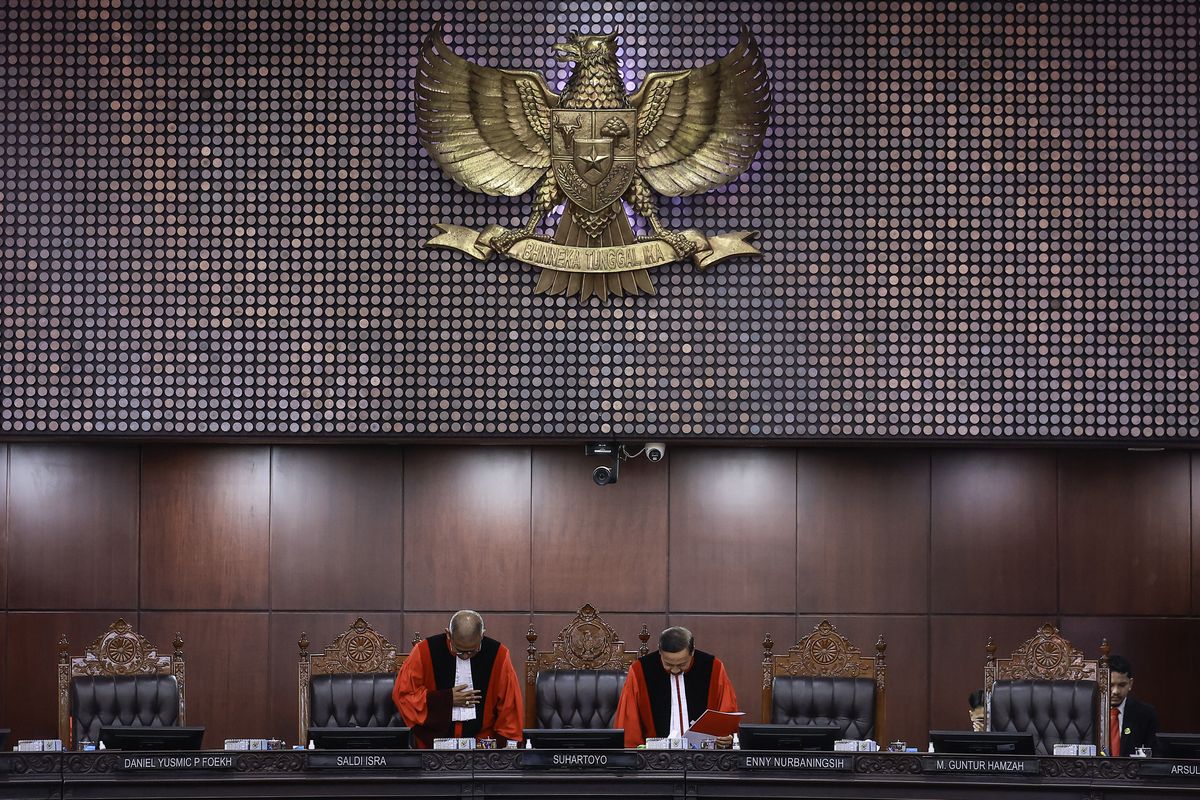
CONSTITUTIONAL Court once again captured public attention for issuing a controversial ruling, namely Decision No. 01/PHPU.PRES-XXIV/2026 regarding the dispute over the election results (PHPU) for the 2024 Presidential election, related to Gibran Rakabuming Raka's junior high school certificate.
Essentially, the court rejected the applicant's request. However, the legal considerations within the decision ignited complex constitutional debates.
The court stated that Gibran did not possess a graduation certificate that was included in the Equivalence Certificate issued by the Ministry of Education and Culture, as outlined in Article 169 letter r of Law No. 7 of 2017 on Elections.
However, this document is exempted as stipulated in Article 18 paragraph (3) of the KPU Regulation No. 19 of 2023 on the Nomination of President and Vice President.
The court also stated that other state institutions according to the 1945 Constitution should determine this. Both of these legal considerations are not part of the court's ruling.
A critical reading of this case leaves larger constitutional issues than merely winning or losing in court.
The rejection of the request due to the applicant's legal standing not being met and the court's jurisdiction limitations are legal facts that must be observed.
How should the court’s decision be followed up and what are the possible legal scenarios moving forward? At least there are three legal and political scenarios surrounding this case.
Case Closure Scenario
First, the case may be considered finished. Proponents of this scenario could argue that the court's decision is final and binding.
Legal certainty demands that disputes over presidential election results not be reopened indefinitely, especially after the president and vice president have been inaugurated.
This argument has an important basis: a rule of law cannot use any controversy as justification to repeat elections.
However, finality of the decision should not be misconstrued as immunity from all other legal processes. There must be a distinction between resolving disputes over election results, examining allegations of violations of nomination requirements, and holding public officials accountable.
Each has different subjects, authorities, and procedures. Consequently, one set of legal rules cannot be equated with another. This is solely for the sake of legal certainty.
Thus, it may be that Gibran's case concerning his diploma stops here due to the lack of other constitutional legal mechanisms.