

Directorate General: Immigration Thwarts Departure of 39 WNI Suspected of Becoming Russian Mercenaries
-
News
-
23 minutes ago
This article was translated by AI. Read the original article on Kompas.com. See Original
JAKARTA, KOMPAS.com - The Free Nutritious Meal Program (MBG) is set to enter its third year. What should be considered?
According to data from the National Nutrition Agency (BGN), the implementation of MBG has reached 56.99 million beneficiaries, which is 76.45 percent of the target of 74.56 million beneficiaries, with a gap of 17.56 million beneficiaries as of August 2026.
Meanwhile, the program's budget realization has reached Rp 139.77 trillion or 63.89 percent of the available allocation of Rp 218.77 trillion.
The government needs to ensure that this program operates optimally in fulfilling the nutritional needs of beneficiaries. It must also ensure that its distribution is accurately targeted.
So, how will the program run in the third year of President Prabowo's administration?
Public Policy Expert from Gadjah Mada University (UGM), Agustinus Subarsono, believes that this program will face adjustments due to economic constraints.
"Given the current unfavorable national economic conditions, I predict that MBG will experience adjustments," Subarsono said in a conversation with Kompas.com on Friday (9/10/2026).
He detailed that there are at least three alternatives or scenarios that the government may adopt.
The first scenario focuses on the target groups in need, rather than all students.
According to Subarsono, this scenario is understandable as the initial goal of MBG was indeed formulated to reduce or even eliminate stunting among children from poor families.
"Thus, it makes sense for MBG to focus on students from low-income families," he explained.
Subarsono stated that the first and second scenarios are relatively reasonable choices. These scenarios are unlikely to meet resistance from central kitchens.
This contrasts with the third scenario, which would reduce profits for SPBG owners.
He also assessed that the signs pointing to the first and third scenarios are much smaller. The government, he noted, has explicitly stated that it will accelerate MBG services in remote, underdeveloped, and border areas (3T).
On the other hand, Subarsono provided several suggestions to prevent repeated cases of food poisoning.
The first suggestion is to pay attention to distribution timing, which should align with children's school hours. For instance, Early Childhood Education (PAUD) and kindergartens have relatively short learning hours, allowing children to go home before noon.
Another consideration is meeting the nutritional needs of the distributed food. He believes the portions should also be adjusted based on the age of the beneficiaries.
"Small portions but nutrient-dense. This is because children's stomachs are small but need to be rich in animal protein (eggs, fish, and meat)," he elaborated.
The third suggestion is to create appealing visuals and flavors so that beneficiaries are eager to consume the meals.
"Foods must be presented attractively, clean, not spicy/sharp, and low in sugar, salt, and saturated fat," Subarsono commented.
Another crucial aspect is the need for nutritional standards in the menu. He emphasized that the government should align the nutrition with its goals, namely preventing stunting. Nutritional standards must be carefully considered and consulted with nutrition experts.
"Monitoring raw materials and the processing of menus at each SPBG must be under the control of nutrition experts to ensure that nutritional content is not compromised during processing due to excessively high temperatures," said Subarsono.
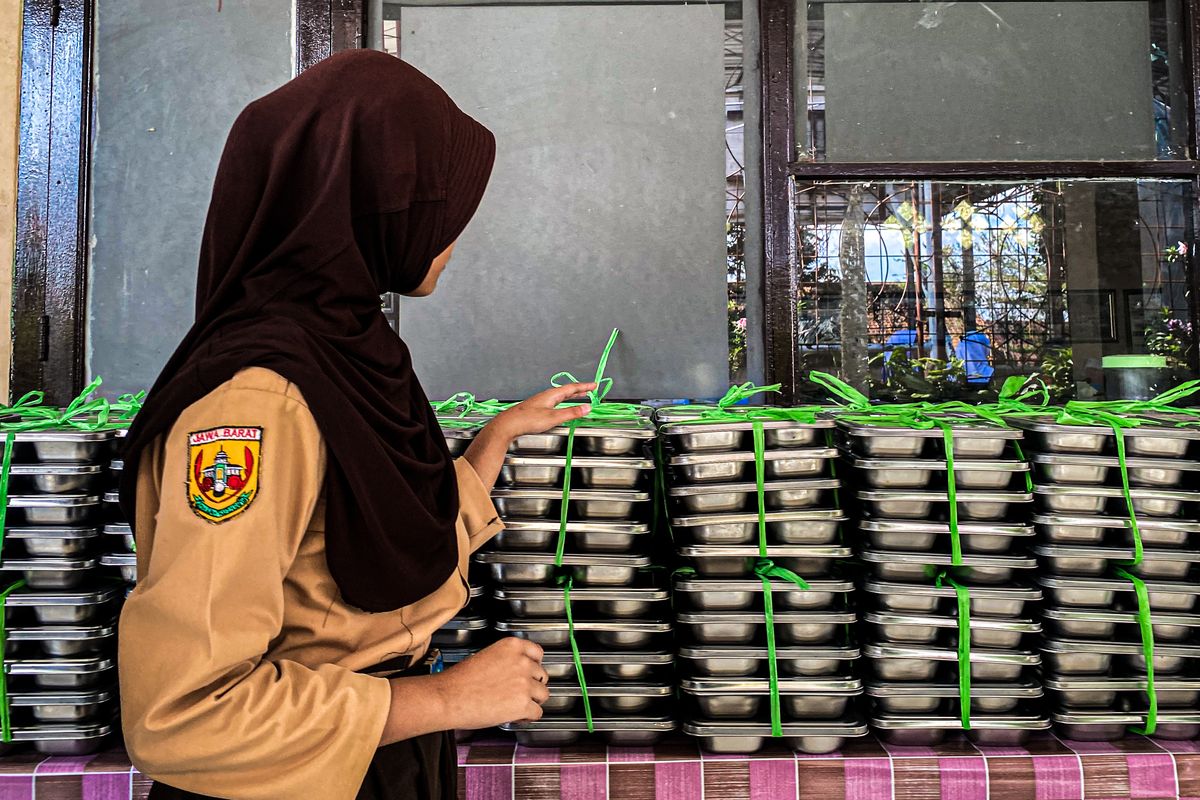
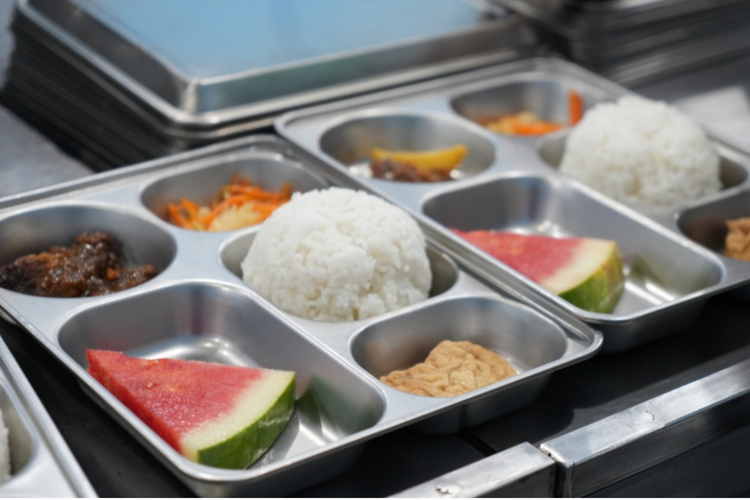 Illustration of MBG.
Member of Commission IX of the Indonesian House of Representatives (DPR RI), Irma Suryani Chaniago, agrees on the necessity of establishing nutritional standards aligned with the program's direction and objectives.
For pregnant women, for instance, two eggs and green bean porridge should be provided weekly to ensure the nutrition for the fetus. Similarly, a variety of green vegetables is essential for expectant mothers.
"Because the president's target is to improve children's IQ, boost their immune systems, and lower stunting rates. If the number of beneficiaries is reduced, I hope the value of a serving can be increased by Rp 2000 for each segment to enhance its nutritional content," Irma expressed.
Furthermore, Subarsono recommended establishing food safety standards, including mass certification for SPBG kitchens and basic food tests (food baseline procedures).
Subarsono advised that every batch of food to be distributed must undergo rapid sample testing to ensure it is free from bacteria, viruses, and parasites, such as Escherichia coli and Salmonella.
"BGN should also provide an allergy reporting form for each child, so SPBG kitchens can offer alternative menus," he stressed.
Separately, BGN Head Sudaryono assured that his team would organize the beneficiary data to ensure the Free Nutritious Meal (MBG) service aligns with ground conditions.
This beneficiary data is continually updated to ensure that the amount of food prepared by the Nutrition Fulfillment Service Unit (SPPG) matches the actual number of recipients. This way, beneficiaries can be clearly identified, including based on identity and educational unit.
According to Sudaryono, this effort is aimed at building a more orderly distribution system that enables monitoring the development of MBG beneficiaries over time.
"We want to ensure that it is truly by name, by address, and that BNBA is accurately tracked. Why? Because we want to trace. How has Hasan, Budi, Ali, Siti progressed before and after receiving MBG?" Sudaryono stated in a statement on Tuesday (6/10/2026).
Sudaryono emphasized that improving systems and data indeed requires a process and brings its own complexities.
Additionally, BGN will continue to evaluate kitchen operations, including aspects of capacity, food safety, and service feasibility.
Such evaluations are conducted to ensure that each SPBG meets the standards set for implementing MBG.
"Quality and food safety are non-negotiable components in carrying out this program," he remarked.