
Student in Malang Dies from Assault, Ministry of Education Urged to Improve Violence Prevention System
-
News
-
7 minutes ago
This article was translated by AI. Read the original article on Kompas.com. See Original
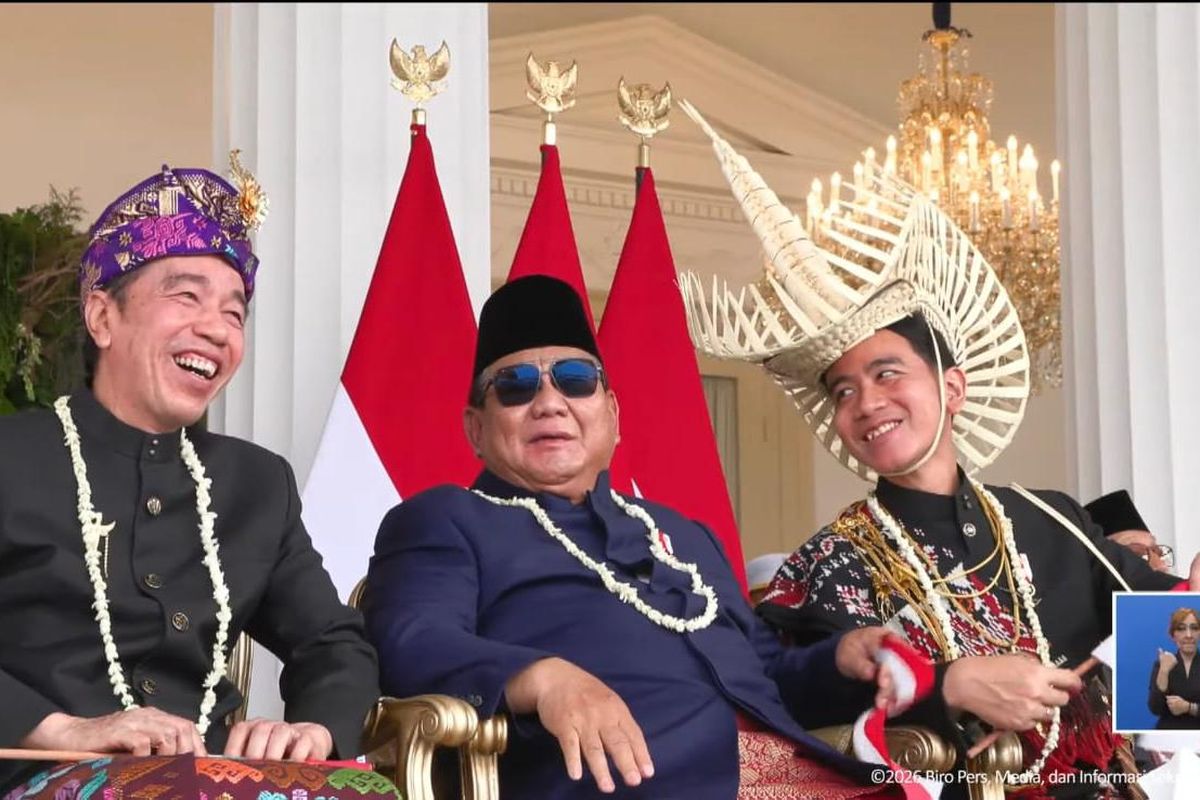
THERE is something intriguing about how Joko Widodo discusses the futures of Prabowo Subianto and Gibran Rakabuming Raka.
In September 2025, he confirmed that he had directed his volunteers to support the pair for two terms. This support was reiterated in January 2026.
However, when the same question was posed again on October 8, 2026, Jokowi did not repeat his earlier statement. He remarked that the election is still far off and urged everyone to focus on serving the people.
There was no retraction of support in that response, nor was there any indication of a potential change in the vice presidential candidate.
Yet, the shift in his way of answering became interesting as it emerged when several parties began to express their views on the 2029 presidential election.
For instance, Golkar supports the possibility of Prabowo running again, but has not yet decided who will accompany him. Gerindra has also yet to announce its decision regarding the candidate pair.
Amidst these developments, the discussion surrounding two terms raises a more important question than simply Jokowi's change in rhetoric.
Does support for the continuation of a president's leadership also entail a commitment to uphold his political partner?
A former president no longer holds governmental power, but his influence does not automatically cease upon leaving the palace.
His relationships with elites, volunteer networks, and political experience keep him relevant in power dynamics.
Jokowi possesses all these resources. His role in the political configuration for the 2024 presidential election means that every statement he makes regarding Prabowo and Gibran draws significant attention.
However, political communication has limits for interpretation. The statement that the election is still far off does not sufficiently prove a change in support.
Conclusions regarding any rift in relationships require stronger evidence than mere variations in word choice.
What is particularly interesting is how Jokowi is now in a different position. While he was still president, he held formal power resources. Now, his influence primarily operates through political relationships and his ability to shape opinions.
This change in position mandates an adjustment in his way of communicating. A statement that is too definitive regarding the next election could give the impression that a former president still wishes to dictate the current government configuration.
By choosing not to provide a new certainty, Jokowi at least avoids that impression. Whether that was his intention, only Jokowi can explain.
What is clear is that the political space of a former president is not the same as the authority of an incumbent president.
Golkar's statement reveals that the candidacy for president and vice president involves different political calculations.
Golkar's Vice Chairman Ahmad Doli Kurnia expressed his party's support for Prabowo in the 2029 presidential election. However, the vice presidential candidate has not yet been determined.
This position can be understood through the nature of multi-party presidentialism. In such a system, a president needs the support of multiple parties to maintain effective governance, while each party has its electoral and organizational interests that are not always aligned.
Some parties are interested in maintaining access to the cabinet. Others seek to strengthen their influence in policy formulation. There is also a need to prepare cadres who have opportunities to hold national positions.
All these interests converge when discussions turn to vice presidential nominations.
This position holds strategic value. Besides being part of national leadership, nominating a vice president can expand support bases, accommodate certain political powers, or enhance the competitiveness of the pair.
Therefore, parties that support the president may not immediately agree on a candidate to partner with him.
Indonesian political experience shows that coalitions can undergo adjustments as elections approach. Parties weigh electoral strength, elite relationships, and the potential benefits of political collaboration.
In this context, the decision regarding Prabowo's pair in 2029 is better viewed as the result of ongoing negotiations, not as an automatic continuation of agreements from the 2024 presidential election.
Excessive focus on Jokowi's stance may obscure significant changes in Prabowo's position.
As he participates in the 2024 presidential election, Prabowo needs support to gain a mandate. After assuming office on October 20, 2024, he will become the holder of governmental authority based on the constitution.
This new position carries responsibilities that cannot be shifted to characters who previously supported him.
Prabowo will determine policy direction, lead the cabinet, and manage relationships between the government and the legislature. These decisions will form the basis for assessing his leadership.
Here, a president's independence takes on meaning. He is not measured by how far he distances himself from his predecessor, but by his ability to make decisions and take responsibility for their consequences.
Prabowo can maintain a good relationship with Jokowi without losing his capacity to make independent political choices.
However, the independence of a presidential system faces challenges in a multi-party framework. The president possesses constitutional authority, but the execution of governance agendas still requires political support.
Providing too many concessions can weaken policy direction. Conversely, neglecting coalition interests can disrupt government collaboration.
The ability to manage these tensions will be a key measure of Prabowo's leadership as he approaches the end of his term.
The question of who will accompany him in the next election only becomes relevant after political needs and the direction of his leadership can be assessed more clearly.
For Gibran, his political challenge is different. He must establish recognition of his role as vice president.
In the 2024 presidential election, Gibran's candidacy cannot be separated from his familial relationship with Jokowi and the debate surrounding his nomination process. This situation shapes part of the public's perception of him.
However, after nearly two years in government, the criteria for evaluation should no longer stop at the origins of political support.
Gibran holds a constitutional position as vice president. In fulfilling this role, he assists the president according to the powers and assignments given to him.
His working space may differ from that of the president. However, the limitations of formal authority should not serve as an excuse to overlook the importance of contributions that can be recognized by the public.
Participation in government activities, the ability to engage in public communication, and involvement in resolving assigned issues can serve as the basis for assessment.
Gibran's challenge is to transform public recognition of him into trust based on his performance.
Historically in Indonesia's governance, the continuity of presidential leadership has not always accompanied that of the vice president.
Susilo Bambang Yudhoyono served his first term with Jusuf Kalla and his second with Boediono. Jokowi also replaced Jusuf Kalla with Ma'ruf Amin when he ran again in 2019.
This experience indicates that changing partners is a legitimate possibility in the presidential election system.
For Gibran, the political lesson is clear. Opportunities for re-nomination must be built on capacity and trust, not merely on proximity to figures who previously supported him.
Discussions regarding the 2029 presidential election arise while the Prabowo–Gibran administration has not yet completed two years. There remains a significant portion of the term to complete.
However, the elite political calendar often moves faster than the government accountability calendar.
As parties begin to calculate the chances for the next election, the public is still waiting for the results of the political promises made in the previous election. This is where attention should be focused.
Economic growth needs to be assessed by its impact on people's lives. Education and health programs must be evaluated based on their quality and reach.
Corruption eradication requires more serious metrics than political statements. Law enforcement and protection of civil liberties also determine the quality of governance.
This assessment requires data, citizen experiences, and oversight from public institutions.
For the government, political support is the capital for action. However, that capital only matters if it results in policies that yield real benefits.
The success of programs also needs to be distinguished from the success of maintaining power. The government can gain electoral support without all its policies succeeding. Conversely, sound policies can continue under a different leadership arrangement.
Thus, discussions about a second term should not precede evaluations of the first term.
Without adequate evaluation, support for two terms risks becoming loyalty to a figure rather than an acknowledgment of governmental achievements.
The constitution allows for presidents and vice presidents to be re-elected once. However, this possibility is not a guarantee that an officeholder will secure the next mandate.
Article 7 of the 1945 Constitution stipulates term limits. The decision of who will lead remains within the democratic process of candidacy and elections.
In this process, political parties have the authority to propose candidate pairs in accordance with constitutional provisions and laws. Voters then decide who earns their trust.
The relationship between these two stages is crucial. Elite decisions determine the options available on the ballot, but cannot replace the people's decisions.
Therefore, the quality of democracy is also determined by how open the nomination process is, how accountable the candidates are to the public, and whether voters have the opportunity to freely evaluate their options.
The discourse about two terms should be part of that debate.
Jokowi's support is a legitimate political stance. Golkar's calculations and those of other parties are also part of the democratic competition. However, none of this addresses whether the public will desire the same leadership in the future.
The answer must be sought through the performance of governance and voter assessments, not through certainties announced far in advance of the elections.
Perhaps that is the most significant meaning of the question mark that now accompanies the two-term discourse.
Democracy does not require us to know who will be in power in 2029 from now. What is needed is to ensure that, when the time comes, the people still have the freedom to determine the answer.