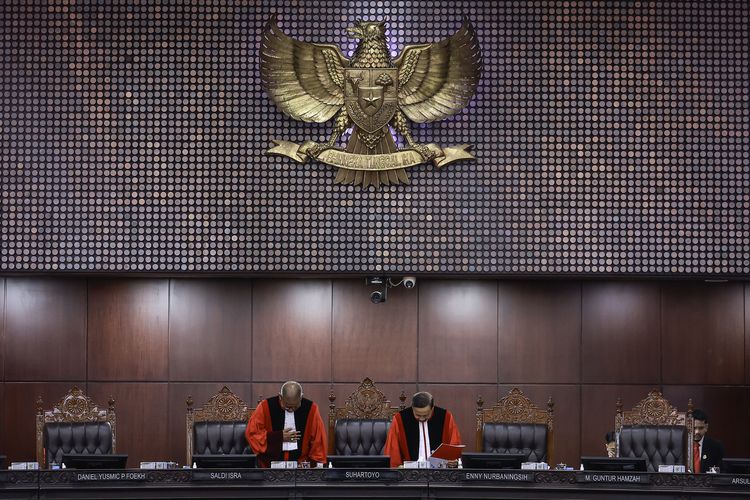


The Paradox of Seats and Spectators
-
News
-
Just now
This article was translated by AI. Read the original article on Kompas.com. See Original
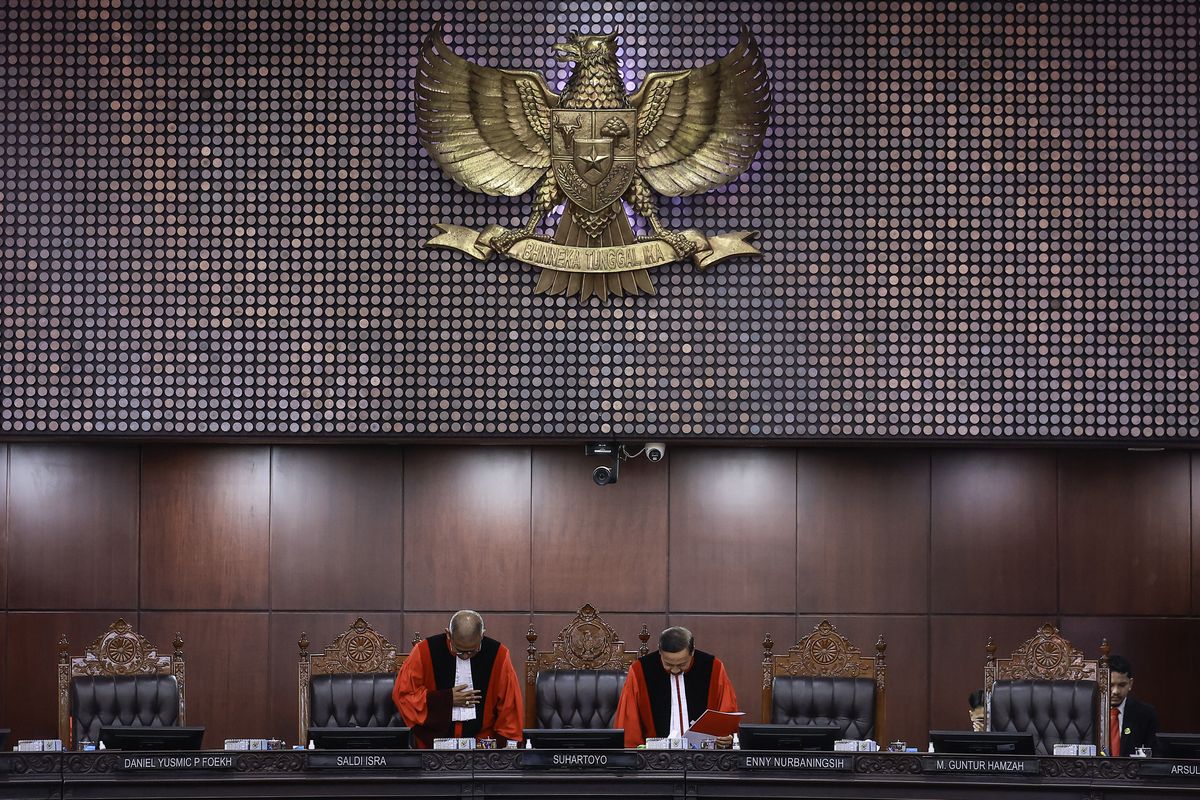
CHAIRMAN of the Constitutional Court (MK) Suhartoyo, along with the Constitutional Judges who adjudicated the Request for Dispute over the Results of the 2024 Presidential and Vice Presidential Election, issued their verdict on Tuesday (6/10/2026), through Decision Number 01/PHPU.PRES-XXIV/2026.
Immediately, the decision sparked both support and dissent. Controversy arose as the Court considered the issues or core of the request.
In fact, the ruling granted the legal standing exception of the Applicants, who were deemed not qualified to file the request as they were not presidential or vice-presidential candidates.
The author understands the a quo decision and recalls what Van Apeldoorn said.
Van Apeldoorn (1990) once stated that a judge's decision must first undergo a fair trial process, with considerations based on moral justice, not just legal justice.
The author sees that the MK decision, which garnered significant public attention, straddles the line between legal justice and moral justice.
The Court's perspective in the decision registered as the Dispute over the Results of the 2024 Presidential and Vice Presidential Election reflects the presence of legal justice, evident when the Court assessed and subsequently ruled on the Applicants' requests, which were not included in the regime for resolving disputes over presidential and vice-presidential election results.
The Court provided legal arguments because, factually, Gibran Rakabuming Raka was no longer a candidate for vice president in the 2024 Presidential and Vice Presidential Election.
According to the Court, the status of vice-presidential candidate ended when the elected candidate was sworn in on October 20, 2024, marking the conclusion of the electoral process for the 2024 Presidential and Vice Presidential Election. (see: page 376)
Secondly, it is evident when the Court constrained itself from stepping into the realm of disqualifying Gibran Rakabuming Raka from his position as Vice President.
The Court wisely allocated that authority to the institution empowered to assess the validity and fulfillment of the requirements for presidential and vice-presidential candidates as stipulated in the 1945 Constitution of the Republic of Indonesia. (see: page 376)
Thirdly, the Court still based its decision on Article 74 paragraph (1) letter b of the MK Law and Article 3 paragraph (1) of PMK 4/2023, which was amended by PMK 2/2024 when adjudicating the request, specifying that the Applicants in the presidential and vice-presidential election results dispute are the pairs of presidential and vice-presidential candidates.
On that basis, the Court ruled that the Applicants lacked legal standing to submit the a quo case.
Since the Applicants consisted of civil society organizations in the form of associations (Applicant I), political parties (Applicant II), and individual Indonesian citizens (Applicants III to XII).
Similarly, the position of the related parties was also not that of presidential or vice-presidential candidates.
The Court's three viewpoints illustrate how the Court works towards achieving legal justice.
In considering and ruling on the requests submitted by the Applicants, the Court relied on existing positive law.
In this context, the Court applied the provisions of legislation to the facts that arose during the trial.
In addition to relying on legal justice as previously stated, the Court also seemed to operate on the principle of moral justice.
The Court transcended the boundaries of formal regulatory provisions and made legal breakthroughs and discoveries as a form of its constitutional moral responsibility.
From the author's reading, the essence of moral justice in the "Gibran diploma" ruling is apparent, firstly, when the Court made a legal finding on something not regulated by law.
In its legal considerations, the Court emphasized its "responsibility" to uncover the substantive truth regarding the case brought forward by Denny Indrayana et al.
The matter adjudicated by the Court pertains to issues not covered by regulation concerning which institutions have the authority to resolve disputes over presidential and vice-presidential election results following the inauguration of elected candidates.
Nevertheless, the Court assumed that constitutional burden. The Court named itself as a manifestation of the principle of ius curia novit. (see: page 362)
Secondly, related to the principle of ius curia novit, the Court rejected the limitation on the timeframe for submitting cases.
The Court addressed the issue as a special circumstance, wherein it had to bear responsibility and unearth the substantive truth regarding the legal issue that garnered public attention: namely, Gibran's eligibility requirements. (see: pages 376-377)
Thirdly, even though the Court did not decide on the core of the request, it deliberately entered into consideration of the special circumstances regarding the fulfillment of the vice-presidential candidacy requirements for Gibran Rakabuming Raka.
In considering those special circumstances, the Court stated:
"... In the trial, no convincing evidence was found or obtained indicating that Gibran Rakabuming Raka has a diploma/certificate from abroad that could be equated with a minimum education of senior high school, madrasah aliyah, vocational high school, madrasah aliyah vocational program, or other equivalent schools as referred to in the norms of Article 169 letter r and Article 227 letter l of the Election Law." (see: page 375)
The Court's stance, on one hand, not deciding on the core request because it upheld the legal standing exception of the Applicants due to not being presidential and vice-presidential candidates, but on the other hand considering the core request, has been viewed by some parties as a contradictory ruling.
This type of ruling is regarded as atypical and inconsistent with general procedural law.
As is known, in civil litigation, particularly civil procedural law, if a judge grants an objection regarding the legal standing of the applicant or plaintiff, the judge will not consider the core of the request or the main issue.
However, in MK Decision Number 01/PHPU.PRES-XXIV/2026, the Court considered the core request concerning Gibran's eligibility requirements, as mentioned above, even though its ruling stated the request could not be accepted due to the Court upholding the legal standing exception of the Applicants.
The steps taken by the Court, in the author’s view, are understandable.
First, referring to Article 5 Paragraph (1) of Law No. 48 of 2009 on Judicial Power, the actions undertaken by the Court can be seen as an obligation to delve into, follow, and understand the legal values and sense of justice that exist in society.
Second, theoretically, the breakthrough made by the Court can be justified at least from the perspectives of the theory of free law (Freiheitslehre) and progressive law.
The free law theory posits that judges have the task of creating law.
In carrying out their duties, judges are not bound by legislation primarily; rather, law serves as a tool to solve problems, and solutions need not align with legal resolutions.
Thus, judges bear the responsibility not just to apply the law, but to create appropriate solutions for specific events.
Judges need to generate law to resolve the issues at hand. (Sudikno Mertoksumo, 1991; Darji Darmodihadjo and Shidarta, 2004)
By demonstrating that it did not find or obtain convincing evidence of Gibran’s diploma abroad that equates to a senior high school diploma, the Court showed that constitutional judges have created law beyond the norms of general procedural law.
In this way, the Court aimed to resolve important public issues that had not been previously addressed by existing judicial institutions.
In a similar vein, the breakthroughs made by the constitutional judges are understood in the context of the progressive law teachings developed by Satipto Rahardjo.
Progressive law holds that the process of change no longer centers on regulations but on the creativity of legal actors in actualizing the law within the appropriate context of time and space.
Progressive legal actors can effect change by creatively interpreting existing regulations without waiting for changes in regulations.
Progressive law embraces both regulations and reality, and social needs must be carefully considered in every decision-making process. (Muhammad Rakhmat, 2015)
In its ruling, the Court did not solely focus on legislative regulations.
Constitutional judges appeared to engage in constitutional interpretation, making breakthroughs by tapping into the justice inherent in society, which called for a resolution of public issues concerning the validity of Gibran's overseas diploma equated with senior high school as a requirement for vice-presidential candidacy.
The MK ruling has been delivered, and the accompanying pro and con reactions are natural in a democratic country.
However, as per applicable legal principles, a judge's ruling must be considered true (res judicata/res judicata pro veritate habetur).
Our choice, of course, is to respect it. May it be so.