

Budi Arie Questioned in Treason Case Involving Listyo Sigit and Others, What Are His Statements?
-
News
-
7 minutes ago
This article was translated by AI. Read the original article on Kompas.com. See Original
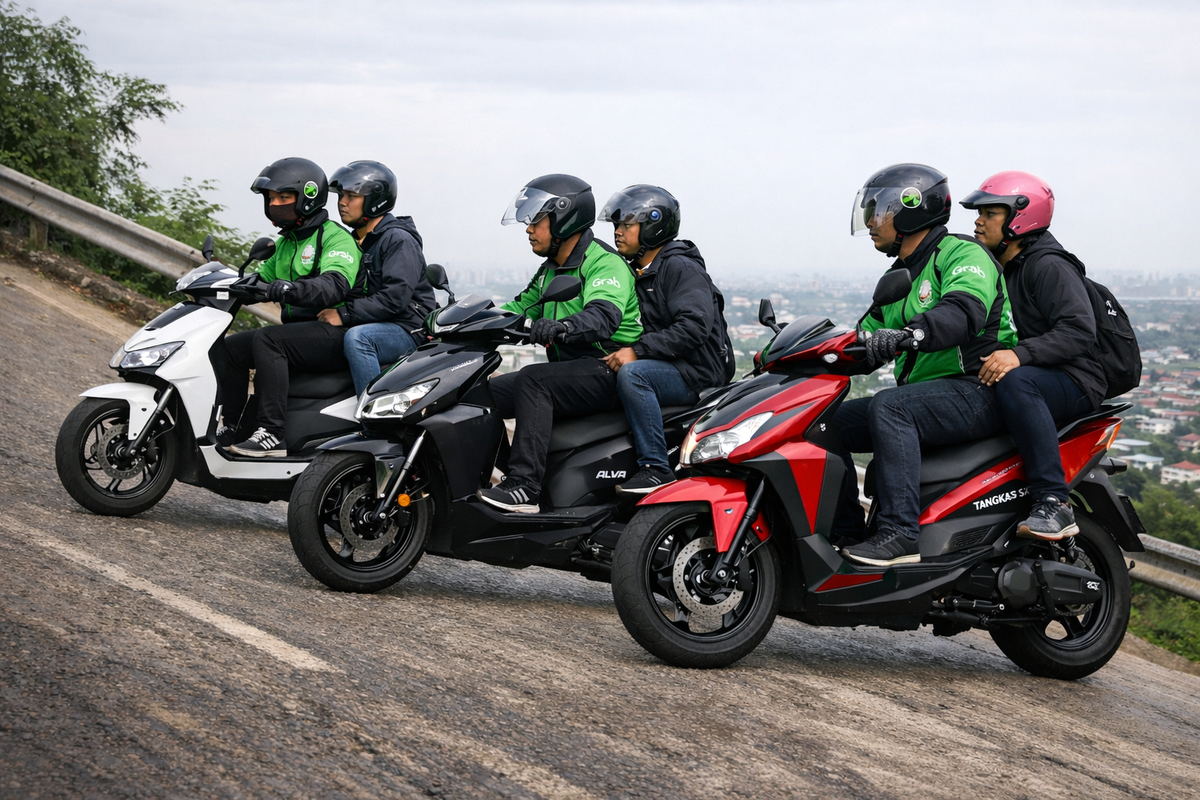
JAKARTA, KOMPAS.com - Online motorcycle taxis (ojol) have become an integral part of daily life for many.
For some people, ojol is the preferred choice for navigating areas that are difficult to access by public transportation.
However, behind its widespread use lies the issue of safety standards and vehicle eligibility.
This concern has surfaced alongside plans to regulate ojol as part of public transportation through a revision of Law No. 22 of 2009 on Traffic and Road Transportation (LLAJ).
The plan is currently being pushed by the government in collaboration with the Parliament to provide a legal framework for transport based on digital platforms.
Transportation Minister Dudy Purwagandhi stated that online transportation has yet to be specifically regulated under this law.
"Originally, there were no regulations for online transportation; this is now being addressed in the LLAJ Bill," said Dudy at the Transportation Journalists Forum Workshop in Bandung, West Java, on Friday (2/10/2026).
Once the LLAJ revision is passed, the regulation concerning online transportation will be further detailed through Presidential Regulations (Perpres) and Ministerial Regulations (Permen).
"This will provide clarity on the rights and obligations for both drivers and operators or providers," Dudy added.
Deputy Minister of Communication and Digital Angga Raka Prabowo mentioned that his ministry has coordinated with the Ministry of Transportation to discuss this regulatory plan.
The two ministries have formed a task force to address various aspects of platform-based digital transportation.
"Our domain is in PSE (Electronic System Organizers), to regulate the platform, which will include specific clauses regarding rights and obligations, as well as law enforcement," Angga stated.
Deputy Chairman of Commission V of the Parliament Syaiful Huda mentioned that the regulations for online transportation have been initiated through the LLAJ bill revision.
Currently, the academic draft is being prepared as a basis for regulatory discussions.
"My personal spirit and that of my colleagues in Commission V is to create the best ecosystem for online transportation. Whether we like it or not, permanent regulations in the form of laws are needed. This is currently being initiated and has been included in the National Legislative Program (Prolegnas)," Huda told Kompas.com on Friday (9/10/2026).
Huda emphasized that the regulations pushed by Commission V focus on transport aspects, including the legal status of two-wheeled online transportation as part of the national public transport system.
"Regarding labor relations, that is certainly not our domain. It will not be part of the substance we include in this law revision," he said.
So, what should be prepared when two-wheeled ojol officially becomes public transportation?
Djoko Setijowarno, Advisor to the Indonesian Transportation Society (MTI), stated that safety requirements for motorcycles serving the public are outlined in Minister of Transportation Regulation No. PM 12 of 2019.
"Safety standards already exist in PM 12 2019," Djoko said when contacted by Kompas.com on Thursday (8/10/2026).
When asked about compliance with these requirements should ojol become public transportation, Djoko emphasized that safety regulations must still be adhered to.
"Compliance is mandatory," he asserted.
Regarding oversight mechanisms if ojol motorcycles fall into the category of public transport, Djoko mentioned that discussions are still pending developments on the LLAJ revision.
Djoko also referred to regulations regarding public transport vehicles, including the use of yellow license plates and vehicle testing or KIR tests.
When asked whether such provisions might apply to ojol motorcycles, Djoko did not detail the mechanisms to be implemented.
Djoko also questioned the choice of two-wheeled motorcycles as the application-based public transportation mode.
He suggested that three-wheeled vehicles be considered to meet transportation needs in certain areas.
"I can argue, why not just use three-wheeled vehicles?" Djoko said.
According to him, three-wheeled vehicles could be used in areas where larger-capacity public transport is not feasible.
"It’s not possible for small islands to have TransJakarta; that doesn’t make sense. However, they could utilize three-wheeled vehicles instead of two," he remarked.
Djoko noted that three-wheeled vehicles can carry more cargo and offer better protection from heat and rain for passengers.
He also mentioned the traffic conditions in Jakarta, filled with motorcycles.
Nevertheless, Djoko admitted that motorcycles are still needed by many, especially in areas lacking access to public transportation.
"But, motorcycles are still necessary. We do have small islands, right?" he said.
In the LLAJ revision, Commission V of the Parliament is also pushing for regulations concerning the rights and obligations of application companies and drivers of technology-based transportation.
Huda stated that these regulations are part of the effort to form a permanent online transportation ecosystem through legislation.
"This includes regulations concerning the rights and obligations of application companies and drivers of technology-based transportation. Currently, it is estimated that the number of online drivers who rely on this profession exceeds two million," Huda disclosed.
"Social issues might escalate sharply in social, economic, and even political conditions," he added.
He emphasized that the substance promoted by Commission V remains focused on the transportation sector, not the labor relations between drivers and application companies.
Huda mentioned that the LLAJ revision is also aimed at aligning regulations with advancements in information technology.
According to Huda, the scope of regulations in the current LLAJ has not fully followed technological developments in the transportation sector.
Some key points of focus include electronic-based public transportation, electronic traffic law enforcement (ETLE), electric vehicles, autonomous vehicles, and electronic road pricing (ERP).
In addition to technological advancements, the LLAJ revision will also address road preservation funding regulations.
Huda stated that although this funding is regulated in existing laws, its implementation has yet to be optimal.
"Regulations concerning road preservation funding need to be synchronized with principles of state financial management," explained the Partai Kebangkitan Bangsa (PKB) politician.
These funds come from state revenues generated from road users and must adhere to budgeting provisions in the State Budget (APBN).
Other issues discussed include taxation regulations for application-based public transport companies, including online taxis.
According to Huda, new regulations are needed to clearly outline tax obligations or non-tax state revenues (PNBP) from application companies to optimize state revenue collection.
"Additionally, regulations concerning corporate taxes or taxes on fares for public motor vehicle transportation not on a route with technology-based applications (online taxis) also need to be addressed," Huda said.
"This LLAJ Bill must be capable of encompassing taxes/PNBP from application companies; the tax system has to be regulated so that potential state revenue does not go astray," he added.
Huda also noted that the improvement of LLAJ includes adjustments to criminal provisions according to Law No. 1 of 2026 concerning Criminal Adjustment.
All of these enhancements are being developed in collaboration with the Council's Expert Body (BKD).
"We expect that the outcome of this bill will lead to improved safety and traffic security, reduced congestion, and enhanced quality of transportation services for the public," he concluded.