

Prabowo Proposes Establishment of Agency to Regulate Procurement of Goods and Services
-
News
-
13 minutes ago
This article was translated by AI. Read the original article on Kompas.com. See Original
IMAGINE a housing complex requiring every guest to register their name and leave an ID card at the security post.
The guest book is thick and neatly organized, but no one ever matches the guest's face with the photo on the card. Residents continue to sleep soundly because the procedure exists.
Auditors refer to this situation as a control that looks good on paper but does not actually work.
Therefore, before deciding whether a control should be tightened or relaxed, auditors first pose two tests.
The first is whether the control is relevant to the risks it aims to prevent. The second is whether the control can realistically be executed and verified at a reasonable cost.
Controls that fail either of these tests are merely formalities. Both tests are now applicable to educational requirements for presidential and vice-presidential candidates.
The current public debate is split in two. Former Constitutional Court Chief Jimly Asshiddiqie suggests that the educational requirement be removed from the law, emphasizing that what matters is that voters are informed, while proposing that the requirements for legislative candidates be raised to at least a bachelor's degree.
The opposing camp rejects the removal and demands stricter verification.
Both sides are debating the diploma issue, yet neither has tested whether the requirement can be deemed a control.
The first test pertains to relevance. Article 169 letter r of Law Number 7 of 2017 concerning Elections mandates that candidates must have at least a high school diploma or its equivalent.
This requirement is not mandated by the constitution, as Article 6 paragraph (2) of the 1945 Constitution merely delegates the regulation of candidate requirements to the law.
The risk to be prevented is that a candidate lacks the capacity to lead.
However, a high school diploma only proves that a person has completed one level of education.
In Decision Number 87/PUU-XXIII/2025, the Constitutional Court noted that since the direct elections in 2004, many candidates proposed by parties have had education above the minimum threshold. This means, in practice, the requirement rarely filters candidates effectively.
It only becomes decisive when the validity of the documents is contested.
The second test examines operational effectiveness, and here the results are even worse.
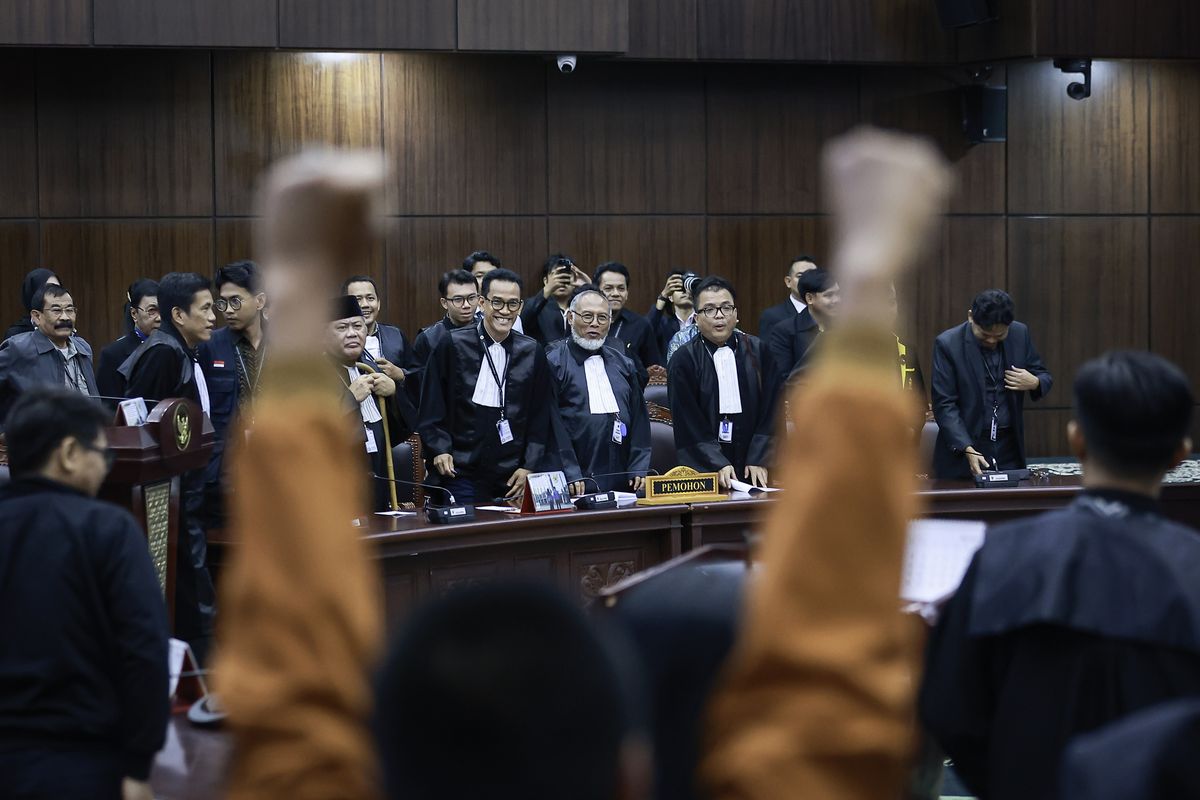
On October 6, 2026, the Court stated that the petition regarding the educational requirements of Vice President Gibran Rakabuming Raka (Case Number 01/PHPU.PRES-XXIV/2026) could not be accepted as the petitioners did not have legal standing.
In its considerations, the Court stated it found no convincing evidence regarding the diploma or foreign certificates that served as a basis for equivalency with a high school diploma.
The Court also assessed that the verification of the candidate’s documents should be complemented with factual verification, although it did not declare the actions of the KPU illegal.
During the hearings, the KPU Chair acknowledged that their institution did not directly verify with the ministry because they received a letter certifying the equivalence, while the Bawaslu Chair stated that their institution could not access the nomination information system.
When the Court finally examined the matter, the candidate's status had already concluded since the inauguration on October 20, 2024.
From these two tests, the audit conclusions become clear. Simply improving verification is not the answer since strengthening controls that are irrelevant leads to costly checks on matters that offer no guarantees.
Such controls are better retired and replaced with ones that target the actual risks. Legally, the door is open.
The Court affirmed that educational requirements constitute open legal policy that can be re-examined by lawmakers for the nation's best interest.
The same conclusion highlights the flaws in Jimly’s proposal. If a high school diploma is not relevant to the presidency, a bachelor's degree is not automatically relevant for legislative positions, especially as verification must be conducted on a far greater number of candidates.
Criticism regarding double standards, where the highest leaders are exempt from requirements imposed on other positions, can only be addressed if all positions are subjected to the same two questions.
Consistency means every position should be tested against the same criteria, not mandated to present the same documents.
So, what control is relevant? The answer is transparency mandated by law. Complete educational histories along with supporting documents should be published from the day of registration, allowing the public, the media, and academics to scrutinize them before voting.
This obligation needs to be written into law, not left to KPU policy, because in September 2025, the KPU restricted public access to diplomas and other nomination documents through KPU Decision Number 731 of 2025 before overturning it.
Sanctions also need clarification. Article 520 of the Election Law threatens a maximum of six years’ imprisonment for anyone creating or using falsified documents for nomination requirements.
If diplomas are no longer a requirement, the law must clarify that false statements in the published educational history still bear equally strict penalties.
Several democracies do not make diplomas a requirement for presidential nomination. The United States Constitution does not stipulate any educational requirements.
In terms of education, the Philippine Constitution only requires candidates to be able to read and write.
Assessment of capacity is left to the voters. In Indonesia, the first filter has already been established by the constitution: political parties, which according to Article 6A paragraph (2) of the 1945 Constitution serve as the sole channel for proposing candidate pairs.
The strongest objections still need addressing. The removal of the diploma requirement right after a dispute involving a public official might read as an attempt to obscure the issue.
Thus, changes should apply moving forward, ideally for the 2029 elections, without nullifying responsibilities concerning documents submitted in previous elections. The moment is ripe.
Commission II of the DPR has established a Working Committee for the Election Bill at the end of September 2026, and KPU members stated that the Court’s decision would serve as a reference for drafting the next regulations.
In audits, the most dangerous finding isn’t a lack of controls, but rather controls believed to be functioning when they are not.
For two decades, the diploma requirement has worked like a guest book at that security post. It provides the illusion that potential leaders have been filtered, and this issue reveals how fragile that illusion is.
Lawmakers can choose to patch the misguided control or replace it with the correct ones.
The first option seems more cautious, yet it perpetuates the false sense of security.