

Rumors Emerge That Jeff Bezos Wants to Fund the Relocation of the Javan Rhino
-
News
-
10 minutes ago
This article was translated by AI. Read the original article on Kompas.com. See Original
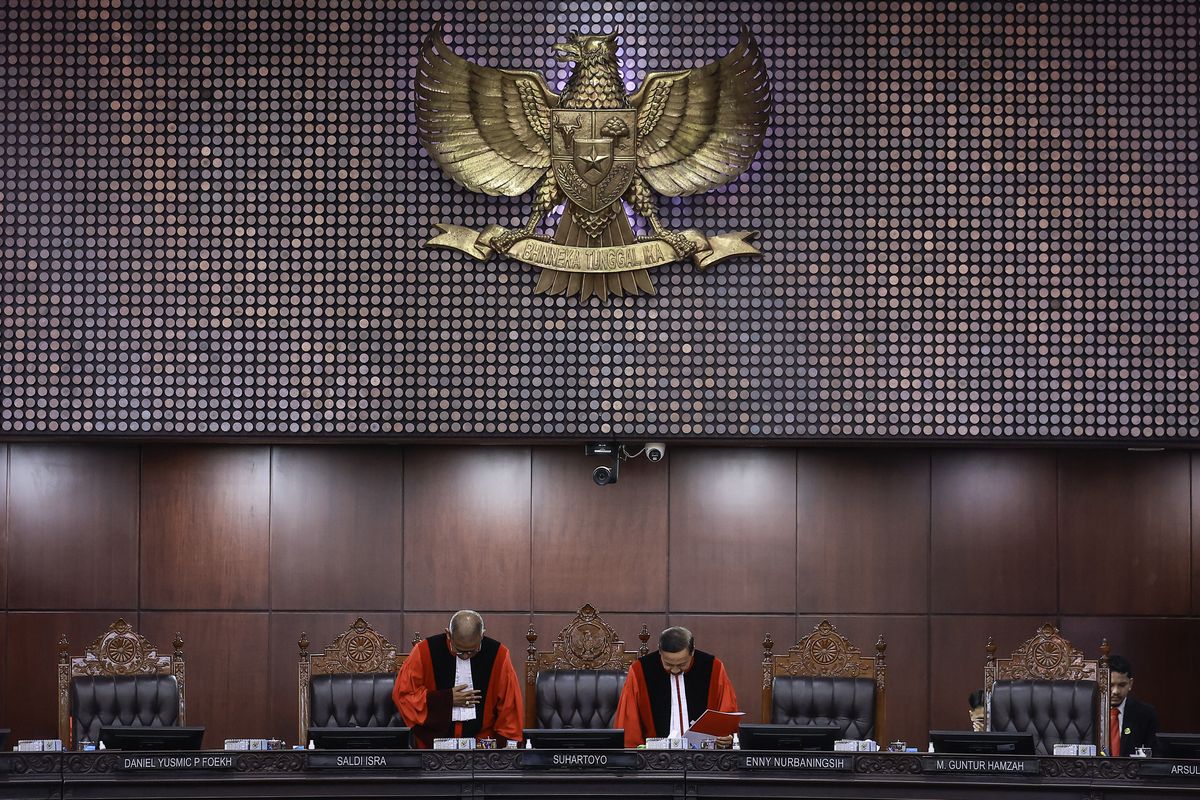
VERDICT The Constitutional Court's ruling Number 01/PHPU.PRES-XXIV/2026, announced on October 6, 2026, is a dangerous decision if read partially.
Those who only read the ruling would cheer: the petition is dismissed, the case is resolved.
However, those who read the considerations will demand: the educational qualifications of the vice president have not been proven.
In my opinion, this ruling must be read in its entirety. It is true that the ruling states "cannot be accepted", but the legal considerations actually contest the matter. Between the two, our constitution is being tested.
First, why did the Court reject it? The answer is not because Gibran Rakabuming Raka's educational documents were declared valid. The Court rejected it due to procedural issues.
Two limitations prevented the disqualification petition against Gibran from being granted: legal standing and the object of the petition.
First, the petitioners, Denny Indrayana and colleagues, are not a pair of candidates in the 2024 presidential election. Under the regime of Election Result Disputes, they do not possess legal standing.
Second, Gibran is no longer a candidate and has taken the oath as Vice President. The PHPU route is not designed to disqualify serving officials.
That is why the ruling states NO: cannot be accepted. This is a classical rule of procedural law. Such decisions never disregard substance; they merely close a legal avenue.
The Court is aware of this. Therefore, in its ruling, the Court explicitly shifted the substantive assessment to the authorities defined by the 1945 Constitution, namely the DPR and MPR, using the provisions laid out in impeachment.
Second, why are the legal considerations a serious matter? After closing the PHPU route, the Court has opened up factual records that are significant.
In its considerations, the Court states that it has examined all court evidence and found no document indicating that Gibran possesses a diploma, certificate, or degree proving he completed education abroad equivalent to high school or its equivalent, as required by Article 169 letter r in conjunction with Article 227 letter l of Law No. 7 of 2017.
Certificates of Attendance, Academic Records, and Explanations of Grades that form the basis for Equivalence Certificate No. 9149/D.D1/KS/2019 are deemed to only indicate attendance, not graduation.
Moreover, the official who issued the equivalence letter could not produce graduation documents from abroad that have been equated.
Doctrinally, indeed, the ruling carries executory force. However, the considerations provide the rationale that explains the meaning of the ruling.
When the Court, as the guardian of the constitution, writes the phrase "no convincing evidence found", this is not an obiter dictum that can be ignored. It is a factual finding in the highest constitutional forum.
Article 169 letter r of the Election Law is a formal requirement that cannot be replaced by popularity or electability.
The KPU should verify graduation documents from secondary schools, not documentation of knowledge equivalence.
If the basis for equivalence is merely attendance, then the completeness of documents should be factually verified.
The KPU has indeed created an exception clause in Article 18 paragraph (3) PKPU Number 19 of 2023. This article was also examined in the Constitutional Court proceedings, and the KPU deliberately "smuggled" that article to allow nominations for candidates without high school diplomas or equivalents. As a result, the legality of the nomination is called into question.
The Constitutional Court's ruling, when viewed from the ruling itself, does not seem to order anything. However, when read in full, the Court actually provides notification to the relevant authorities as per the 1945 Constitution, namely the DPR, to utilize its authority.
Although the constitutional route is open, it is advisable that this serves as an important ethical lesson for state officials. We have MPR Decision No. VI/MPR/2001 regarding National Life Ethics that remains in effect.
This MPR Decision demands officials and political elites behave with honesty, trustworthiness, sportsmanship, readiness to serve, greatness of spirit, exemplary character, humility, and readiness to resign from political positions if proven to have committed errors and if their policies morally contradict the law and societal sense of justice.
Moreover, the governance ethics in that MPR Decision mandates that state organizers possess a high sense of concern in providing public service, ready to resign if they feel they have violated norms and values or are considered incapable of fulfilling the trust of society, nation, and state.
In this context, an official does not need to wait for a court ruling. What is needed is awareness.
The standard is actually quicker than impeachment: to openly disclose all educational documents to the public.
If that explanation fails to make sense, then resignation becomes an honorable path to uphold the dignity of the presidency.
For example, if the ethical route does not provide awareness, then the constitutional route may be pursued.
Article 7A of the 1945 Constitution opens two doors. First, the door of legal violations such as treason against the state, corruption, bribery, serious crimes, or disgraceful acts. Second, if proven to no longer meet the requirements as president/vice president.
Allegations of document fraud could be categorized as "disgraceful acts" if formulated and proven through legal processes.
Likewise, "no longer meeting the requirements" must be proven through the mechanisms of Article 7B in stages: the DPR provides an opinion, the Court examines and rules on the DPR's opinion, then the DPR can propose dismissal to the MPR, and the MPR decides.
Therefore, we cannot simply conclude this ruling by stating "the petition cannot be accepted", as this is merely a question of legal standing.
Meanwhile, the substance of the petition is that the educational qualifications were not met by a candidate for vice president from the beginning of his candidacy to his current position, as proven neither by the relevant officials nor by Gibran himself.
If that requirement is later found unmet, then there are legal consequences, indicating that the Vice President "no longer meets the requirements" under the provisions of Articles 7A and 7B of the 1945 Constitution.
Indeed, this ruling does not order Gibran to resign from his position as vice president.
However, the findings in the Constitutional Court hearings can serve as a source of ethical awareness for a vice president to consider resignation.
The ruling 01/PHPU.PRES-XXIV/2026 procedurally has met all requirements, and substantively has made everything that the public wishes to know about their vice president clear.
Therefore, we must not reduce this ruling to just its decision but also consider its legal rationale.
What remains from this ruling are two responsibilities. The ethical obligation for officials to transparently account for their nomination documents.
And the constitutional obligation for the DPR to decide whether these serious findings by the Court are sufficient reason to initiate the mechanisms outlined in Articles 7A and 7B.
Without that, we allow the vice presidency to stand on documentation that remains unproven even in the Constitutional Court itself.