

Health Minister Prays for President Prabowo to Live to 100 Years
-
News
-
4 minutes ago
This article was translated by AI. Read the original article on Kompas.com. See Original
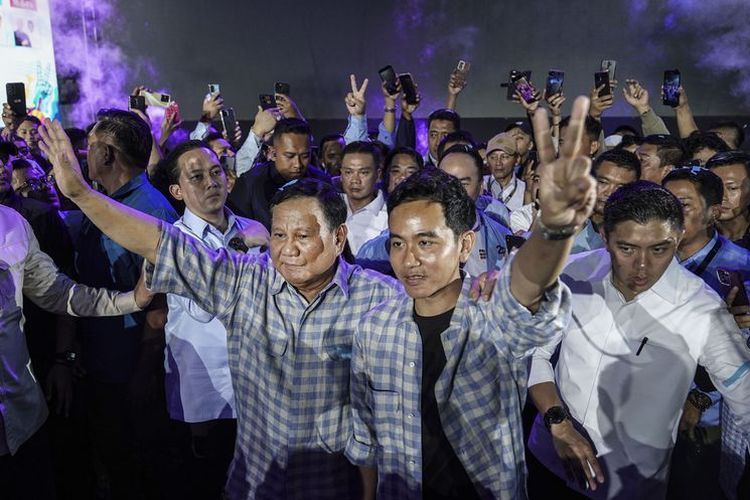
THERE are two events that occurred almost simultaneously on the night the Constitutional Court announced its ruling regarding the education qualification of Vice President Gibran Rakabuming Raka.
In Medan Merdeka Barat, Jakarta, the constitutional judges stated that they found no convincing evidence that Gibran possesses a high school diploma, but they could not disqualify him.
Meanwhile, in Kertanegara, Jakarta, President Prabowo Subianto hosted Joko Widodo, Gibran's father, in a closed-door meeting lasting two hours at Prabowo's invitation.
Earlier in the day, the Government Communication Agency announced that the President had fully handed the matter over to the judiciary.
Two days later, the Palace stated that it was still studying the ruling, requesting two to three days, and emphasized that Gibran’s legitimacy remained intact.
The Deputy Minister of State Secretary couldn't even confirm whether the President was aware of the ruling’s contents.
This sequence reflects a larger pattern than a single case. Prabowo's political strategy relies on two things: embracing and holding back words. The question is, where is this political direction heading, and who truly benefits?
Embracing is the most consistent feature of Prabowo's leadership. Almost all parties have joined the government, except for the PDI-P.
Former presidents are welcomed in turn. Anwar Usman, the Chairman of the Constitutional Court at the time of the 90 ruling, was appointed as a member of the Presidential Advisory Council just four days before Gibran's case was decided.
Benedict Anderson in his classic essay, The Idea of Power in Javanese Culture (1972), explains that in Javanese power dynamics, a powerful ruler is not one who eliminates adversaries but one who absorbs them into his orbit.
Prabowo, who did not originate from that tradition, seems most adept at navigating it.
The President's stance on the Constitutional Court ruling can be understood within this framework. There are no decisive statements backing Gibran, nor any distancing.
Thomas Schelling in The Strategy of Conflict (1960) indicates that ambiguous signals are often more valuable than clear ones, as they compel all parties to guess, while the sender remains free.
The Constitutional Court's ruling gives Prabowo a comfortable position. Gibran remains in office, maintaining stability, but his chances for 2029 weaken.
For a president, a vice president who persists but no longer poses a threat is the most manageable.
The Kertanegara meeting reinforces this interpretation. In 2024, Jokowi is the president who entrusted his son. Now, Jokowi comes for an invitation on the night his son is most vulnerable.
The message to coalition parties is conveyed without words. That message is that Gibran remains under the President's protection.
It is no surprise that Gerindra calls for all parties to move forward, while Golkar reminds that speculation about the ruling only disrupts the economy and investment.
This is where the inquiry driven by the PDI-P hits a wall. The President's silence gives Gerindra space to mitigate issues in Senayan.
However, the PDI-P's pressure is not entirely detrimental to Prabowo. As long as the inquiry remains a threat, Jokowi and his family become more reliant on the President's protection.
Thus, the opposition from the PDI-P inadvertently strengthens Prabowo's bargaining position against his own allies.
Alternative interpretations remain open. Prabowo may simply be loyal to the partner who helped him win or genuinely respect the separation of powers.
However, loyalty and respect require propriety. Dennis F. Thompson in Ethics in Congress (1995) reminds us that the public cannot see what happens behind closed doors, making appearances the only basis to judge officials’ honesty.
Hosting the father of a party currently under decision, right at the time the ruling was read, is not legal interference. However, this step tarnishes the impression of independence that the government itself claimed on the same day.
Is an embracing political strategy electorally safe? The surface numbers appear convincing.
A Poltracking survey in May 2026 recorded that 72.2 percent of respondents were satisfied with the government's performance, primarily supported by social aid and free nutrition programs.
However, the same survey also noted a downward and stagnant trend compared to previous periods (Kompas.com, 4/6/2026).
The deeper layers reveal more honesty. An INES survey in September 2026 indeed noted general satisfaction at 79.3 percent.
Nevertheless, satisfaction in the economic sector was only 50.8 percent, with more than half of respondents complaining about the difficulty of finding jobs, and 54.8 percent expressing concern over essential commodity prices (INES, 2026).
Another survey in the same month recorded satisfaction at only 57.6 percent. The public seems to evaluate the government from their kitchens rather than from the closeness of elites.
Edward Aspinall and Ward Berenschot in Democracy for Sale (2019) illustrate how Indonesian politics often operates on two floors.
On the upper floor, elites exchange support and positions. On the lower floor, citizens receive aid but rarely have a say in direction.
An embrace on the upper floor does not automatically translate into benefits on the lower floor. As long as the economy remains stagnant, such an embrace may be electorally neutral at best.
When the economy deteriorates, the same embrace can easily transform in the public eye: from unity to collusion.
Embracing certainly has value. The reconciliation post-2019 polarization, when Prabowo joined Jokowi's cabinet, was once celebrated as political maturity.
Stability facilitates policy implementation and distances the nation from division. However, reconciliation without accountability shifts to immunity.
The issue surrounding Gibran's diploma is the test. Does the President's embrace also shield violations of qualification requirements?
An embrace that only comforts elites while the prices of rice and job opportunities remain concerns does not meet the people's expectations.
Similarly, silence over the defects in the nomination verification process may calm the coalition but does not address the people's need for certainty that the rules apply equally to everyone.
Prabowo's political direction, therefore, is at a crossroads. He can leverage the strength of his embrace to reform institutions: ordering audits of nomination verifications, pushing for improvements in diploma equivalency systems, and maintaining appropriate distance from matters involving his allies' families.
Or he can continue to embrace everyone while leaving public questions hanging.
The first choice may make some allies uneasy. The second choice might feel safe today.
So the question is: for whom is this embrace actually extended, for a select few at the Kertanegara dining table, or for millions still calculating commodity prices in their kitchens?


























