

Prabowo: I Want to Confess, I’m a Soldier but Afraid of Doctors
-
News
-
8 minutes ago
This article was translated by AI. Read the original article on Kompas.com. See Original
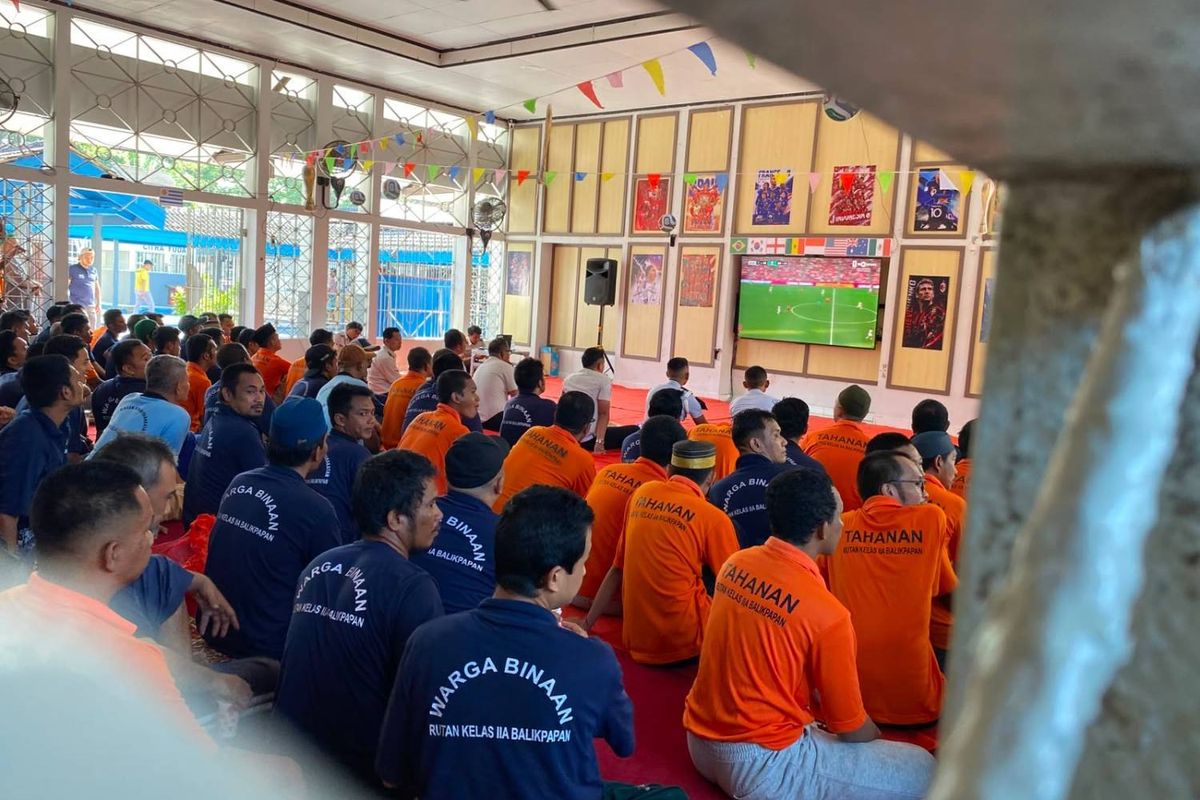
THERE is something intriguing about how we treat someone after they are sentenced. When prison doors close, it seems as if we assume their entire life has come to a halt.
Their freedom is stripped away, their mobility is constrained, and their social connections are severed from the life they once knew.
In public consciousness, punishment is often understood as the suffering one must endure for their actions.
However, amidst that belief, there is a question seldom discussed openly: does the removal of a person's freedom also necessitate the sidelining of their entire humanity?
This question finds relevance when Commission XIII of the Indonesian House of Representatives begins to raise the discourse on providing family booths and sexual aids for inmates.
On September 24, 2026, member of Commission XIII Yanuar Arif Wibowo advocated for the management of family booths as part of guidance and social reintegration.
Two days later, Commission XIII Chairman Willy Aditya discussed the fulfillment of sexual health needs of female inmates, including health education, alternative medical tools, safety, and privacy protection.
On September 30, Willy again proposed family booths and sexual aids in prisons. This discourse places an issue long considered taboo into a more open institutional discussion.
This initiative should be interpreted as a gateway for reforming the correctional system. Not because every proposal must be accepted without scrutiny, but because the state needs the courage to address tangible issues that may not always be comfortable for society.
Sexuality is a part of human life. However, within the confines of prison, it confronts borders of law, discipline, health, morality, and power.
Discussing it openly is a first step toward a more responsible understanding of this issue.
So far, debates about inmates often stop at questions of what is appropriate for them to receive.
Public attention is more readily drawn to the severity of punishment, the length of incarceration, or the strictness of oversight.
Little space is afforded to discussing how human life unfolds behind prison walls, including how one maintains relationships with their partner and family.
In fact, someone serving a sentence does not automatically lose their identity as a partner, parent, or family member. Their status as an inmate does not erase all the dimensions of humanity inherent in them.
Here, an anthropological perspective helps us see the issue more clearly. Prisons are not just buildings that separate individuals from society, but institutions that regulate daily life.
Time, space, interaction, and personal relationships are all structured under surveillance. In Erving Goffman’s concept of total institutions, the lives of inhabitants in such institutions are shaped by governance regulating various aspects of their existence.
Meanwhile, Michel Foucault illustrates how the body becomes part of disciplinary and power mechanisms.
Both perspectives raise an important question: to what extent do restrictions on the body become part of punishment, and how does the state ensure that these restrictions do not undermine human dignity?
Family booths, in this context, should not merely be understood as spaces to fulfill biological needs. They can be discussed as part of efforts to maintain relationships that may experience strain during incarceration.
Distance, limited meeting times, lack of privacy, and economic burdens can affect relationships between partners. However, the impact is certainly not uniform across families.
Therefore, attention should not only focus on the existence of facilities but also on how the needs of inmates and their partners are understood, how both parties’ consent is ensured, and how access to those facilities is managed fairly.
The same holds true for discussions around sexual aids. This issue should not be inflated into sensational debates about inmates’ sexual behavior.
More crucial is how individual needs, health, privacy, and safety can be integrated into a framework of responsible policy.
If these issues remain wholly concealed, institutions miss the chance to understand the real risks and needs.
Conversely, if discussed openly, the state has room to examine health standards, usability, proportional oversight, and protections for inmates.
Of course, not every need can be directly translated into a right to specific facilities. Policy proposals still require legal grounding, medical studies, readiness of facilities, and security considerations.
There are also issues that must not be overlooked: how to ensure that facilities are accessible not only to inmates with money or influence?
How to protect women and vulnerable groups from pressure? How to maintain confidentiality and prevent abuse of power?
These questions are not reasons to halt discussions, but rather, they are crucial components of the process of designing viable policies.
Here, the Indonesian House of Representatives plays a significant role. The courage to bring the sexual issues of inmates into public discourse needs to be accompanied by diligent oversight and measurable policy formulation.
Political statements alone are not sufficient. The government, through the ministry responsible for corrections, must assess needs, establish accountable mechanisms, and ensure that each policy is implemented within the framework of prevailing laws.
It is also essential to distinguish between proposals currently being discussed and policies that have been formally instituted.
As it stands, this discourse should be understood as a discussion agenda, not as evidence that these facilities have become national policy.
Furthermore, this issue should prompt us to reconsider the very meaning of incarceration.
If the goal of corrections is to prepare inmates for reintegration into society, then guidance should not only include job training, education, or religious activities.
Social relationships and the ability to maintain family responsibilities should also be priorities, without neglecting the needs of victims, the rights of others, and the obligations of inmates to serve their sentences.
Social reintegration is not just about physically returning someone to society, but also about preparing the conditions for them to rebuild their social life responsibly.
We need to move away from the notion that attending to inmates’ needs equates to leniency in punishment.
Criminal justice and respect for human dignity are not two concepts that must negate each other.
An individual must still be held accountable for their actions, while the state remains obligated to implement corrections humanely, safely, and non-discriminatorily.
Punishment restricts freedom based on law; it should not be an excuse to cease critical thinking about all the human needs that still live within it.
Ultimately, the discourse on family booths and sexual aids opens a larger conversation than the facilities themselves.
It tests how we perceive individuals who have committed legal violations: are they solely defined by past mistakes, or are they human beings with the potential to improve their lives?
The answer to that question will shape how we design the correctional system, not merely how we treat them while they are behind bars.
Therefore, the House of Representatives' initiative to raise this issue deserves to be progressed into serious, evidence-based, and open policy discussions.
Not by ignoring the law or sidelining public voices, but by ensuring that every decision has a clear basis and sufficient protections.
After all, the measure of humanity within a correctional system is not only evident in how tightly it locks the doors but also in how it safeguards human dignity behind those doors.
Someone may lose their freedom due to the law, but the state's duty is not to erase their humanity.


























