

Habiburokhman Requests Ban on 4 Bullying Suspects in Malang from Taking Exams: No Special Treatment!
-
News
-
22 minutes ago
This article was translated by AI. Read the original article on Kompas.com. See Original
JAKARTA, KOMPAS.com - The revision of the Copyright Bill (RUU) will be discussed by the Indonesian House of Representatives (DPR RI) and the government after the DPR's recess in November 2026.
This bill is targeted for completion by December 17, 2026, at the latest.
So, what regulations will be included in the Copyright Bill?
Deputy Minister of Law Edward Omar Sharif Hiariej stated that the government is preparing an inventory list of 1,117 issues related to the Copyright Bill.
Of these, 558 issues are permanent, 91 are amended or substantive, 143 are proposed for deletion, 181 are new substance, and 144 are editorial.
During a working meeting with the Legislative Body (Baleg) of the DPR at the Parliament Complex in Jakarta on Tuesday (October 6, 2026), Eddy explained that the revision of the Copyright Act is necessary because the regulations have been in effect for over a decade.
Therefore, adjustments are needed to accommodate developments in law, technology, and societal needs.
“This renewal is aimed at building a fair, competitive copyright ecosystem, providing legal certainty, and placing intellectual property as one of the pillars of national progress,” said Eddy Hiariej.
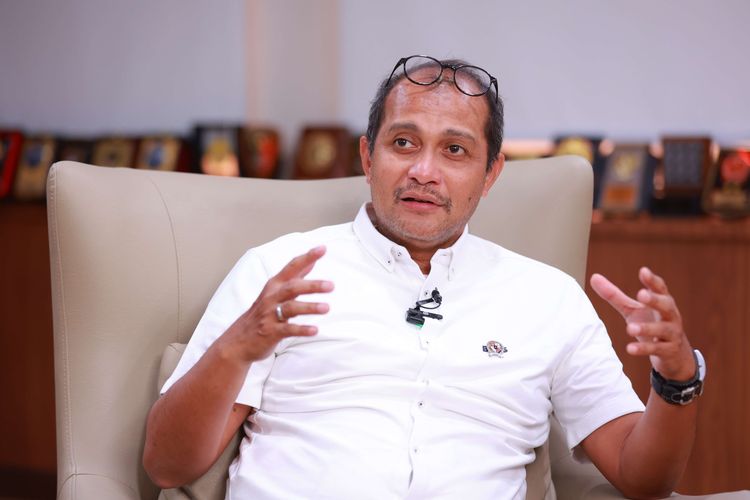 Deputy Minister of Law Edward Omar Sharif Hiariej poses after being interviewed by Kompas.com at the Ministry of Law in South Jakarta on Thursday (January 8, 2026).
Edward mentioned that the government proposes adjustments to the institutional framework of Collective Management Organizations (LMK) and the National Collective Management Committee (KMKN), including updates to the management system and governance of royalties.
“First, we focus on the institutional framework of the LMK and KMKN, including updates to the management system and governance of copyright royalties, both for works in music and other fields,” said Edward.
Additionally, the government is proposing regulations for an endowment fund for royalties to enhance governance and sustainability in royalty management.
Furthermore, discussions are expected to include the legal status of works produced with the assistance of or entirely by artificial intelligence (AI) systems.
The government is also encouraging the strengthening of the involvement of media companies and the protection of journalistic works in copyright issues.
“Strengthening the involvement of media companies and protection for journalistic works is part of adapting to developments in the media industry and the digital ecosystem,” he stated.
The draft Copyright Bill proposes regulations requiring event organizers to pay a minimum of 25% royalties before the performance takes place.
This provision is included in Article 10 of the draft Copyright Act, which was presented during the harmonization working committee (panja) meeting of the Legislative Body (Baleg) on January 20, 2026.
Next, Article 10, paragraph (2) stipulates that these royalties must be paid before the performance by submitting a request for royalty rate approval to KMKN for at least 25% of the total performance royalty rate.
The remaining royalty payments must be completed after the performance has taken place.
Article 10 of the draft Copyright Bill regulates that royalties must be fully paid within a maximum of 30 days after the performance.
“Event organizers must settle the royalty payment as referred to in paragraph (1) no later than 30 (thirty) days after the performance is completed,” reads paragraph (3) of Article 10 in the draft, as explained by the Baleg DPR on January 20, 2026.
Meanwhile, the Chair of the Copyright Bill panja at Baleg DPR RI, Martin Manurung, stated that the Bill will strengthen protections for creators, copyright holders, and related rights owners, including those of journalistic works.
“In general, this Copyright Bill aims to: A, adapt regulations to the era of digitalization and technological transformation. B, provide optimal protection for creators, copyright holders, and related rights owners, including in journalistic works,” Martin said on Tuesday (October 6, 2026).
The bill will also govern the obligations and responsibilities of digital platforms in preventing copyright violations, protecting expressions of traditional cultural heritage, as well as AI-based creations.
Additionally, materials will include economic rights, broadcasting institutions, media companies, fair use, copyright and related rights duration, licenses, royalties, Collective Management Organizations (LMK), disputes and law enforcement, as well as criminal provisions.
Board member of the Press Council, Dahlan Dahi, explained that journalistic works used for commercial purposes must pay royalties to the collective management organization (LMK).
“So royalties are paid to a single organization known as the collective management organization. That is the term used in the draft law,” said Dahlan on June 23, 2026.

























