

Klaten Chicken Soup Amidst Hamenang Corruption Case
-
News
-
12 minutes ago
This article was translated by AI. Read the original article on Kompas.com. See Original
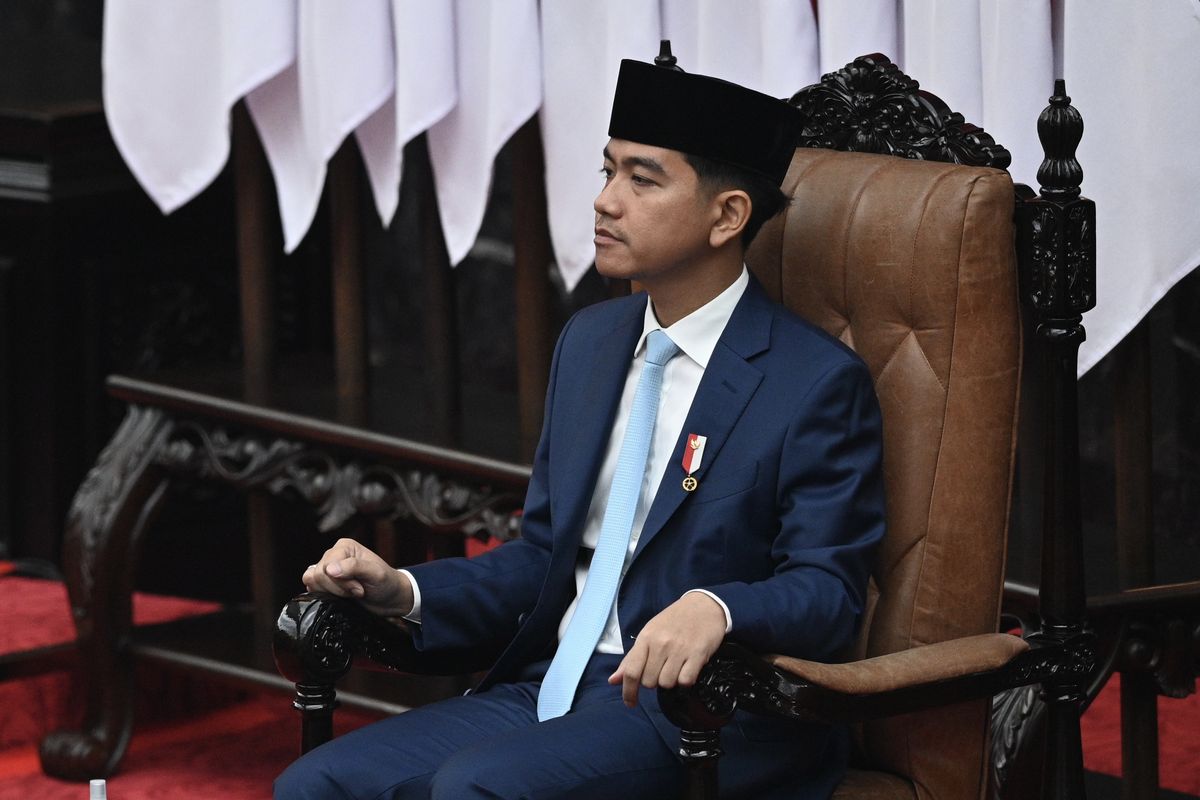
CONSTITUTIONAL Court has concluded the case regarding the educational qualifications of Vice President Gibran Rakabuming Raka with a ruling that sounds ordinary: the petition is not accepted.
However, behind that ruling lies reasoning that is far from ordinary. The Court stated it found no convincing evidence that Gibran possesses foreign diplomas equivalent to a high school graduation, while simultaneously confirming that it cannot disqualify him since the electoral dispute regime has ended with his inauguration on October 20, 2024.
This decision has given rise to a paradox. Both sides celebrate. Gibran's supporters are relieved that his position is unscathed, while the petitioners are pleased because the facts they presented were acknowledged by the judges.
This very paradox needs to be analyzed clearly. Legally, Gibran is safe. Yet in terms of legitimacy, he bears a burden that will not dissipate merely because the ruling did not state disqualification.
This article begins from a simple thesis: Gibran's fate is no longer determined in the courtroom but in the political and ethical arena.
More importantly, this case is not solely about the fate of one individual. It reflects how cleanly the state conducts processes that shape Indonesia's direction.
From a legal standpoint, Gibran's position is indeed strong. Mahfud MD had long warned that the Court does not have the authority to disqualify someone who has already been elected, and the validity of educational documents falls under the jurisdiction of administrative law.
The actions and policies of Gibran during his tenure are also deemed valid based on the principle that officials' decisions are considered correct until overturned.
In the end, the Court chose a path predicted by Mahfud: acknowledging the factual considerations without imposing consequences in the ruling.
For his supporters, this ruling also affirms that the lawsuit was filed too late and by non-participants of the election, concluding the narrative around the annulment of results here.
Zainal Arifin Mochtar reads between the lines. He sees this case as an opportunity for the Court to repay its “debt” from Ruling 90, which allowed Gibran to pass based on an age limit interpretation, ultimately leading to the removal of the Court's chairman at that time.
Using his metaphor, the debt has only been partially repaid. The Court acknowledges there is a problem, but its resolution is delegated to other institutions.
The practical implication, according to Zainal, is that Gibran's path to 2029 is nearly blocked, unless he can present his diploma.
This raises the most pressing question: is this fact sufficient for impeachment?
Article 7A of the 1945 Constitution provides two relevant doors: “no longer meets the requirements” and “unseemly conduct.” Both are not easy to navigate.
The phrase “no longer” presupposes that the originally fulfilled requirements have since dissipated, not that the requirements have been questioned from the outset.
As for unseemly conduct, which in the Court's law is interpreted as actions that degrade the dignity of the position, it demands proof of awareness: did Gibran know his documents were inadequate but still used them?
Gibran's defenders have arguments that cannot be overlooked. The equivalency letter was issued by the ministry and accepted by the Election Commission, making the flaws more attributable to the issuer and the verifier.
The Court's consideration also states “did not find evidence,” which logically in terms of proof does not equate to establishing the intention to deceive.
This finding also arises from a case where the petitioners were declared to lack legal standing.
Conversely, critics can counter that the seeker of equivalency is Gibran himself, making it reasonable to assume he knows what was attached and what was not.
The suggestion of a Package C program floated by some reveals a similar dilemma.
Legally following that equivalency program does not constitute acknowledgment, nor does it rectify the flaws from 2024 since candidate requirements are assessed at registration.
However, politically that move is almost certainly interpreted as a silent admission.
Not taking it means closing the door to 2029; taking it means bearing public interpretation.
Meanwhile, the route to impeachment requires two-thirds support in the House of Representatives and the People's Consultative Assembly, a threshold hard to meet as long as the government's supporting coalition remains solid.
Too much focus on Gibran's fate could mislead attention.
The more fundamental question is how a candidate can pass without convincing evidence of graduation.
The chain is long, involving the Court's ruling leading to severe ethical sanctions, a stern warning from the DKPP to the leadership of the Election Commission in the same registration, disputed nominations, equivalency letters without basic documents, and verification that was confirmed not to have directly checked diplomas during the hearings.
This is not the error of a single table but a cascading failure.
Guillermo O'Donnell termed this phenomenon as weak horizontal accountability, where state institutions that should oversee each other instead enable one another.
Ethical sanctions, warnings, and acknowledgments of negligence are proliferated across various institutions but never converge into a comprehensive corrective action.
Steven Levitsky and Daniel Ziblatt added that democracy is not only safeguarded by written rules but also by the willingness of power holders to restrain themselves.
Throughout this case, that willingness to hold back seems to have been absent.
The stakes are greater than a single position. Indonesia was not born of conquest but of consent.
The mandate given by Sultan Hamengkubuwono IX and Paku Alam VIII on September 5, 1945, followed by various other sultanates and kingdoms, illustrates that this republic is built on the agreement to coexist.
Ernest Renan described a nation as a daily plebiscite: the willingness to remain united must be continuously renewed.
The fuel for this is the belief that the state is managed honestly and that rules apply equally to everyone, including the children of the powerful.
The realistic threat, indeed, is not territorial disintegration in the near future.
The threat is more subtle: erosion of trust. When citizens see requirements can be manipulated and monitors bypassed, the bonds of nationality gradually lose their substance.
Here the irony feels sharp. The Preamble to the 1945 Constitution has made “educating the nation's life” one of the objectives of the state, while the state stumbles on verifying the diploma of its leader.
The vision of Indonesia Golden 2045 will not stand on infrastructure and downstreaming alone.
It requires certainty that institutions work straight, as investors, bureaucrats, and citizens read the same signals questioning whether rules can be bent for power?
Ultimately, Gibran's fate is a personal matter and political choice, such as choosing to step down, endure, pursue Package C, or face processes in the House.
The fate of the republic is a shared matter. If this case merely ends with who wins and who loses, this nation loses its most important lesson.
Improving nomination verification, overseeing diploma equivalency, and restoring the ethics of judicial institutions are far more decisive for the future than one vice-presidential seat.
Thus, the question should be directed to those holding the keys: will the Election Commission, ministries, and the House dare to acknowledge negligence and correct it, or will we watch the same drama unfold again as 2029 approaches?

















