

Habiburokhman Requests Ban on 4 Bullying Suspects in Malang from Taking Exams: No Special Treatment!
-
News
-
34 minutes ago
This article was translated by AI. Read the original article on Kompas.com. See Original
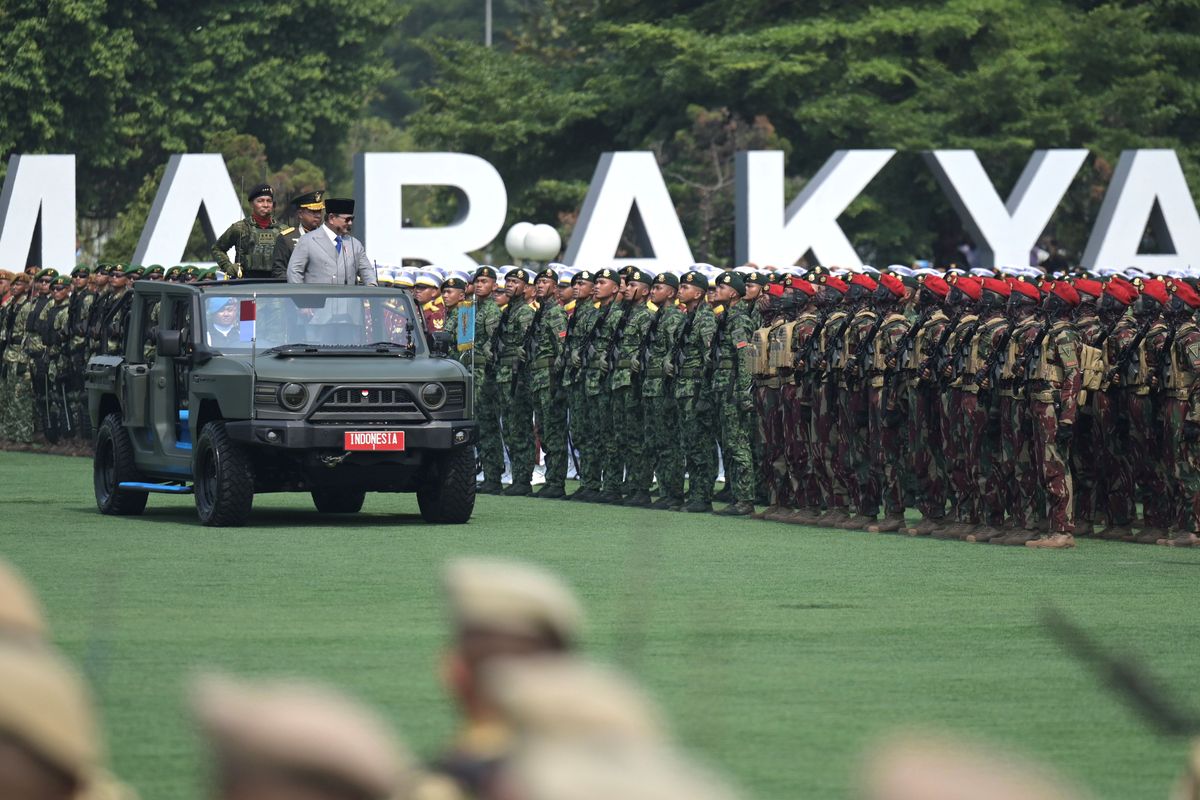
ON the commemoration of the 81st anniversary of the Indonesian National Armed Forces (TNI) on October 5, 2026, President Prabowo Subianto inaugurated 204 new TNI units.
This expansion includes six Regional Military Commands (Kodam), 30 Territorial Development Infantry Brigades, 150 Territorial Development Infantry Battalions, as well as several new units within the Navy and Air Force.
The six new Kodam are located in the Riau Islands, Special Region of Yogyakarta, East Nusa Tenggara, North Maluku, Central Papua, and West Nusa Tenggara.
The scale of this expansion indicates that the development of defense capabilities is entering a new phase.
However, because it is so extensive, it raises an academically valid question: Does a larger TNI organizational structure automatically mean a stronger defense for Indonesia?
This question does not suggest that Indonesia does not need a strong TNI. On the contrary, Indonesia needs a TNI that is increasingly strong, professional, modern, and capable of facing an increasingly complex strategic environment.
The challenge lies in how to build that strength. In the 21st century, the size of military organizations does not always correlate with military effectiveness. This is a crucial point for evaluating the logic behind TNI's expansion.
In defense studies, Stephen Biddle in his book “Military Power” illustrates that victory in modern warfare is not solely determined by the number of troops or the sophistication of weaponry.
How that strength is employed, how doctrine is applied, how units operate, and how various combat capabilities are integrated are critical factors influencing military effectiveness.
In other words, having more battalions does not automatically lead to greater deterrence. More bases do not inherently translate into higher defense capability.
The key factor is whether the additional structure provides genuinely needed operational capabilities.
Barry Posen's thoughts in “The Sources of Military Doctrine” are also relevant. According to Posen, doctrine and military development do not emerge in a vacuum.
Both are influenced by a state's strategy, military organization, technology, geography, and security environment.
Therefore, changes in the character of threats should also affect how a country builds its military strength.
This issue becomes particularly intriguing for Indonesia. Modern warfare is increasingly moving towards network-based combat, leveraging sensors, artificial intelligence, drones, satellites, electronic warfare, cyber warfare, precision strikes, and rapid decision-making.
The Ministry of Defense has recently emphasized the importance of interoperability, information sharing, situational awareness, and command and control capabilities in the context of modern warfare.
This indicates that Indonesia recognizes technology and networks as vital components of its future defense strategy.
However, if the character of warfare is changing, the next question is whether the structure of military power is evolving with the same logic.
Indonesia encompasses vast territory made up of thousands of islands. Yet, extensive territory does not always necessitate more command structures.

























