

Bakom RI Dismisses Ulta Levenia Since November 1, 2026
-
News
-
10 minutes ago
This article was translated by AI. Read the original article on Kompas.com. See Original
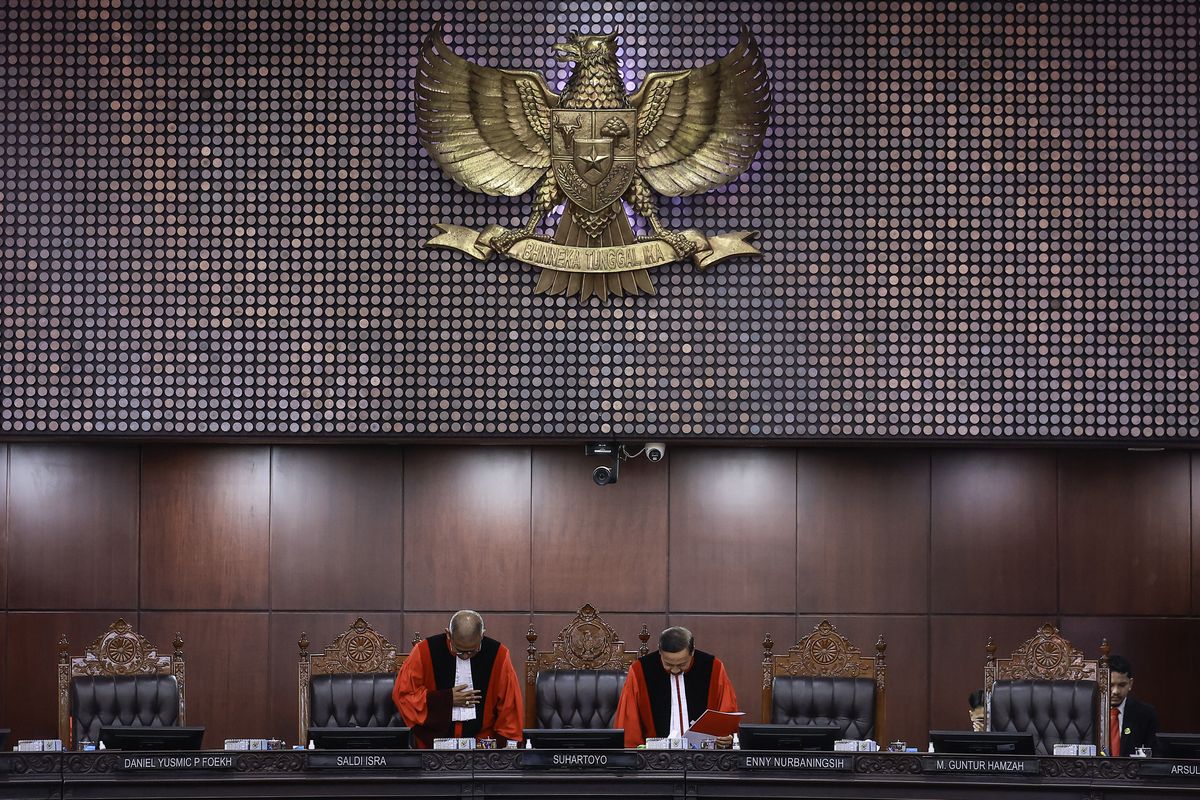
THE Constitutional Court stated that it found no convincing evidence showing that Gibran Rakabuming Raka possesses a diploma, certificate, or foreign educational degree that could be used as a basis for equivalence with at least a high school education (Constitutional Court, 2026).
However, the application was not rejected. It was declared inadmissible. Gibran remains the Vice President.
This did not occur because the Court examined all substantive claims and ruled that the educational qualifications lacked legal basis.
The case Number 01/PHPU.PRES-XXIV/2026 stopped at the legal standing issue: the applicants were not presidential or vice-presidential candidates entitled by law to file election result disputes.
Thus, that night, the law seemed to open a window, reveal something, and then close the door.
Franz Kafka wrote Before the Law: a man from the village comes to the door of the law. He wishes to enter.
The gatekeeper does not say that the door will be closed forever. He just says: not now. The man waits. For years.
Indeed, legal standing is no trivial matter. It determines who has the legal right to knock on the court's door. Without such limits, the court could become a space for anyone to litigate any issue.
However, public concerns do not always end when procedural doors are closed. The Election Law uses simple language in the requirements for presidential and vice-presidential candidates: “completed” high school, MA, vocational school, or equivalent.
That word seems small, yet law often hinges on small words.
During the hearings, it was revealed that an educational equivalency certificate is neither a diploma nor the process of issuing a passing certificate.
The Ministry of Education explained that the original educational documents still originate from the respective educational institutions (Constitutional Court, 2026).
The Court then stated it did not acquire convincing evidence in the form of a diploma, certificate, or foreign educational degree that could serve as the basis for equivalency.
Documents like a certificate of attendance indicate presence in an educational process, but are not themselves proof of graduation (Constitutional Court, 2026). Here, the paper begins to cast shadows.
However, another fact cannot be hidden. The Management Development Institute of Singapore officially stated that Gibran was a full-time student at MDIS from 2007 to 2010, completing an Advanced Diploma, and later obtaining a Bachelor of Science (Honours) in Marketing from the University of Bradford (MDIS, 2025).
Thus, this matter cannot honestly be reduced to the accusation that Gibran never attended college or that his degree does not exist.
The issue is narrower, and indeed more complicated: how is the minimum education requirement of a vice-presidential candidate evidenced?
PKPU Number 19 of 2023 provides an exception. A prospective presidential or vice-presidential candidate lacking proof of high school graduation from a foreign school is not required to submit it if they possess proof of higher education completion (KPU, 2023).
This gives rise to an administrative paradox. The legal requirement is completing high school or its equivalent. However, administrative proof of that requirement can be waived if someone has proof of education that comes after high school.
Perhaps there is no administrative violation inherent in that. Former KPU Chairman Hasyim Asy'ari stated that such provisions were not created to facilitate specific candidates but originated from input from the Ministry of Education (Constitutional Court, 2026).
However, norms do not only live by the intentions of their makers. They also live by the consequences they bring. And sometimes the effects of an administrative exception become apparent only when it encounters a concrete case.
Soon after the decision was read, the complexity was easily distilled into a common question: “So, no high school diploma was found, but he remains Vice President?”
Legally, that question is too simplistic.
The Constitutional Court never ruled that Gibran did not meet the educational requirements. The finding that certain evidence was not obtained does not equate to a decision that the substantive requirement was unmet.
However, therein lies the public's agitation.
The legal language works with categories: authority, legal standing, evidence, decision decree. Public language works with something more instinctive: so, what really happened?
The chasm between those two languages is sometimes wider than the courtroom.
India once grappled with a similar issue regarding candidates' educational information. In broader Indian election jurisprudence, transparency regarding candidates is framed as a voter’s right to obtain information; the case Mairembam Prithviraj v. Pukhrem Sharatchandra Singh demonstrates how seriously false claims about education can be treated (Supreme Court of India, 2016).
Because elections are not merely about whether a box on a form has been checked. They are also about trust.
In Indonesia, the Constitutional Court's ruling on October 6, 2026, does not imply that the Court declared Gibran did not meet educational qualifications. That is too far a conclusion.
However, the ruling also does not yield a substantive answer that resolves all the questions.
The case stopped primarily on the issue of who has the right to submit it. This is where the distinction between inadmissible and rejected becomes important. The former speaks to the entrance. The latter concerns the content.
And we, that night, still stood at the threshold.
In Gustav Radbruch's thoughts, law is always in tension between certainty, utility, and justice. Not always do all three arrive simultaneously.
Sometimes certainty comes first. Justice, or at least the public’s curiosity about it, lags a few steps behind.
Now the state has a decision. Gibran remains the Vice President. The nomination mechanism has worked. The PKPU has been implemented. The court decision has been read.
Legally, the matter is concluded. Yet, the law can produce a final answer to a case without yielding a final answer to the questions that gave rise to the case.
Perhaps therein lies the difference between law and trust. Law requires authority, procedures, deadlines, and legal standing. Trust often asks for something much simpler.
The law can uphold the certainty of a position. However, trust seeks something simpler, and often more difficult: a piece of evidence that requires no shadows to explain it.



















