


Habiburokhman Requests Ban on 4 Bullying Suspects in Malang from Taking Exams: No Special Treatment!
-
News
-
1 minute ago
This article was translated by AI. Read the original article on Kompas.com. See Original
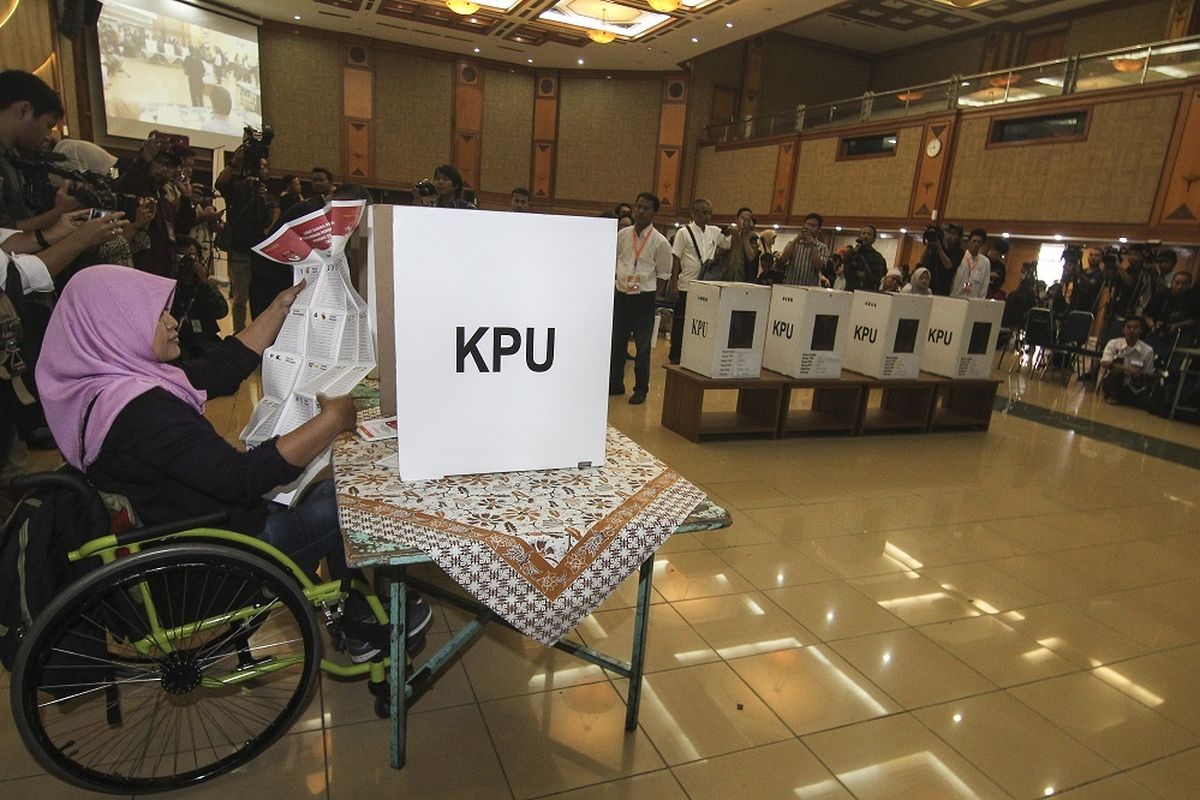
REVISION of the Election Law, which is included in the National Legislative Program and is targeted for discussion by Commission II of the DPR at the end of 2026, reopens the discussion on the political rights of persons with disabilities. On paper, the guarantees are already complete.
The Constitution guarantees non-discrimination, Law Number 8 of 2016 affirms the right to vote, to be elected, and to be an election organizer, and Indonesia has ratified the Convention on the Rights of Persons with Disabilities through Law Number 19 of 2011.
The Constitutional Court even expanded that guarantee to include the voting rights of persons with mental disabilities through Decision Number 135/PUU-XIII/2015.
What remains unresolved is the gap between recognition and the obligation to fulfill it. The right to vote or be elected can only be exercised when the state provides suitable accessibility and accommodations, while that obligation has yet to be formulated as a binding norm.
This gap is evident when elections are viewed from three positions of persons with disabilities: as voters, as candidates, and in front of the organizers.
As Voters
Data from the General Election Commission shows a regression in numbers. The registered disabled voters decreased from 1,247,730 in the 2019 elections to 1,101,178 in 2024.
In reality, their potential is estimated to exceed 14 million people, meaning that only about 8 percent have been recorded.
This decline, despite the expansion of legal guarantees, is more reasonably seen as a failure in data collection rather than a shrinking population.
Intellectually disabled individuals, the most vulnerable group, made up only about 5 percent of registered disabled voters in 2024.
The root of the problem lies in the norms, as the regulations on the voter list in the Election Law do not require the recording of various disabilities, and the recap report only includes gender.
Without this data, voters' needs cannot be legally translated into assistive tools, designs for polling stations, or socialization strategies.
This burden has increased following the Constitutional Court Decision Number 130/PUU-XXIII/2025, which expanded the scope of physical disabilities to include individuals with chronic illnesses with significant functional impairments through voluntary medical assessments.
This new group requires adjustments in data and accommodations, while the existing systems are still unable to capture the widely recognized variants.
The impact is felt on polling day. The Election Supervisory Body (Bawaslu) recorded 25,769 polling stations without Braille templates in 2024, and monitoring by the Disability Voter Assistance Program found that Braille voting aids were only available in about half of the polling stations.
Studies by Lisa Schur and colleagues (2002 and 2017) show that polling station accessibility is directly linked to the participation of disabled voters, making tools like these a prerequisite for exercising their voting rights.
However, the standards still rely on implementing regulations without clear sanctions, while unregulated assistance threatens the confidentiality and autonomy of voting.
As Candidates
In the position of participants, barriers are written into the law itself. The phrase “physically and mentally healthy” appears in several candidacy requirements, including Article 169, 182, and 240 of Law Number 7 of 2017.
The explanation of the articles states that physical disabilities do not categorize as incapacity, yet the standards still measure health rather than the ability to perform duties.
Such standards open the doorway to discriminatory interpretations. In the 2019 elections, a wheelchair-using legislative candidate was deemed ill by medical staff, despite the fact that their condition stemmed from an accident and did not affect their work ability.
A more appropriate formulation already exists in Article 169(g), which states “able physically and mentally to perform the duties,” so what is needed is alignment of the norms.
However, removing a single phrase is not enough. More structural barriers exist beyond the health examination table, such as the high costs of a political system reliant on open proportional representation, limited access to party structures, and persistent stigma.
This combination of barriers is reflected in the near absence of representatives with disabilities in the DPR RI.
This situation does not reflect a lack of public support. In the DPD pathway, which does not go through parties, a candidate from West Java garnered approximately 313,000 votes, ranking 13th out of 43 candidates despite running at their own expense.
One case may not be sufficient for a conclusion, but this contrast indicates that the main barriers lie at the nomination door controlled by parties.
Thus, the right to be elected needs affirmative policy support, as argued by Prasetio, Masnun, and Widodo (2025).
This idea aligns with The Bill of Electoral Rights for Citizens with Disabilities from the International Foundation for Electoral Systems (2002), which asserts that disabilities should not serve as a basis for restricting political rights.
In the Hands of Organizers
Organizers design data collection, prepare polling stations, compile informational materials, and enforce candidacy requirements.
As long as accessibility is understood as an add-on facility relying on leftover budgets and staff initiative, its fulfillment will continue to be unequal across regions and phases.
Many accessibility guarantees are also regulated only in KPU Regulations, which can be altered by the organizers without a legislative process, thus weakening their binding nature.
In fact, most barriers arise long before polling day, beginning with inaccurate data collection, inaccessible information, and narrowing candidacy requirements.
The phrase “physically and mentally healthy” even appears in the recruitment requirements for organizers in Articles 21, 72, and 117. Yet, Article 13 of Law 8/2016 guarantees the rights of persons with disabilities to be organizers and overseers of elections.
One norm closes two doors simultaneously: both running as candidates and conducting elections from within.
On the enforcement side, complaint mechanisms are not yet available in an accessible format, and sanctions for failing to provide accessibility are not stringent.
Bawaslu's supervision is also hindered by the absence of an accurate disability database, while ethical enforcement has yet to consider neglecting accessibility as a violation.
The revision of the Election Law needs to elevate several guarantees from implementational regulations to the statutory level.
Among them, the obligation to record various disabilities in voter data, health requirements based on the ability to perform duties as per the model of Article 169(g), and specific nomenclature for accessibility budgets so they are no longer treated as additional expenditure.
Accessibility guarantees, suitable accommodations, and non-discrimination must be raised from principles in the preamble to binding norms that can be enforced throughout the electoral cycle, from data collection to dispute resolution.
When the nomination space is truly open, political parties can no longer treat disabled voters and candidates as mere complements.
Treating accessibility as charity positions individuals with disabilities as those waiting to be given.
In contrast, treating it as a legal obligation recognizes them as citizens entitled to a fair election designed from the start.
The revision of Law Number 7 of 2017 is an opportunity to ensure that the rights of persons with disabilities are guaranteed from the moment the regulations are drafted, whether when voting, running for office, or participating in the conduct of elections.

























