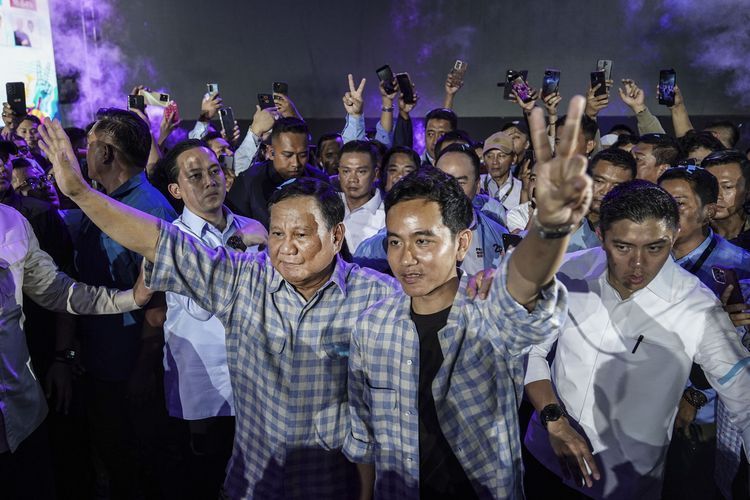


Prabowo: I Want to Confess, I’m a Soldier but Afraid of Doctors
-
News
-
9 minutes ago
This article was translated by AI. Read the original article on Kompas.com. See Original
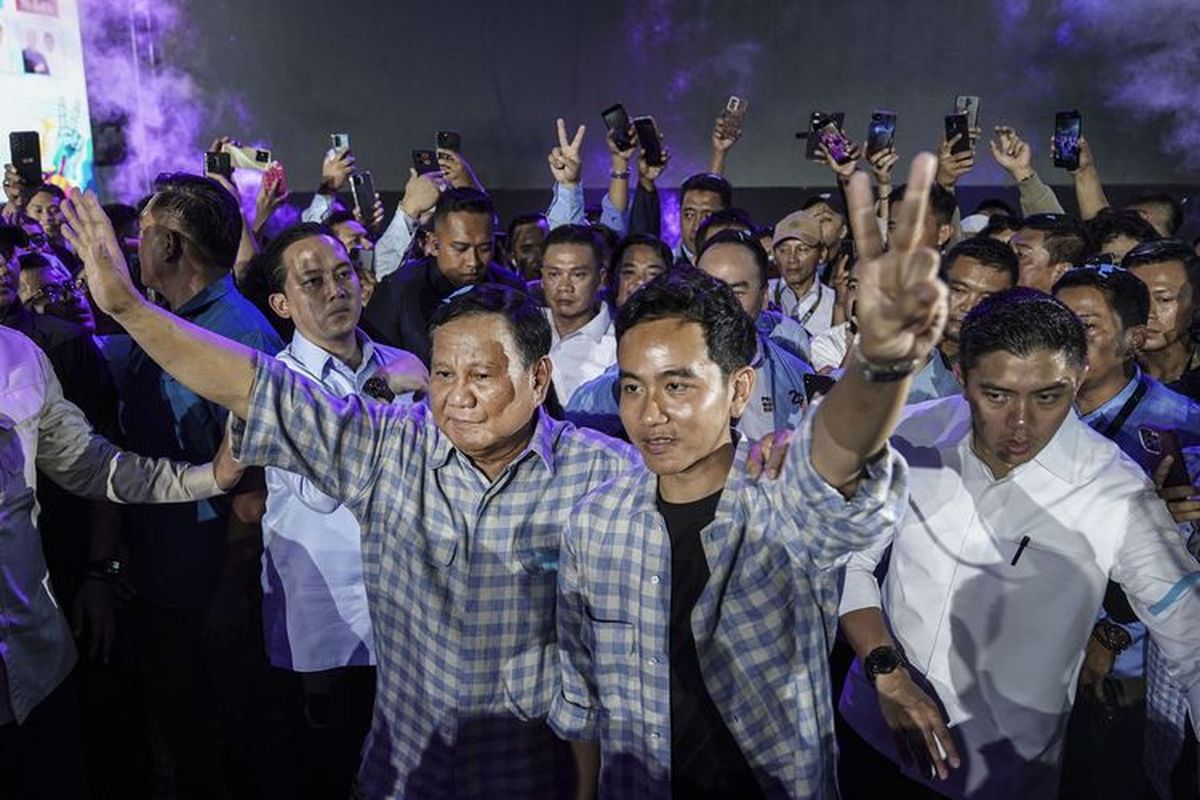
“The conflict between justice and legal certainty must be resolved by prioritizing legal certainty, unless the contradiction reaches an unbearable level.” — Gustav Radbruch (1946).
THIS STATEMENT by Gustav Radbruch resonates anew following the Constitutional Court's (MK) conclusion in the case Number 01/PHPU.PRES-XXIV/2026.
The trial, commonly known as the “Gibran Vice Presidential Diploma Dispute”, ended with a simple yet tumultuous ruling: the applicants' petitions were deemed inadmissible.
However, interpreting the verdict solely based on the ruling overlooks a more significant issue. The MK not only closed the case.
The MK allowed room for examination of the issues. Yet, once these issues emerged, the law appeared to lack a clear path for resolution.
This is where Vice President Gibran is not truly alone. He finds himself in the midst of a classic legal dilemma: legal certainty versus justice.
In this case, legal certainty demands resolution while justice insists that alleged shortcomings should not cease to be addressed simply because time has elapsed.
In this matter, the applicants alleged that Gibran's vice presidential candidacy was flawed due to educational requirements. The MK stated it has the authority to examine the case, even though the petition was submitted long past the PHPU deadline.
The rationale is that there existed a “special circumstance” that, according to the MK, has never been contested in the case PHPU of the President for 2024, thus requiring prior examination.
The MK based this approach on the principle of ius curia novit: courts must not reject cases merely because the law is absent or unclear (MK, 6/10/2026).
This measure is significant. It demonstrates that electoral justice cannot always be confined to procedural timetables.
The MK reminds us that its role is not just to tally votes. Beyond that, it ensures elections are conducted directly, openly, fairly, secretly, honestly, equitably, and periodically.
We know that electoral justice encompasses the protection of both the right to vote and the right to be elected (MK, 6/10/2026).
However, this opening of the examination raises a secondary issue. After reviewing the substance, the MK discovered troubling facts.
The MK did not find convincing evidence that Gibran possessed a diploma, certificate, or degree that qualifies him as equivalent to high school level or its equivalent.
The Certificate of Attendance used in the equivalency process was deemed insufficient proof of graduation.
Moreover, the phrase “considered to have equivalent knowledge” in the equivalency certificate does not equate to “having at least completed school” as stipulated in Article 169 letter r of the Election Law (MK, 6/10/2026).
Nonetheless, this finding did not lead to disqualification. This is where the logic of the ruling becomes intriguing.
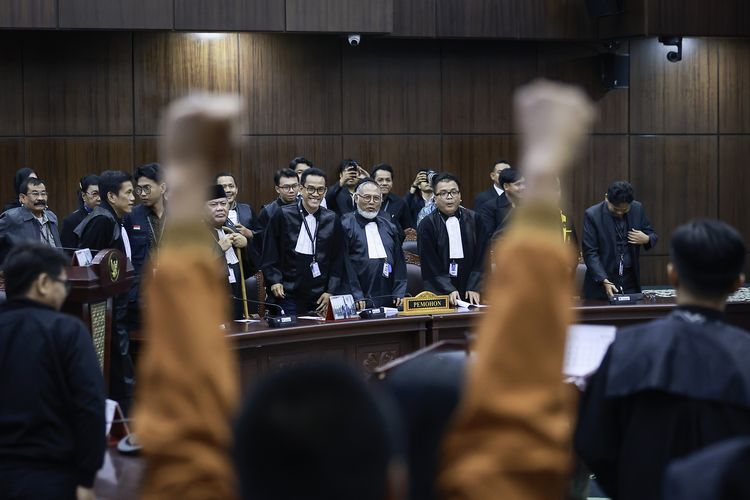 Expressions of several applicants after attending the ruling session of the Presidential and Vice Presidential Election Results Dispute (PHPU) concerning the validity of Vice President Gibran Rakabuming Raka's educational requirements at the MK building, Jakarta, Tuesday (6/10/2026). The Constitutional Court judges stated that the lawsuit regarding the validity of Gibran Rakabuming Raka's educational requirements when he was a vice presidential candidate in the 2024 election, filed by Denny Indrayana and others, was inadmissible.
With the end of the electoral phase, the case is no longer appropriately placed within the PHPU framework to revoke Gibran's position as Vice President (MK, 2026).
In this regard, prominent legal scholar Gustav Radbruch aids in understanding this tension. In his theoretical horizon regarding the three objectives of law—justice, legal certainty, and utility—legal certainty is not in conflict with justice.
Legal certainty is indeed part of justice because laws must be reliable and not change according to circumstances.
It is also crucial to understand that certainty should not serve as a pretext for upholding injustices that have reached an unbearable level (Radbruch, 1946).
The issue at hand, however, deals not with evidently unjust laws but two equally legitimate demands: the finality of electoral stages and the necessity to correct potential candidacy flaws.
Finality is essential so that elections have a definitive endpoint. Without it, every defeat could be revived years later.
Nonetheless, electoral justice also necessitates correction mechanisms when fundamental issues only surface after the conclusion of the electoral phase.
This situation vividly illustrates what can be termed as a “remedial gap” in election law.
The MK successfully opened investigative avenues through special circumstances, yet when substantive findings appeared, the PHPU forum did not provide a remedy for someone who has transitioned from candidate to public office.
The applicants were ultimately found to lack legal standing as they were not presidential and vice presidential candidates. The ruling of “not admissible” arose from procedural law issues (MK, 6/10/2026).
At this juncture, criticism of the ruling should not be directed toward whether the MK's decision “benefits” Gibran or “hinders” the applicants.
A far more crucial question is whether our electoral law design provides adequate exit strategies when candidacy flaws are discovered post-inauguration.
If not, the issue shifts from individuals to a normative framework and even institutional design.
Going forward, lawmakers need to clarify who holds authority and through what mechanisms issues of candidacy requirements, newly discovered after inauguration, can be examined. And if proven, legal consequences should apply.
The KPU must also reinforce verification processes to go beyond mere administration, implementing a rigorous clarification mechanism for documents that determine candidate eligibility.
This ruling reminds us that “presumptio iustae causa” cannot stand alone. It must be accompanied by thoroughness and caution, especially in contests for government positions at the vice presidential level (MK, 2026).
Thus, Gibran Rakabuming indeed becomes the most readily mentioned name. However, his legal situation is far more complex than just one name and one document.
Democracy requires certainty so that election results are not perpetually contested. Conversely, democracy also demands justice to ensure finality does not become a blanket for errors discovered too late.
Between the two, rather than being forced to choose one, the law should provide a pathway for truth to find its way without sacrificing state certainty.
Isn't the fundamental goal of the law to seek the truth?
Ultimately, the quality of a state governed by law is tested not only when the law can say “finished”, but when it can address the more challenging question: does it dare provide a way for unanswered questions? An answer that truly tests our statesmanship.


























