

Prabowo: I Can Skydive from Tens of Thousands of Feet, but I'm Nervous Seeing a Syringe
-
News
-
6 minutes ago
This article was translated by AI. Read the original article on Kompas.com. See Original
JAKARTA, KOMPAS.com - There was something different about the appearance of the Indonesian National Armed Forces (TNI) during the 81st TNI anniversary celebration at the Prima Field, TNI Headquarters, Cilangkap, East Jakarta, on Monday (10/5/2026).
The change was not evident in the weapons or military equipment, but rather in the ceremonial dress uniform (PDU) worn by several TNI officers.
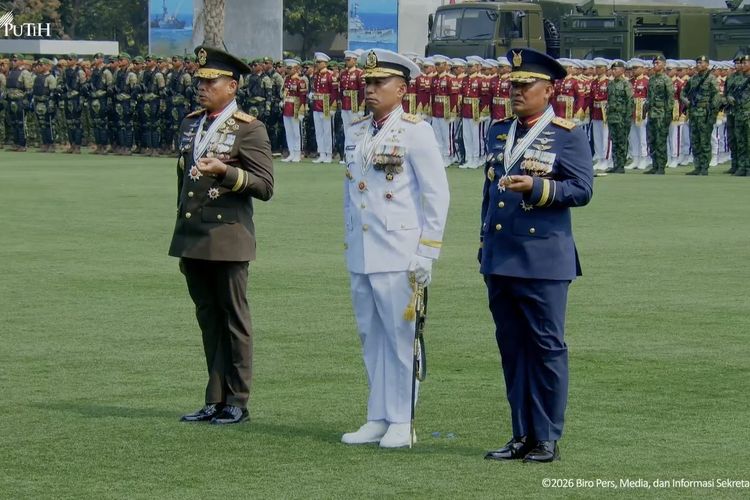
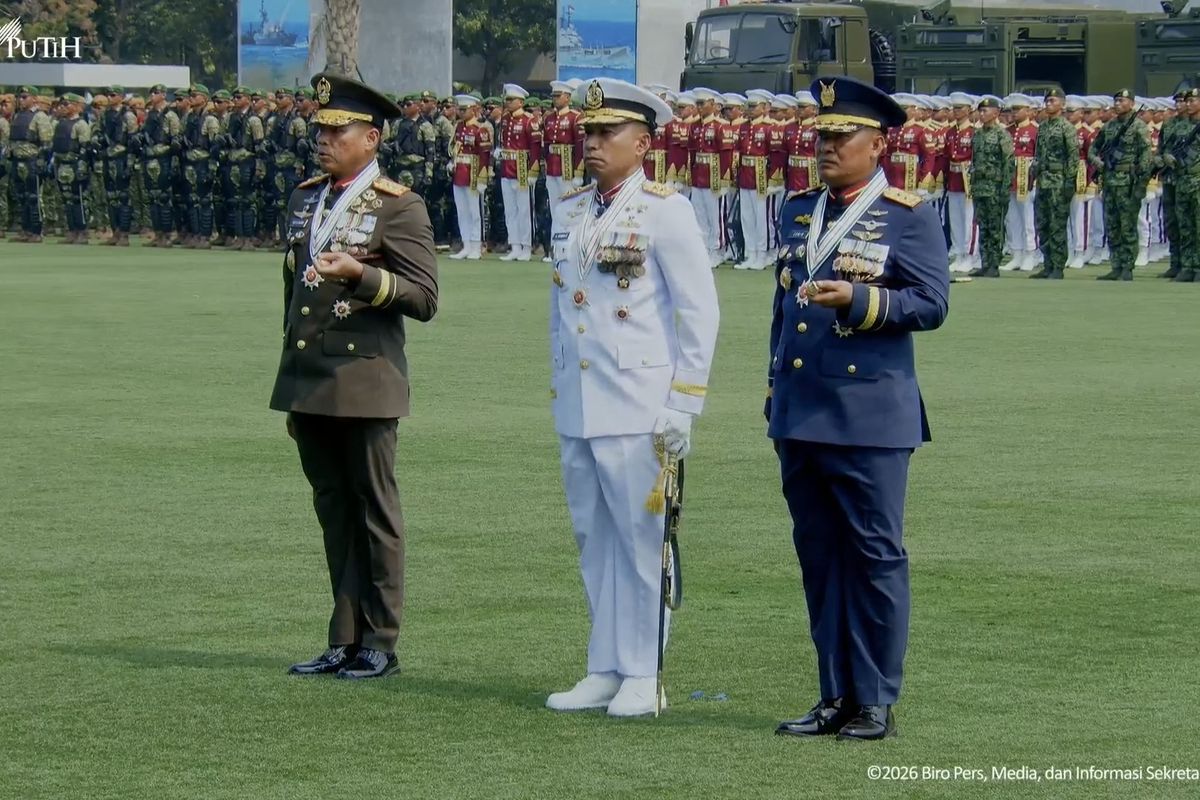
For the first time, the TNI showcased a new PDU model used by representatives from the three branches during the ceremony.
These included the Commander of Division 1 Kostrad, Major General TNI Ahmad Fikri Musmar, the Commander of XIII Military Region, Admiral TNI Sumarji Bimoaji, and the Commander of Air Operation Command I, Air Vice Marshal TNI Erwin Sugiandi.
The most noticeable change was in the collar design.
Previously, the PDUs for the Army and Air Force had a spread collar like that of a suit; the new PDU features a standing collar that encircles the neck.
The collar includes a red section adorned with a golden line.
Gold line embellishments are also seen at the sleeve ends.
While the base colors of each branch's uniform remain unchanged.
The Army's PDU is dark green, the Navy's is white, and the Air Force's is dark blue.
TNI Commander General Agus Subiyanto explained that this change is more than just a matter of looks.
The new PDU was designed inspired by traditional Indonesian attire, particularly the beskap.
"The philosophy is that we embody our culture. This is the beskap, a local wisdom, so we can be independent in our clothing and have a distinctive mark that the uniform worn by the TNI signifies, culturally representing Indonesia: it’s the beskap," Agus stated after the TNI anniversary ceremony.
The Ministry of Defense also stated that the latest PDU 1 Tri-Matra is an internally developed design within the TNI.
The uniform aims to reinforce the identity, honor, and traditions of the TNI.
The new TNI PDU indeed looks different compared to its predecessors.
According to previous PDU I regulations, the PDUs for the Army and Air Force essentially consisted of a suit with a spread collar tapering at the tips.
This suit came complete with four closed patch pockets, epaulets on the shoulders, and gold-colored metal buttons bearing the service insignia.
The older PDU also included an inner shirt.
For the Army and Air Force, this shirt has a standing collar and comes with a tie.
The new PDU I regulations still describe the PDU as a combination of a long-sleeved shirt and a suit according to the branch color.
For the Army and Air Force, a tie remains part of the uniform.
In the newly unveiled PDU for the 81st TNI anniversary, the design has changed.
Old PDU:
New PDU:
This change gives the new PDU a more enclosed look around the neck while offering a distinct impression compared to the previous uniform model.
This model does not mean diminishing each branch’s identity.
The color differences remain intact, while various ranks, positions, qualifications, and honors are still significant components of the PDU.
Previous regulations, for instance, listed name tags, rank insignia, position insignia, skill badges, and honor symbols as attributes of the PDU I.
The Ministry of Defense stated that the design merges modern military character with the philosophical underpinnings of archipelagic culture.
The design adapts structured ceremonial cuts inspired by modern traditional attire of beskap.
"The newest PDU 1 Tri-Matra uniform combines the assertive character of modern military with the depth of archipelagic cultural philosophy," said the Ministry of Defense on its official website.
"This design adapts structured ceremonial cuts from traditional military tailoring, with special inspirations from modern beskap traditional clothing, showcasing the noble values of national culture reflecting the identity of the entire TNI," the Ministry added.
The Ministry also highlighted various unique features of the TNI's new PDU, such as collar and cuff design details laden with philosophical meanings.
"The red collar symbolizes strength and resilience and distinguishes officers and commanders, while for juniors and seniors, the collar’s base color is aligned with the dominant color of each branch's uniform," explained the Ministry of Defense.
"The chain or mine detail on the collar symbolizes a strong and unbreakable bond of service, uniting the Army, Navy, and Air Force in safeguarding the sovereignty of the Republic of Indonesia (NKRI)," it continued.
Meanwhile, the rice embroidery on the cuffs symbolizes the dedication of TNI soldiers who hold high humility but remain steadfast in their duty as protectors and guardians of the people's welfare.
Military observer Aris Santoso noted that the uniform change cannot be separated from issues of identity and leadership within the TNI.
According to Aris, changing the uniform is often a way for a leader to leave a mark on the institution they lead.
"Each TNI leader always wants to leave a mark. One way is by changing the uniforms of TNI members. Thus, the current TNI leadership will be recorded in history," Aris told Kompas.com on Monday.
"The subjectivity of TNI leadership becomes prominent over time," he remarked.
Aris reminded that uniform changes are not new in TNI history.
He cited the example of Prabowo Subianto when he commanded Kopassus.
At that time, according to Aris, there was a change in Kopassus uniforms, including a new model for commanders' command sticks.
However, this change was later reversed by the subsequent leadership after Prabowo no longer headed the unit.
Aris acknowledged the significance of uniforms for military organizations as they are closely tied to unit traditions and identity.
Consequently, design changes may have broader implications beyond merely changing clothing models.
However, he cautioned that uniform changes should not be too frequent, partly due to budget efficiency considerations.
"But it's advisable not to change too often. Because it is a form of waste; old uniforms are just stored even though they are still wearable, and then budgets are allocated for new uniform production," Aris said.
Vice Chairman of Commission I DPR Dave Laksono stated that the PDU change can be seen as part of the renewal of the organization and the strengthening of TNI identity.
He noted that changes in attributes certainly have distinct considerations, both from the standpoint of duties, identity, tradition, and organizational development.
"Such changes certainly have their own considerations from aspects of duty, identity, tradition, and organizational development," said Dave to Kompas.com on Monday.
Commission I DPR will follow up on explanations and developments regarding the changes to the PDU attributes.
If the PDU changes indeed represent organizational transformation, Dave believes this can be justified as long as it reflects the character, honor, tradition, and professionalism of the TNI.
"Both organizational restructuring and attribute renewal are part of efforts to strengthen national defense," said Dave.
According to Dave, these renewals ultimately need to be linked to the TNI’s readiness and professionalism in carrying out defense duties.
"Commission I of the DPR RI supports steps aimed at enhancing the TNI's readiness, professionalism, and capability in carrying out duties to uphold the sovereignty and territorial integrity of the Unitary State of the Republic of Indonesia," said the Golkar Party politician.

























