Government Considers Relocation of Javan Rhinos from Ujung Kulon to Alas Purwo
-
News
-
5 minutes ago
This article was translated by AI. Read the original article on Kompas.com. See Original

CASE law in the constitutional realm sometimes hinges on small words.
Article 6A paragraph (2) of the 1945 Constitution states that pairs of presidential and vice-presidential candidates must be proposed by political parties or coalitions of political parties participating in the election prior to its execution.
The word “or” separates two possibilities for submission: by a single party or by several parties cooperating together.
Following the Constitutional Court's annulment of the presidential nomination threshold, discussions emerged regarding support from at least two factions in the House of Representatives (DPR).
On September 21, 2026, Said Abdullah mentioned an alternative: at least two and a maximum of four supporting political parties.
He himself noted that the definitions of party and faction still need to be clarified, as these remain undefined by law.
This distinction is significant: the faction requirement initially excludes parties that do not hold seats in the DPR; the two-party requirement still prevents a single party from nominating a candidate on its own.
Lawmakers indeed face issues when the number of election participants is high. However, solutions must begin from the authority guaranteed by the constitution.
Article 6A section (2) does not provide a route for individual candidates. The proposers must be political parties participating in the election, either alone or in coalition with others.
Given this clear choice, the law cannot eliminate either path that has been opened.
In legal language, “or” typically indicates an alternative. If a single party is required to seek a second party, the phrase “political party” as an independent proposer loses its legal effect.
It merely becomes part of the “coalition of political parties.” It is difficult to justify an interpretation that renders one part of the norm non-functional when the constitution deliberately mentions both.
The meaning of “or” must still be read within the entirety of the phrase. Here it determines who has the authority to propose candidates.
The law may regulate the procedures, but it cannot make the rights of any one holder impossible to exercise.
Aharon Barak, in Purposive Interpretation in Law (2005), explains that interpretation operates within the boundaries of the meaning that the text can bear, then selects its legal meaning by considering the purpose of the norm.
This framework aids in reading Article 6A: the purpose of ordering candidacies does not justify an interpretation that eliminates the alternatives explicitly written in the constitution.
Barak does not discuss this article; any evaluation of Indonesian norms must still rely on the 1945 Constitution and the Court's decisions.
During several elections, Article 222 of Law No. 7 of 2017 requires support from parties or coalitions of parties that hold at least 20 percent of the DPR seats or obtain 25 percent of the national valid votes in the previous DPR election.
This provision is known as the presidential threshold. Its proponents argue that coalitions from the outset will strengthen the presidential government.
Opponents see the rights of election-participating parties limited by the previous election results.
The issue appears especially for new parties. Although recognized as electoral participants, they may lack seats or votes from prior elections.
Their status is acknowledged for legislative elections but insufficient to exercise the right to propose a candidate pair. This imbalance cannot simply be resolved by stating the necessity for a coalition.
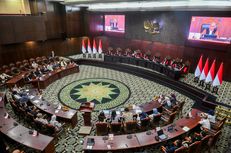
On January 2, 2025, through Decision No. 62/PUU-XXII/2024, the Constitutional Court declared that the threshold provision was contrary to the 1945 Constitution and lacked binding legal force.
What was annulled was not merely the figures of 20 or 25 percent.
In its considerations, the Court stated that the regime of proposal thresholds based on percentage, regardless of the amount, contradicts Article 6A paragraph (2).
Therefore, changing 20 percent to five percent is not a solution.
The Court's decision does not automatically close all avenues for regulation by lawmakers.
The Court acknowledges that the number of candidate pairs could become very high if each participating party proposes its own pair.
In a multiparty system, this possibility deserves consideration. Elections should offer choices that voters can truly understand, not simply a long list of names.
However, this recognition of practical issues accompanies limits. The Court affirms that all participating parties have the right to propose candidate pairs.
Proposals cannot be based on the percentage of DPR seats or national votes. Parties can merge, provided that such mergers do not lead to dominance that narrows candidate options and voter choices.
The Court also calls for meaningful participation in changes to the election law, including from parties without seats in the DPR.
This guideline must be read as a unity. The sentence allowing for restructuring the number of candidates cannot be separated from the recognition of the rights of every participating party.
Similarly, the freedom to form coalitions should not be interpreted as a requirement to form coalitions. In constitutional law, legitimate political choices are not automatically translatable into legal requirements.
What if the law later establishes that a candidate pair must be supported by at least two parties? The direct consequence is easily seen.
An election-participating party wishing to nominate its own pair cannot do so.
It must seek approval from another party. The right granted to it by the constitution becomes contingent upon the will of a second party.
This dependency is not mere formality. Two parties may disagree about the vice-presidential candidate or the direction of the program.
If an agreement fails, the first party loses the opportunity to make a nomination, even if it has met the requirements as an electoral participant.
It may well be that every party eventually finds a partner. However, political possibility does not replace legal guarantee.
If a new right can only be exercised after another party agrees, the authority of the proposer becomes a mandatory joint authority.
This minimum condition of two parties thus faces serious constitutional objections. The Court has yet to adjudicate such a formulation; this is an evaluation of the proposal.
This objection can be sharpened using Robert Alexy’s proportionality framework: does the coalition obligation align with the goal of structuring the number of candidates, is there a less burdensome way, and do the benefits correspond with the rights that are restricted?
However, this test does not give permission to entirely bargain away alternatives that are clearly available in Article 6A.
Before weighing the pros and cons of restrictions, lawmakers must answer whether they are entitled to close the route for proposals by a single party. Alexy offers general analysis tools, not opinions on Indonesian discourse.
The proposal to limit coalitions to a maximum of four parties requires a different examination.
The Court’s decision indeed reminds that coalitions should not become means of dominance that constrict voter choice.
If nearly all parties rally behind a single pair, direct elections lose some of their competitiveness. The interest in preventing such situations deserves consideration.
However, the figure of four is not an automatic consequence of the ruling. Why four, and not three or five?
What if the number of election participants changes? That question demands justification and simulation.
Coalition limits must also not negate the possibility of parties proposing their own pairs.
Here, lawmakers must distinguish between the right to propose, the requirements for nominees, and the registration procedures.
Verification of candidates' identities, official approval from party leaders, registration deadlines, and restrictions on proposing more than one pair are all organizational issues.
All these can be formulated equivalently. However, compelling one party to find a partner alters who can exercise the nomination right. These two types of regulation must not be treated as if they are the same.
There is a deeper question: does a pre-election coalition truly guarantee that the president will receive stable support after being elected?
Party support can shift according to issues, positions, and the state of governance.
The agreement to propose candidates is an event before the public grants a mandate. Budget and legislative discussions take place subsequently within a politically changeable context.
Bruce Ackerman, in The New Separation of Powers (2000), argues that institutional efficiency is meaningless without substantive goals to be achieved. This methodological caution is helpful here.
Reducing the number of candidate pairs or consolidating supporting parties has not demonstrated that administration will perform better.
A coalition’s signature on the nomination form does not resolve how the president and the DPR negotiate for five years.
This is a conclusion about Indonesia, not Ackerman's statement concerning the requirement of two parties.
The constitution does not stipulate that the president be elected by a majority of parties in the DPR. The president and vice-president are directly elected by the people.
Article 6A even governs the possibility of a second round of voting if the requirements for victory in the first round are not met.
Thus, the presence of more than two candidate pairs has been accounted for in the constitutional design.
The costs and complexities of elections must be managed, but the existence of a second round should not be considered a defect justifying the restriction of rights to propose without grounds.
The president's need to work with the DPR remains real. The answers lie in governable programs, open legislative negotiations, and party responsibility for their positions in parliament. A coalition imposed at the time of registration does not automatically engender loyalty in the third year of administration.
Shifting the political cooperation issue to the nomination door only makes that door narrower.
In its considerations, the Court stated that the right of parties to propose candidates involves an obligation to be executed. As a guide for lawmakers, the Court mentioned the sanction of prohibiting electoral participation in subsequent elections for parties that do not propose candidate pairs.
The details of its application still require careful legislative formulation. A party that joins to propose one pair has exercised its right; it is not the same as a party that does not participate at all in the proposals.
The process of formulating new rules cannot be monopolized by the parties currently sitting in the DPR.
They have a direct interest in the shape of future competition. Therefore, the voices of parties without seats, election organizers, experts, and voters need to meaningfully enter the discussions.
Transparency allows the public to assess whether a requirement is created to uphold the quality of elections or to maintain the advantages of existing participants.
Lawmakers should present simulations: how many candidate pairs might emerge, what the chances are for new parties, and whether voters have real alternatives.
Technical difficulties should not immediately be raised as constitutional arguments; constitutional rights also demand orderly election processes.
Ultimately, the word “or” in Article 6A paragraph (2) reminds us of a simple limit.
One party may go alone. Several parties may go together.
The law can regulate how both paths are taken, but it should not close one while pretending that both are still available. In front of the constitution, such small clarity determines whether the Court's decision is carried out according to its intention, or merely followed in name.