

Cak Imin Encourages Pesantren-Based Vocational Schools to Elevate Standards to International Levels
-
News
-
4 hours ago
This article was translated by AI. Read the original article on Kompas.com. See Original
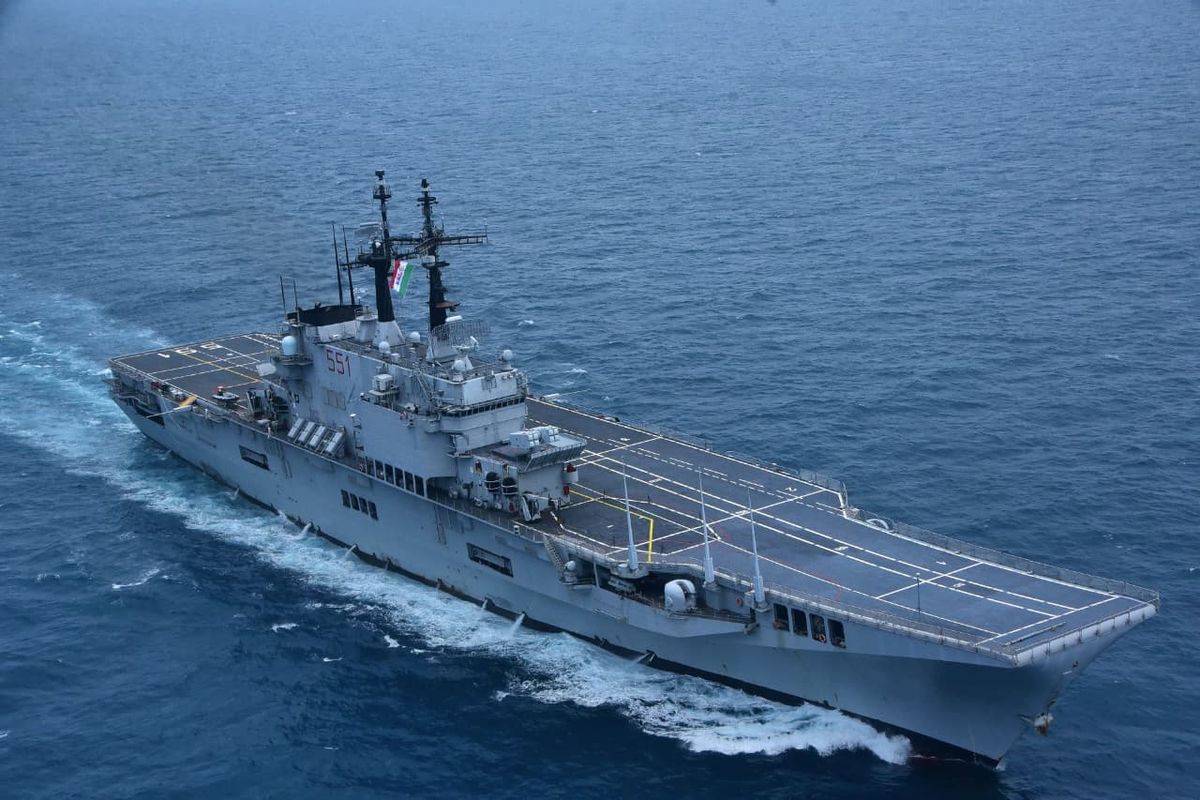
The aircraft carrier, measuring 180.2 meters in length and weighing 13,850 tons, finally docked in Indonesia on Friday, September 18.
Entering Indonesian waters a day earlier, escorted by two Indonesian Navy frigates—KRI Brawijaya-320 and KRI Prabu Siliwangi-321—the Italian aircraft carrier named Giuseppe Garibaldi berthed at Pier 107 of Tanjung Priok Port, North Jakarta.
The arrival of Indonesia's first aircraft carrier was enthusiastically welcomed by the TNI ranks, as evidenced by the presence of Defense Minister Sjafrie Sjamsoeddin and Indonesian Navy Chief of Staff Admiral Muhammad Ali during the reception.
The presence of this Italian-built aircraft carrier should be warmly embraced by the Indonesian public.
Although it is no longer young—over 40 years old and built by Fincantieri shipyard in Genoa and Monfalcone, Italy—this aircraft carrier holds strategic value to strengthen the main duties of the TNI as the principal component of the national defense system.
Especially considering the Indonesian Navy's role, which involves dense activities in defense, diplomacy, and constabulary functions.
This aircraft carrier is not intended for war but is planned to support the TNI’s non-military operations, including disaster response and humanitarian activities.
The arrival of this used aircraft carrier should not be met with cynicism by the public or certain groups.
The government, through the Ministry of Defense and the TNI, acknowledges the existence of cynical views regarding the urgency of Indonesia possessing such a vessel.
Many criticisms have been raised, such as potentially higher maintenance costs than operational benefits, diminished tactical military capabilities due to age, high fuel costs amid fluctuating global energy commodity prices, and more.
What needs to be underscored is that Indonesia accepted this aircraft carrier at no cost whatsoever.
In the long term, the presence of the Giuseppe Garibaldi aircraft carrier can also serve as an alarm and inspiration for defense policymakers in the homeland to recommit to strengthening the country’s maritime defense capacity.
Prof. Geoffrey Till—a world maritime expert from King’s College London—has said that not all countries realize that to become a maritime power state, possession of maritime advantages taken for granted is not enough.
Becoming a maritime power state requires strong intelligence from policymakers to integrate all available resources, including territory, population, government, infrastructure, and policies adopted.
By referencing Geoffrey Till’s idea, the claim that Indonesia is a maritime nation is questionable and debatable.
It is true that Indonesia is an archipelagic state with more than 70 percent of its territory covered by waters and possesses over 17,000 islands.
It is accurate that Indonesia has one of the longest coastlines in the world—more than 90,000 kilometers—and sits on a highly strategic maritime geographic contour between two oceans: the Indian and the Pacific.
Nonetheless, these comparative advantages are only taken for granted.
Such advantages do not become competitive advantages unless supported by sound and reliable maritime policy and governance by the government.
The absence of an aircraft carrier even after more than eight decades of independence indicates Indonesia’s status only as a maritime state, not yet a maritime power state.
At the deepest level of awareness, the arrival of the old aircraft carrier Giuseppe Garibaldi serves as a catalyst for defense policymakers to review and even reconsider the direction of the country’s defense policy.
Like it or not, acknowledged or not, the country’s defense policy under President Prabowo’s administration currently returns to the old pattern—continental oriented.
This is reflected in the policy of expanding the number of regional military commands and massive development of territorial battalions.
This policy is not entirely wrong, but it is inappropriate and regrettable.
Many threats to national defense come from the sea, especially those based on transnational crimes such as drug trafficking, human trafficking, illegal fishing, smuggling of timber and illegal commodities, toxic waste disposal, and sand dredging in poorly guarded coastal areas.
Such maritime crimes occur massively and cause significant losses to the nation and society—violations of sovereignty and sovereign rights, loss of potential financial benefits, and collapse of the country’s defense dignity.
If the management of national defense capabilities is not conducted appropriately—focusing predominantly on the land domain as is currently the case—then the state may claim to benefit from military involvement in national development projects such as food and energy security through territorial development battalions and others.
However, the existing and potential losses suffered by the nation due to minimal presence and protection of maritime resources could, in a calculated sense, be greater than the benefits derived from the land territory.
Therefore, the arrival of the old Giuseppe Garibaldi aircraft carrier should not be viewed simply through the “naked” lens of its physical specifications alone.
More strategically significant is that its presence offers a “wake-up call” for the government to revisit the ongoing maritime defense policy, assessing whether it has been optimal in supporting national interests as stipulated in the constitution, the State Defense Law, and the TNI Law.
Twelve years ago, when Joko Widodo was first inaugurated as president in 2014, one of his strategic visions was to position Indonesia as a world maritime axis.
This policy felt brilliant and spectacular because, for seven decades after independence, Indonesian presidents seemed confused navigating the direction of national military policy.
Only during President Joko Widodo’s era was the commitment to strengthening the maritime sector as a national comparative advantage loudly accentuated. However, it is regrettable that this policy lasted only one term.
The world maritime axis policy began to fade when President Joko Widodo entered his second term and further diminished during President Prabowo Subianto’s leadership.
Therefore, the presence of Giuseppe Garibaldi in Indonesian waters brings at least three strategic benefits.
First, it serves as a moment to correct the direction of national maritime policy. It is time for the maritime domain to return to the center, becoming central to national defense policy after being sidelined for so long.
Second, the existence of Giuseppe Garibaldi as one of the national defense equipment assets can be a learning laboratory for the national strategic industry—PT. PAL—to study, develop, and eventually produce similar vessels independently as a product of the nation.
Third, the presence of Giuseppe Garibaldi can be a means to strengthen Indonesia's military diplomacy with Italy and other major European countries in the future.
Through the arrival of Giuseppe Garibaldi, the government should draft a more measured, maritime-oriented blueprint for national defense policy.
Prioritizing a massive continental orientation while sidelining the maritime domain, which is the main strength, is an unwise stance.
With the presence of Giuseppe Garibaldi, it is hoped that the government will strategically strengthen the minimum essential forces, particularly the navy, making it more comprehensive in carrying out defense duties, bolster the national maritime strategic industry so that it can independently produce aircraft carriers and other military ships in the future, and enhance naval military personnel capabilities simultaneously and continuously, especially in intelligence, surveillance, combat, diplomacy, and constabulary tasks.
If the government is willing and able to serve these strategic measures, the dream of becoming a maritime power state will not be hard to achieve. Benvenuto Garibaldi.