

Cak Imin Encourages Pesantren-Based Vocational Schools to Elevate Standards to International Levels
-
News
-
20 minutes ago
This article was translated by AI. Read the original article on Kompas.com. See Original
JAKARTA, KOMPAS.com - From the outside, Taman Sari Stadium on Jalan Mangga Besar VI Selatan in West Jakarta looks like any ordinary football field.
But that impression changes the moment you step through its entrance, evoking the feel of a football pitch in Brazil.
Kompas.com visited Taman Sari Stadium on Saturday (19/9/2026). Near the entrance, an old sign stands.
Its paint is fading, and some of the metal parts show rust.
The inscription "Stadion Taman Sari" is still legible, complete with the Jaya Raya emblem, indicating the facility belongs to the Jakarta Provincial Government under the Youth and Sports Office (Dispora) of DKI Jakarta.
As you walk further inside, the unique character that sets this stadium apart becomes evident.
Taman Sari Stadium is not a grand venue with modern architecture.
At the center lies a roughly one-hectare football field.
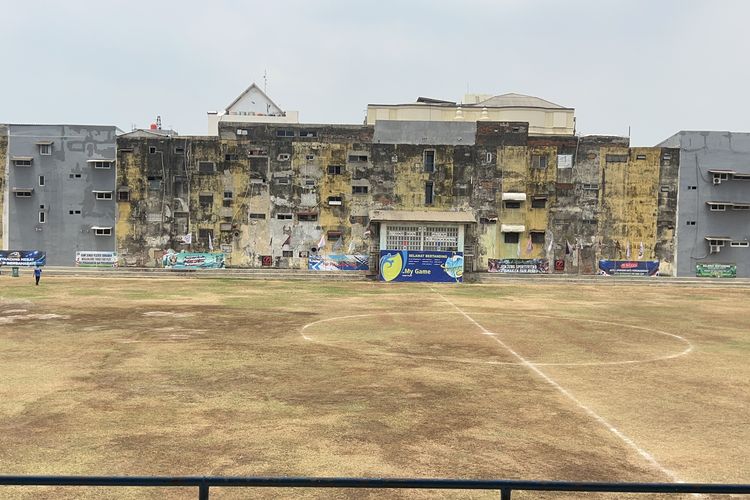
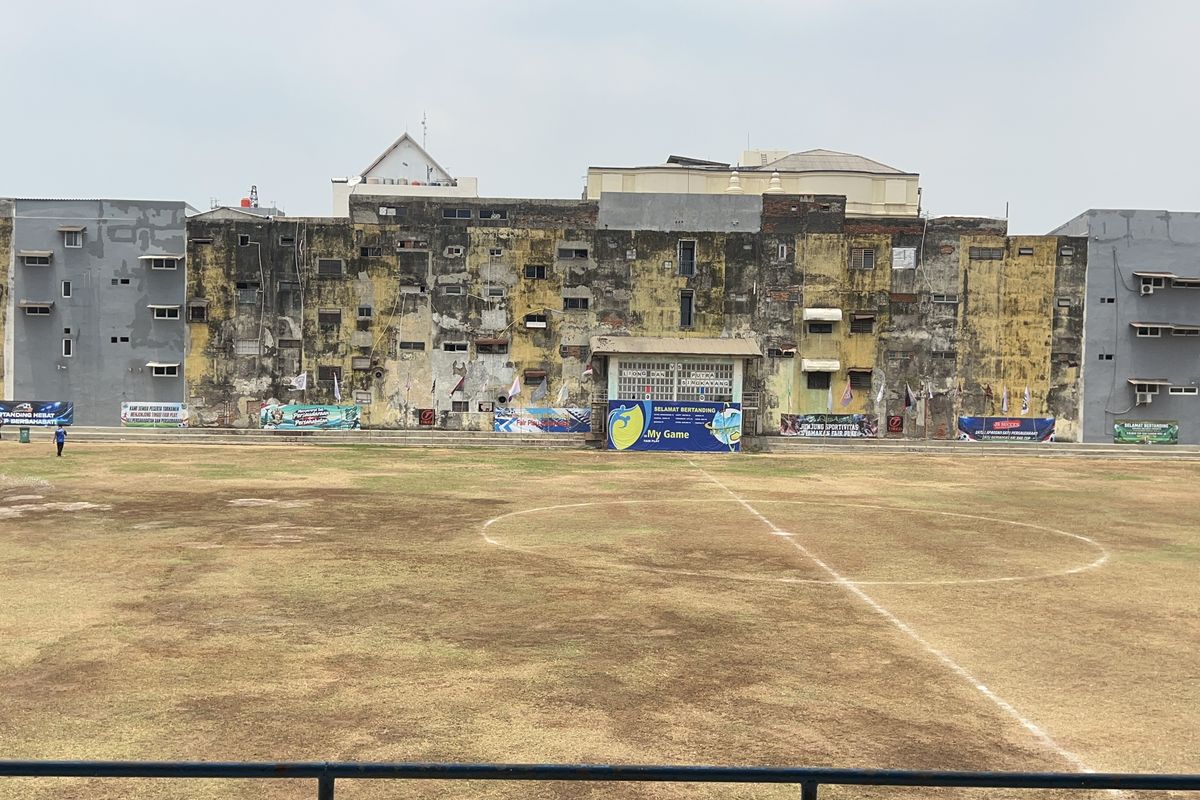
The field is tightly surrounded by rows of buildings, mostly shophouses.
The walls appear worn, with peeling paint — a sign of weather wear over time.
At a glance, the atmosphere resembles a football pitch nestled within a dense Brazilian neighborhood.
The football field itself looks dry, with yellowing grass, likely due to the recent intense heatwave affecting the capital.
The white lines on the field are faint but still usable for play.
Several football tournament banners hang on the fence.
This indicates that despite its aged appearance, the facility remains a trusted spot for local residents to engage in sports activities.
On one side of the field is an open spectator stand.
The stand is simple: a series of long concrete benches without backrests serve as seating.
The benches are a light cream color, while the top is sheltered by a corrugated metal roof.
The steel framework is aged and rusting.
At a glance, the stand transports visitors back to the ambiance of old-school stadiums.
But it is precisely this "aged" charm that has become part of Taman Sari Stadium's appeal.
Rosidi (46), a stadium attendant, says the old buildings around the field have been there for a long time.
According to historical stories he knows, the field was originally built on land that used to be a swamp.
"It used to be all swamp. The field probably dates back to the '70s. Once the swamp was filled, the field was there," Rosidi said.
He mentioned the land was a donation from the Chinese Indonesian community for sports purposes.
Rosidi recalls the field being actively used as a football venue starting in the early 1980s.
He even remembers a film shot there.
"It was around '81. Because Dono was filming in '82. The field was still new, paint still looked good," he explained.
Taman Sari Stadium also holds stories about various Indonesian football teams.
Rosidi clearly remembers Persija Barat using this place as their base before moving to Lapangan Cendrawasih.
Also, Tunas Jaya once used Taman Sari Stadium as their basecamp.
"Persija Barat's basecamp was here. Tunas Jaya too, before moving to Cendrawasih," he said.
The stadium has also been used for film and television shoots, especially football-related productions.
Among its historical notes is the fact that Warkop DKI filmed here during the 1980s.
There is something interesting about the buildings surrounding the field.
Rather than being seen as eyesores to cover up, the old walls with peeling paint have become sought-after backdrops for some visitors.
Rosidi says in recent years, young people and students come not only to play football.
Some come specifically to take photos.
"It’s been quite a while. About five years ago, even earlier. Especially young people, students. Many come for theses, lots of photoshoots," Rosidi explained.
He even remembers a group of youths traveling from Depok just to shoot photos.
"Not long ago, there were about six young people from Depok. Like a photoshoot, just taking pictures," he said.
They brought cell phone cameras and dressed in vintage-style clothes.
No field rental is required for such activities.
Visitors are allowed as long as it’s for personal use and just taking photos with phones.
Commercial use, however, is a different matter.
Interestingly, there’s even been requests to leave the old parts untouched and not repaint them.
According to Rosidi, photo visitors often ask to keep the walls looking as they are.
"The message I get is always, 'Please don’t paint over it!'" he said.
The field itself last underwent a major renovation in 2012.
However, that renovation focused mainly on the pitch, not the stadium buildings.
Most improvements were to the field—grass and drainage.
"The last total renovation was in 2012, only the field, not the building. The field got new grass, drainage improvements," Rosidi said.
Other facilities have been repaired gradually—for example, ceilings and pavement were refurbished around 2015.
Bathrooms were also improved. Beyond that, time has slowly left its mark on this stadium.
Peeling paint, exposed rusted metal, and darkened walls have become part of Taman Sari Stadium’s character today.