

Cak Imin Encourages Pesantren-Based Vocational Schools to Elevate Standards to International Levels
-
News
-
4 hours ago
This article was translated by AI. Read the original article on Kompas.com. See Original

JAKARTA, KOMPAS.com - Drought is becoming a growing concern for the Jakarta Provincial Government (Pemprov) DKI Jakarta.
If this condition persists longer, the availability of raw water to meet the community's needs could become problematic.
The Jakarta Regional Disaster Management Agency (BPBD) previously issued an early meteorological drought warning for several areas in Jakarta.
According to analysis by BMKG, five regions fall under the "Alert" category for drought during the second ten-day period (Dasarian II) of September 11-20, 2026. These areas are West Jakarta, Central Jakarta, East Jakarta, North Jakarta, and the Thousand Islands.
Amid this situation, the idea of seeking alternative raw water sources has emerged. One such option is seawater, which surrounds Jakarta.
The Chairman of DKI Jakarta's DPRD, Suhud Alynudin, has proposed that the provincial government begins to consider seawater as an alternative raw water source.
According to Suhud, the technology to convert seawater into fresh water is already in use in the Thousand Islands.
Therefore, similar technology could be considered for use on mainland Jakarta.
"What needs to be done is to implement, since in the Thousand Islands there is already desalination technology to convert seawater into clean, fresh water. I think this should also start to be tried in anticipation of the possibility that Jakarta will face a shortage of clean water," Suhud said at the DPRD DKI Jakarta building on Thursday (17/9/2026).
Suhud believes this step needs to be considered now, as the drought could be prolonged and impact water availability.
"It definitely must be anticipated. Recently, BPBD issued an alert level. I think this must be taken seriously because drought is inevitable and likely to last a long time," he added.
The proposal then received a response from Jakarta Governor Pramono Anung.
Pramono said that processing seawater into fresh water could be realized.
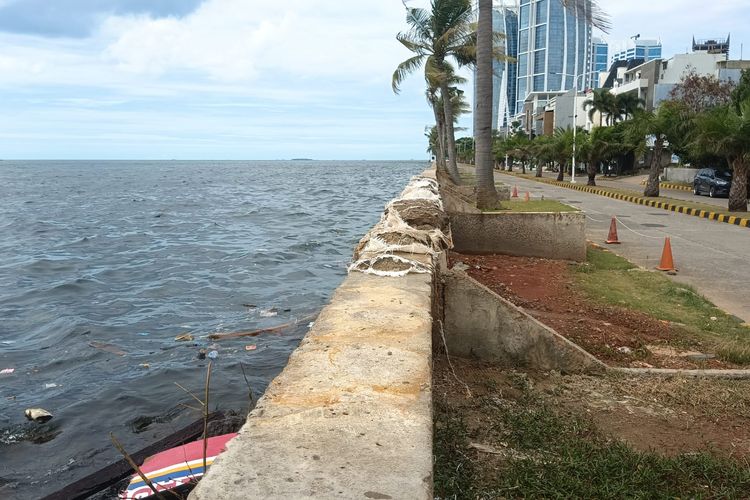
However, he noted that this would be related to the planned construction of the Giant Sea Wall.
"To convert seawater into fresh water that can be used, one key step is to immediately start the Giant Sea Wall project," Pramono said when met at the PMI DKI Jakarta office on Thursday (18/9/2026).
Pramono explained that the Giant Sea Wall's existence would open opportunities to utilize brackish and seawater as water sources for treatment.
If this water source can be utilized, Pemprov DKI through PAM Jaya stated readiness to manage the processing.
"For Jakarta, if this can be achieved, then the supply of brackish or fresh water to be processed into water usable by the public can easily be managed by the Jakarta Government through PAM Jaya. We are ready to undertake this," he said.
However, converting seawater into fresh water on the mainland Jakarta is not a straightforward task.
Significant technology, energy, and costs must be prepared to process seawater into water that meets standards.
PAM Jaya actually has experience using this technology.
PAM Jaya's Operational Director Syahrul Hasan said desalination has been implemented on nine islands in the Thousand Islands.
"So, we need to differentiate that desalination to extract raw water from the sea has actually been done on nine islands in the Thousand Islands," Syahrul said when met at the PAM Jaya office on Friday (18/9/2026).
PAM Jaya uses Sea Water Reverse Osmosis (SWRO) technology.
In the process, seawater is filtered through specialized membranes to separate salt and other dissolved substances, producing water that meets quality standards.
This experience means seawater processing is not new to PAM Jaya.
Nonetheless, the technology has not been applied to meet water needs on the main mainland of Jakarta.
"Specifically for mainland Jakarta, we have not done this yet. Why? Because it requires a very significant effort," Syahrul explained.
PAM Jaya's Technical Director Akhmad Santika further explained why processing seawater in the capital city requires much greater effort.
The issue lies in the characteristics of seawater, which has high salt content and total dissolved solids (TDS). As such, seawater cannot be processed using conventional water treatment systems.
"The raw water is seawater, which has very high TDS and salt content. This cannot be done using ordinary water treatment systems," Santika said.
Seawater must pass through membranes with very fine pores.
To allow water to pass through the membranes, high pressure is required.
"So, imagine processing water with a very tight filter that requires a very large effort," he said.
Generating such high pressure demands significant energy.
"Besides the huge effort, this also requires high energy because it needs pressure," Santika added.
The high energy requirement affects the production cost of the water.
"The result is high operational and maintenance costs. Therefore, the cost of production will automatically be high," he continued.
Considering the energy needs, operational, and maintenance costs, PAM Jaya has not yet implemented large-scale desalination to supply water needs on Jakarta's mainland.
For now, PAM Jaya continues to maximize available raw water sources.
Amid drought threats, the option to process seawater remains a possibility to consider in the future, especially if supporting infrastructure like the Giant Sea Wall begins construction.
Thus, seawater could not only serve as an option when raw water sources diminish but also potentially be prepared as a new water source for Jakarta.