

DKPP Highlights KPU's Inconsistent Statements Regarding 'Gibran's Education Article'
-
News
-
4 hours ago
This article was translated by AI. Read the original article on Kompas.com. See Original
QUESTION and public curiosity that have been bustling on social media and chat groups since Tuesday (3/11/2026) afternoon were finally answered that evening.
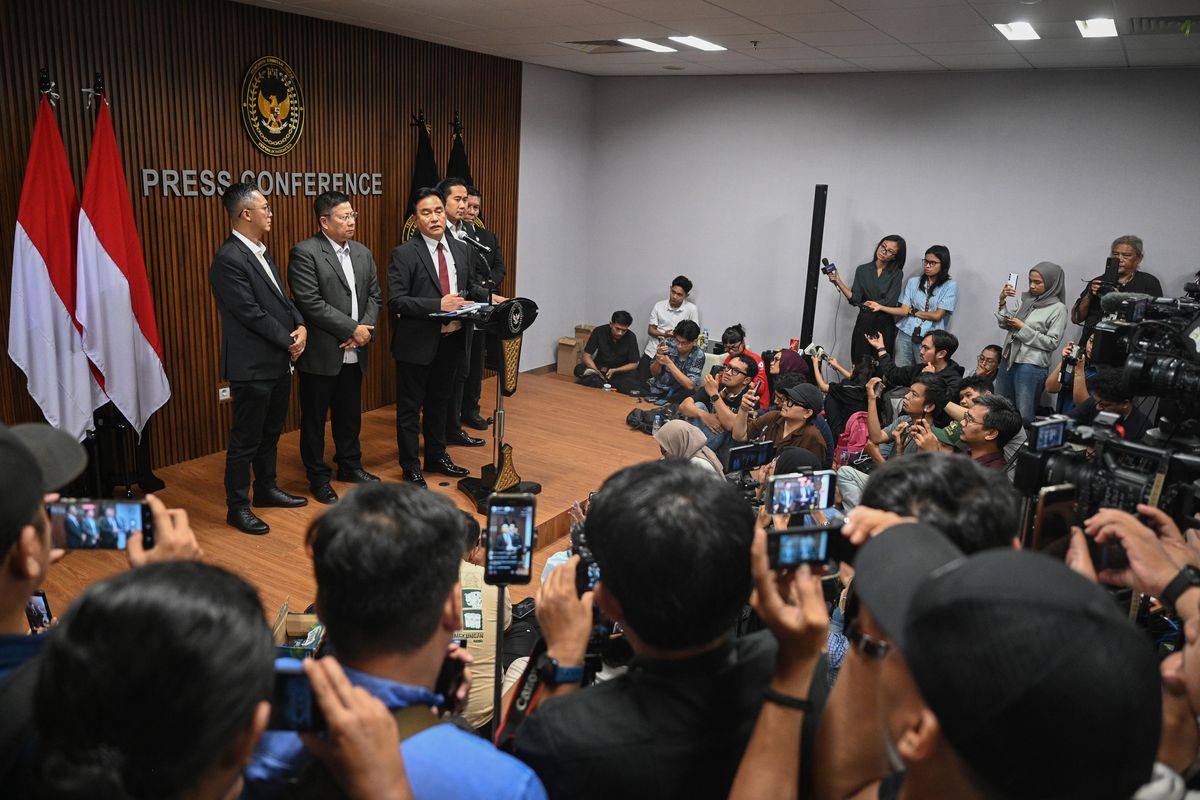
This answer was delivered by high-ranking officials at the National Police Headquarters during a press conference.
The Head of Criminal Investigation Agency, Police Commissioner General Asep Safrudin, admitted that there has been a "silent operation" carried out to uncover the alleged wiretapping case involving President Prabowo.
The suspects are generals, one of whom is a former Chief of Police who stepped down just a month ago.
"The suspects have wiretapped the president's number, political figures, mass organizations, the media, and businesspeople."
This statement was made by the Head of Criminal Investigation Agency during the press conference. The president's name as a victim of wiretapping certainly holds significant news value.
Therefore, it is no wonder that all media outlets have made the president's name the angle and headline of their news.
However, it should not be forgotten that the victims of this wiretapping are not only the president but also the media. The Head of Criminal Investigation Agency did not specifically mention who the other victims are.
Nevertheless, the wiretapping of media personnel, whether editors or journalists, is, of course, a violation of the law that cannot be accepted.
So how is this wiretapping case viewed from the legal perspective of the press?
What are its implications for press freedom and democracy? How should media workers protect themselves from digital crime threats aimed at silencing the media?
Interception or wiretapping is the act of stealing or intercepting digital communications without permission, conducted through hacking methods such as Man-in-the-Middle (MITM), packet sniffing, or malicious applications such as spyware and keyloggers.
Wiretapping becomes a digital attack as it violates privacy, exploits sensitive data, threatens national security, and is often used for criminal activities such as extortion or fraud (AJI, 2025).
From this definition, unauthorized interception targeting media practitioners or journalists constitutes a serious legal violation.
This not only triggers a cybersecurity crisis but also threatens one of the main pillars of democracy: press freedom.
Journalists' work is protected by Law Number 40 of 1999 concerning the Press as a special legal framework (lex specialis).
This means that when a journalist performs journalistic duties—from seeking, obtaining, possessing, storing, processing, to disseminating information—they cannot be arbitrarily treated or punished, as the law provides legal protection and special rights to uphold press freedom.
Article 4 Paragraph (2) of the Press Law states that national press is not subject to censorship, banning, or prohibition of broadcasting.
While paragraph (3) states that to guarantee press freedom, the national press has the right to seek, obtain, and disseminate ideas and information.
Furthermore, paragraph (4) mentions that in accounting for their reporting before the law, journalists have the Right of Refusal.
In cases of press disputes, journalists have the right to refuse to disclose the names or identities of confidential sources who provide them with information, even when questioned by investigators or in court.
The above article clearly contains provisions protecting the press when they engage in journalistic activities.
Therefore, unlawful wiretapping of media or journalists poses a real threat to the institutional independence of the press and democracy.