

Political Parties' Responses to Prabowo's Two Vice Presidential Candidates: Amran and Sugiono
-
News
-
4 minutes ago
This article was translated by AI. Read the original article on Kompas.com. See Original
DYNAMICS of law and politics in the country always resonate beyond territorial boundaries.
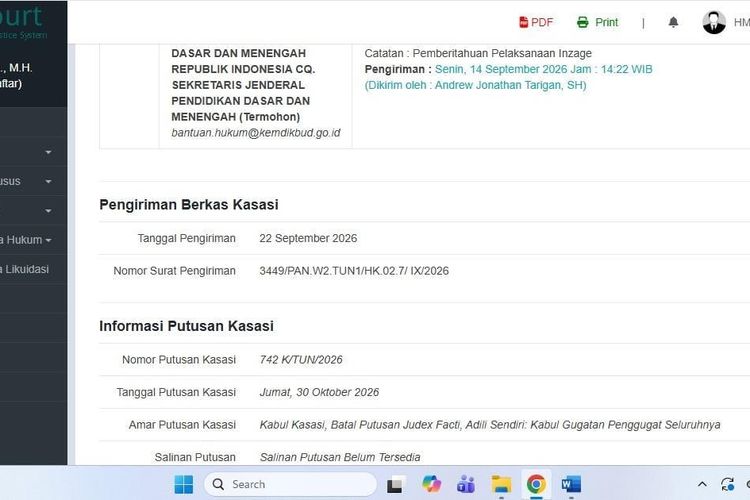
International public attention has now turned to Indonesia following the judicial dynamics regarding the validity of the nomination administration of Vice Presidential candidate Gibran Rakabuming Raka, particularly after the Supreme Court's Cassation Decision (MA) No. 742 K/TUN/2026 annulled the Certificate of High School Equivalency related to him.
The journey of this lawsuit demonstrates that the fight for justice is not easy. The plaintiff, H.M. Subhan, initially found his lawsuit declared inadmissible (Niet Ontvankelijke Verklaard/NO) by the Jakarta Administrative Court on May 21, 2026.
Attempts at the appeals level through the Jakarta Administrative Court also hit a dead end.
However, the plaintiff persevered and filed for cassation to the Supreme Court on September 22, 2026.
This unwavering effort eventually paid off when the Supreme Court annulled the judex facti decision and ordered that the equivalency certificate be withdrawn and destroyed.
This issue becomes increasingly complex because the petition submitted to the Constitutional Court also included specific notes.
In its legal considerations, the Constitutional Court's panel of judges noted that they found no convincing evidence of documents or high school equivalency diplomas in the nomination files during the trial.
Although the cancellation petition was ultimately not accepted by the Constitutional Court due to limitations in the jurisdiction of post-inauguration electoral dispute regimes, the series of facts presented at the Constitutional Court and the cassation ruling from the Supreme Court highlight fundamental doubts regarding the validity of the administration of the related public officials.
For a large democratic country like Indonesia, legal certainty and the integrity of political processes are not merely domestic governance matters but rather the main foundation supporting the credibility of the nation on the global stage.
Amidst globalization and information transparency, every judicial decision and governmental response to public officials' administrative matters has become a subject of scrutiny by diplomats, foreign investors, and international research institutions.
Compliance with the rule of law principle is now being openly tested, demanding mature governance to ensure that diplomatic bargaining and the investment climate remain sustainably preserved.
In the practice of international relations, a country's strength is not only measured by military capacity or the size of its Gross Domestic Product (GDP) but also by soft power—one of its main pillars being reputation, integrity, and legal certainty.
When the legitimacy of the nomination process or the completeness of a public official's administration is fundamentally debated at the high court level, the impact can trigger a trust deficit or a decline in levels of confidence from international partners.
Friendly nations, especially those bound by strict standards of transparency and public ethics, tend to closely monitor these developments with caution.