

BRIN Researcher Warns Against Hasty Relocation of Javan Rhinoceros
-
News
-
43 minutes ago
This article was translated by AI. Read the original article on Kompas.com. See Original
JAKARTA, KOMPAS.com - The 11 percent Value Added Tax (PPN) on feminine hygiene products has come under public scrutiny.
The government's rationale, presented by the Directorate General of Taxes (DJP), asserts that the imposition of VAT on these products is not specifically aimed at women or menstruation.
This tax is part of the existing consumption tax system in Indonesia.
Inge Diana Rismawanti, the Director of Counseling, Services, and Public Relations at the DJP, explained that in principle, goods consumed by the public are subject to Value Added Tax (BKP), except for certain goods eligible for exemptions under legislative provisions.
Feminine hygiene products sold in Indonesia are subject to VAT as long as their delivery complies with applicable tax regulations.
"Currently, feminine hygiene products are not included in the category of goods eligible for such exemptions," Diana stated in a message to Kompas.com on Thursday (29/10/2026).
As a result, these products remain subject to VAT at the rate of 11 percent.
In contrast, several other countries have eliminated taxes on feminine hygiene products.
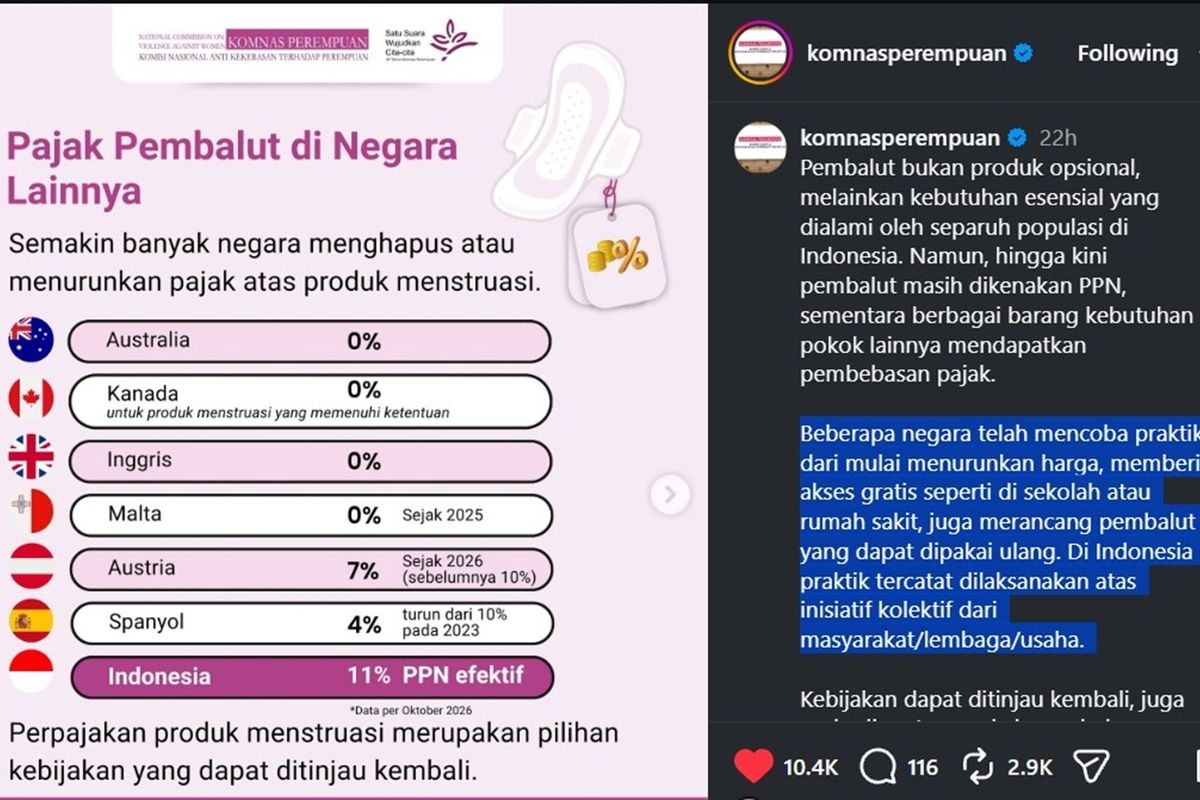
According to a post from the official Instagram account of the National Commission on Violence Against Women (Komnas Perempuan), there are four countries that exempt tax on feminine hygiene products.
These countries include Australia, Canada, and the United Kingdom, with Malta set to implement tax exemptions for these products starting in 2025.
This data was sourced by Komnas Perempuan from various official government websites of the four countries.
In addition to removing the tax altogether, some countries have lowered the tax on feminine hygiene products, such as Austria from 10 percent to 7 percent and Spain from 10 percent to 4 percent.
"Several countries have tried various measures, including lowering prices, providing free access in schools or hospitals, and designing reusable pads. In Indonesia, such practices have emerged through collective community initiatives," noted Komnas Perempuan's Instagram on Friday (30/10/2026).
Niti Emiliana, the chairwoman of the Indonesian Consumers Foundation (YLKI), asserted that feminine hygiene products are a basic necessity for women and should not be taxed.
"These products are essential for maintaining hygiene, health, and comfort during menstruation," she stated.
She believes that imposing a tax on these items could increase the financial burden on women, particularly those with low incomes.
As such, YLKI urges the government to abolish the VAT on feminine hygiene products and reassess the taxation of other menstrual necessities.
YLKI emphasized that tax policies should prioritize fairness and the welfare of the community.
"The government must protect consumers, not further burden them with tax on unavoidable biological needs," she concluded.